
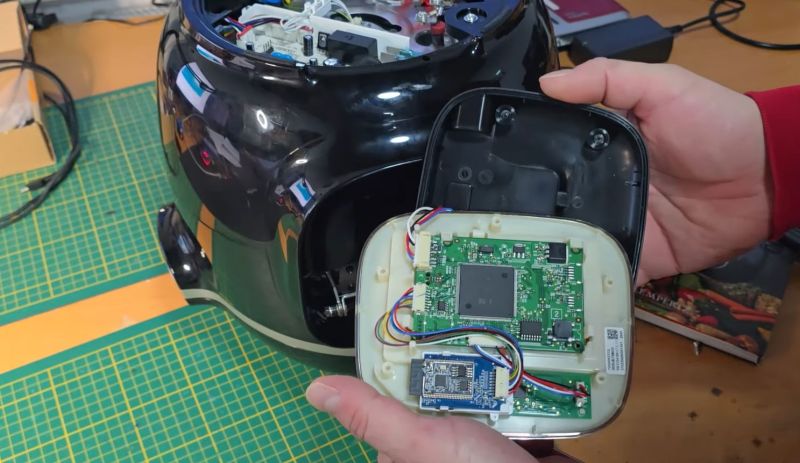
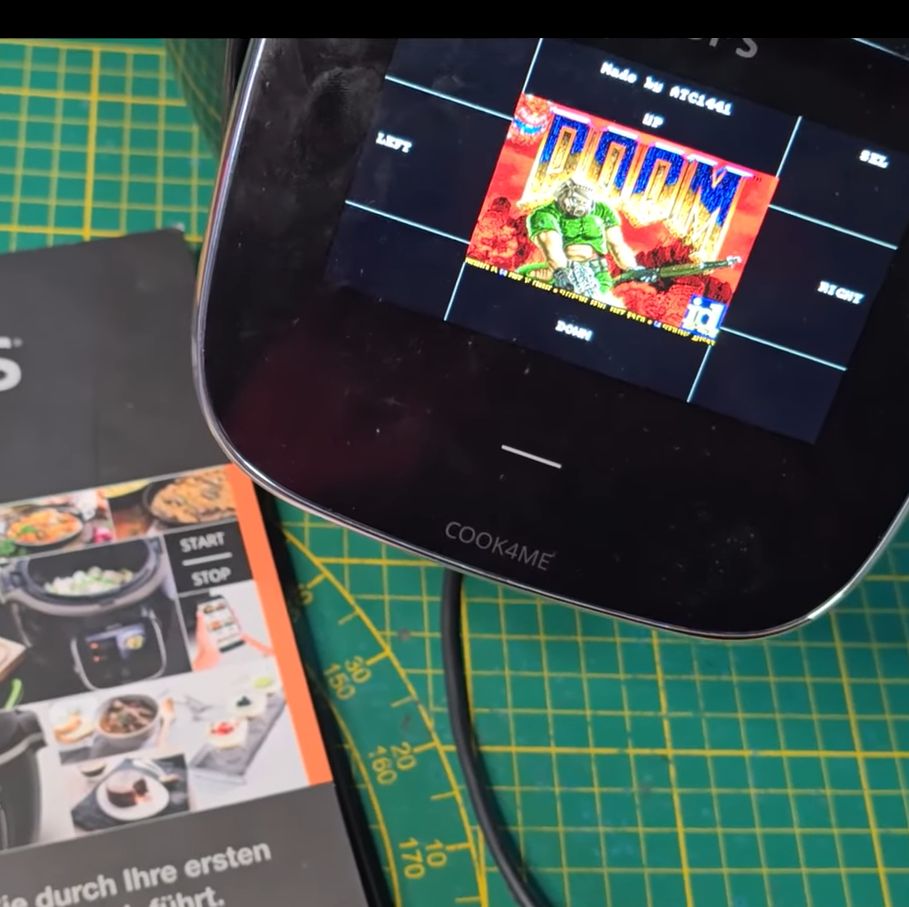
 With more and more kitchen utilities gaining touch screens and capable microcontrollers it’d be inconceivable that they do not get put to other uses as well. To this end [Aaron Christophel] is back with another briefly Doom-less device in the form of the Krups Cook4Me pressure cooking pot with its rather sizeable touch screen and proclaimed smarts in addition to WiFi and an associated smartphone app.
Inside is an ESP32 module for the WiFi side, with the brains of the whole operation being a Renesas R7S721031VC SoC with a single 400 MHz Cortex-A9. This is backed by 128 MB of Flash and 128 MB of RAM. The lower touch interface is handled by a separate Microchip PIC MCU to apparently enable for low standby power usage until woken up by touch.
The developers were nice enough to make it easy to dump the firmware on the SoC via SWD, allowing for convenient reverse-engineering and porting of Doom. With the touch screen used as the human input device it was actually quite playable, and considering the fairly beefy SoC, Doom runs like a dream. Sadly, due to the rarity of this device, [Aaron] is not releasing project files for it.
As for why a simple cooking pot needs all of this hardware, the answer is probably along the lines of ‘because we can’.












I just love the @ 08:40: “And yeah, I know how stupid this is, but … it had to be done.”
It probably has a way overkill hardware because the company or actual manufacturer of that cooking pot, basically use the same hardware in a lot of different products and just change software. Mass producing one thing is cheaper, and so is using the same underlying development software and coders used to it.
3 MCUs, one of which is a 400MHZ cortex A9? For a pressure cooker? I get that they are dangerous, but how many pins and how much compute do you need? How many sensors did they pack into this thing?
Damn, this makes me feel better about all my projects where I used an ESP32 when I could have probably used a 555.
Much of it probably comes down to using as many existing modules as possible instead of spinning a (costly) custom solution, as [R.] mentioned as well.
When you can take an OTS display with associated Renesas board, add an existing ESP32 WiFi module, an existing MCU touch controller module and write a bit of software to tie the whole lot together, that’s probably a fraction of the cost of an optimised custom hardware solution.
Definitely wasteful, but it makes economic sense.
Makes sense. Somewhat similar to using Adafruit i2c/SPI breakout modules for ICs rather than creating a custom board for a project. Modularity definitely has benefits. I imagine that if some of the modules already passed EMI/compliance testing, then further testing would be less expensive.
Having watched the video, I realized it’s 4 MCUs, not 3! A STM32 in the base for critical controls and sensors, a ESP32 for WIFI, a PIC for low-power states, and a Renesas A9 for LCD control. A lot of pins can be used for parallel control of LCDs, and capacitative touch could be also pin heavy if they aren’t using a specific IC for it. The buttery smooth full-screen scrolling animations and responsiveness of the touchscreen must require a hardworking MCU.
It is called marketing driven engineering.
1. Marketing calls for a new product with delivery ASAP
2. Engineering puts something together with the parts they have (software included)
3. If it the product is successful, they make a cost optimized version if not, they drop it and now the smart cooking pots sold become no longer smart or potentially a brick for the e-waste pile.
Marketing calls for a new product with delivery ASAP
I guess in a decade or so we’ll see arduino-grade MCUs working at multiple GHz.
Which makes me cringe because in 2007 I used to run an entire Metin2 server on a Northwood Celeron. With their dependence on JavaScript and Electron modern programmers can’t even wirte a simple GUI app without needing literal gigabytes of frameworks.
You could probably run a smallish large language model on there, thereby really juicing the folks in marketing. It cooks your food and tells you how amazing you are, who needs a wifey?