
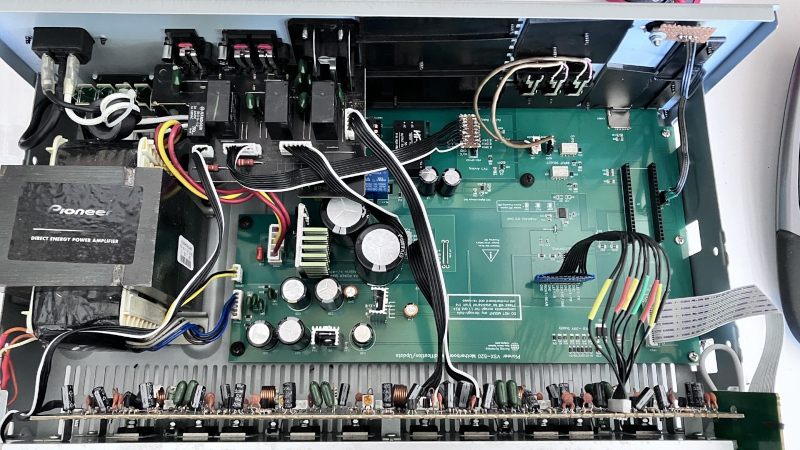
An audio amplifier was once a fairly simple analogue device, but in recent decades a typical home entertainment amplifier will have expanded to include many digital functions. When these break they are often proprietary and not easy to repair, as was the case with a broken Pioneer surround-sound device given to [Boz]. It sat on the shelf for a few years until he had the idea of a jukebox for his ripped CDs, and his returning it to life with a new main board is something to behold.
Internally it’s a surprisingly modular design, meaning that the front panel with its VFD display and driver were intact and working, as were the class AB amplifier and its power supply. He had the service manual so reverse engineering was straightforward, thus out came the main board in favor of a replacement. He took the original connectors and a few other components, then designed a PCB to take them and a Raspberry Pi Pico and DAC. With appropriate MMBASIC firmware it looks as though it was originally made this way, a sense heightened by a look at the motherboard inside (ignoring a couple of bodges).
We like seeing projects like this one which revive broken devices, and this one is particularly special quality wise. We’re more used to seeing it with gaming hardware though.










Yep, pretty much ALL amps/stereos I’ve came across had their power amps fully functioning, what usually would be glitching either the CD player, or some kind of proprietary blob of preamp stage. If you manage to get plain vanilla analog signal in, power amp and speakers would almost always just work.
Disclaimer – plenty 1990s “integrated stereos” used rather low quality caps that sure enough dry out (and sometimes short circuit). Not even “high end” stereos are immune – though, if you know where to find good replacement caps, you can fully restore them.
Pretty much correct, but in this Pioneer modal everything before the amplifier input goes through a propriety digital front-end processor for volume, DSP integration and input selection, and the Renesis micro controlling all this assets a fault signals that shut off the main +/-50V power supply and speaker relays if any of this does not work. So you either have to rip out or reverse engineer all of this or just replace the complex stuff causing the issue. Idea here was to keep it going into landfill and keep it looking as much as possible like the original so it would look good. Re-doing the motherboard without the fault-aware power supply and propriety micro let me re-use the good bits. I also re-used all the electrolytic caps to save money, all still good quality thankfully.
I have a mtx 1000 amp and no sound
you don’t miss the DSP? I have the idea a lot of audio hardware these days corrects defects in the amp and speakers by running correction in the DSP, but i don’t really know
I guess DSP was for a different target audience than me. I expect an audiophile would never use it as it “interfered” with the natural whatever, and for this amplifier now I admit I cannot tell the difference between the CD playing and the MP3, and both sound great to my old ears. I expect someone who knows more about the subject can chip in but no I don’t miss it.
I guess I’ve seldom come across the newer tac button stereo stuff. All though I hacked 4 channels into a 7.1 blue ray player-system that had only 2 line in. It used to be dirty switches a lot or blown outputs or worse the whole DC coupled stack. Dog chewed speaker cables or careless striping or splicing of the wires at ether end was the demise of many a good amp.
I have an Elan D1200 that is slowly losing channels. Is it worth having someone replace the guts of this or is it best to let it go? I really love its power and can’t afford new.
I have never hears of this amplifier, but it sure looks a beast and worth saving. It’s always worth taking the lid off to look for anything obvious like blown power/speaker fuses, bad caps, and stuck relays, you can do that with just your eyes or a multi-meter. Like another commenter said there were a lot of bad electrolytic capacitors back in the day and they are easily identified/replaced. I guess with AI we are not too far off Vibe-Repairing, might be worth a look too :-)
however on my 1970 sansui au999 integrated amp , caps are pretty robust..not a
single cap faulty and performaning flawlessly
Fair amount of output transistors , but I think it’s a high voltage amplifier , not a high current amplifier. Pioneer made good stuff , but they were never really known for super high current amps , especially something that small. I could be wrong, but the measurements would show the output current level.
Yes. The power supply to the AB power amplifier was +/- 50V so not many amps required
I’m confused about the “high voltage” vs “high current” reference. Most amps for home use are designed to deliver their rated power into 8-ohm speakers, sometimes built to handle 4-ohm loads. All their power supply voltages will be similar for a given power rating. Higher current and lower voltage amplifiers are typically seen in car subwoofer amplifiers, typically rated to 4-ohms, often 2- or even 1-ohm loads, but wouldn’t easily be confused with the unit pictured here. If there are common exceptions to the above then I’m curious what kind of units they are and how common they would be?
Yes I have a old receiver a Yamaha RX v863 I brought in 2009 and it still works great but the circuitry board looks like it been in the desert and it could use a bit cleaning up all four circuitry board it’s filthy dirty but I am thinking about it
“He had the service manual…” Those were the days :-( Now such things can be closely guarded secrets.
What about a firmware update that might fix things
My Musical Fidelity P180 power amps have been and still are running flawlessly. Sensibly the power amps have outboard PSUs, so don’t degrade due to heat, the amps will play sound for a good 30 seconds after switching off, not bad for late 90s equipment. The electolytics in the 3B pre have been replaced.
I have a Bob Carver Cinema Grand Signature 400wpc x5 into 8 ohms and 800wpc x5 into 4 ohms all channels driven . These are known for the caps going bad, and mine is no exception, but I plan to have it restored this year. I got it for $150 so the ROI will be thru the roof, and I’ll have one of the most powerful and rare amplifiers ever made.
Peace
I owned a Bob Carver silver series tube amp in early 2,000. Got rid of it and never thought I’d see another Carver again. Went to my home town for Christmas and got a Model M-1.0t. Haven’t had a chance to reach it but if it’s close to the original one I had it will be a great amps. Carver is my favorite home amp I’m more of a car audio but health don’t allow me to do that anymore. But in 1988-89 I heard a Carver on some Bose 901’s and the low/mids and highs were impressive to a 18 year old kid. And I got lucky and ended up with a pair of series 2 901’s. Think the magnet was stamped 1974? Not positive of the year but I know they were Series 2. Sorry for rambling I just seen Carver amp and it had me at Carver.
I applaud that.
Replacing proprietary brains with something you truly own and still keep as much as possible of the old hardware working.
And a VFD.
Kudos for not migrating to C in this case!
The facts are: You’re not planning too much later work on the code, it already works with MMBBASIC, you already implemented quite readable names and structure.
The “alternative facts” would be: C is a proper language / MMBASIC is not, one-does-not-use-basic etc.
IMHO a proper and professional decision.
Alas, you could have scored by re-implementing in C while concealing the MMBASIC step. People would have thought: “Wow, superguy, all written instantly in bloody C”.
Even though a PiPico cries for MicroPython, anyway ;-)
You’re right, people should chill out about what language they use, as long as it works and you’re happy, go for it. I guess my mind was still stuck in the 1980’s when I first started using BASIC, but MMBASIC is a total monster compared to those (It probably also helps that the processing power of the RP2350 is better than a 1980’s supercomputer!).
I think this should be the big take away from the blog post, that programming is no longer the hard part, and should not be the thing that holds you back.
Still using the Yamaha DSP-A2 for home theater projector. What a power house. Got it serviced recently. No hdmi so no glitches.
For the last 10+ years I’ve been daily driving a McIntosh MC2505, from ‘67 – turns 60 next year. Took it for a tuneup when I first got it, in all honesty I don’t think they did anything to it, but it got a clean bill of health.