
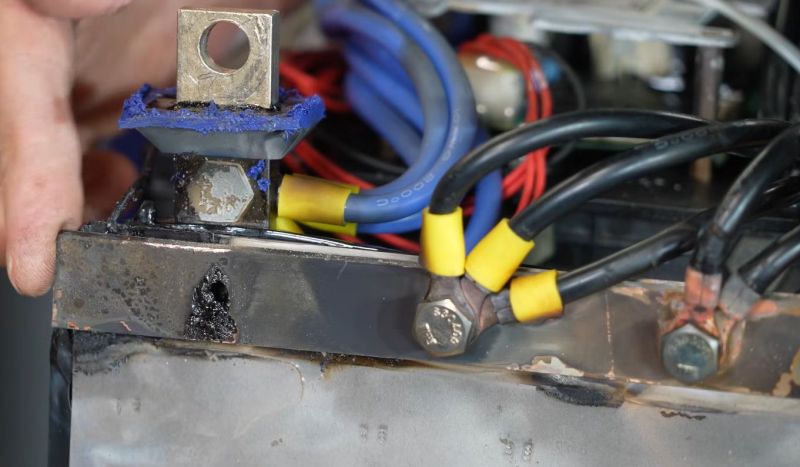
Following up on user-reported cases of Battle Born LiFePO4 batteries displaying very hot positive terminals, [Will Prowse] decided to buy a brand new one of these LFP batteries for some controlled cycle testing.
Starting with 30 cycles with a charging current of 49 A and a discharge current of 99 A, this put it well within the 100 A continuous rating for the battery. There is also a surge current rating of 200 A for thirty seconds, but that was not tested here.
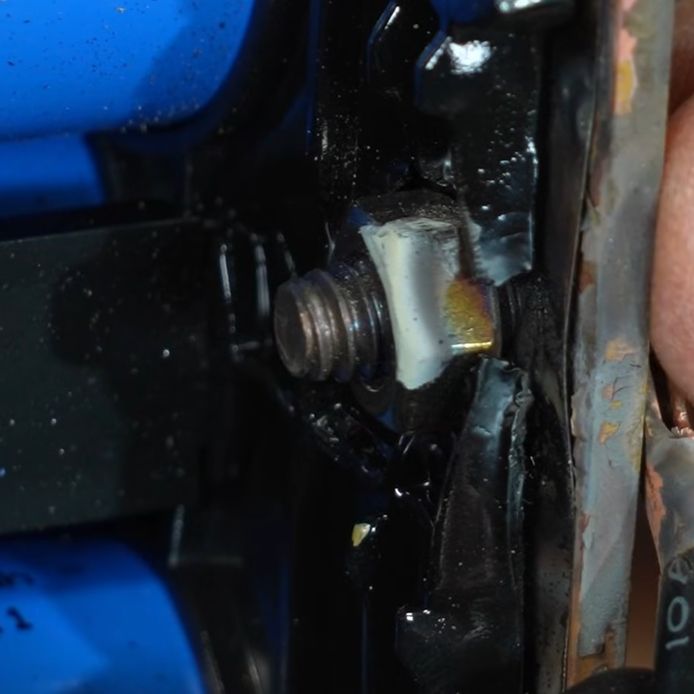
What’s interesting about the results here is that instead of the positive terminal getting visibly discolored as with the previous cases that we reported on, [Will] saw severe thermal effects on the side of the negative terminal to the point where the plastic enclosure was deforming due to severe internal heating.
During testing, the first two charge-discharge cycles showed full capacity, but after that the measured capacity became extremely erratic until the battery kept disconnecting randomly. After letting the battery cool down and trying again with 80 A discharge current the negative terminal side of the enclosure began to melt, which was a good hint to stop testing. After this the battery also couldn’t be charged any more by [Will]’s equipment, probably due to the sketchy contact inside the battery.
It’s clear that the plastic spacer inside the terminal bus bar was once again the primary cause, starting a cascade which resulted in not only the enclosure beginning to char and melt, but with heat damage visible throughout the battery. Considering that the battery was used as specified, without pushing its limits, it seems clear that nobody should be using these batteries for anything until Battle Born fixes what appears to be the sketchiest terminal and bus bar design ever seen in a high-current battery.












Those battle burn are hot! the market is on fire, and the brand will turn to ashes.
you certainly had a spark of imagination there
This actually looks worse than what I thought last time.
It looks like the company decided to use the cell spacer mounting hardware as the same mounting hardware for conductors mounted to the bus bar, and the bus bar to the cell spacer. Triple duty fasteners.
Just look at ~3:31min in the video.
Not only did they fail to implement proper fusing, but they didn’t even want to spend the money on a separate part to mount the bus bar to the end cell spacer.
That’s ~3USD worth of plastic vs thousands in brand image damage.
What I said last time:
Partial connections in electrical joints cause resistance outside of design specifications, which causes heat, which leads to creep and arcing, which causes oxides and pitting which cause poor connections, which leads to more resistance, which leads to more heat, which leads to more resistance, which leads to more heat, which leads to more resistance, which ends in an open circuit caused by melting.
They created a poor quality product because they didn’t want to spend money on proper fusing.
And Battle Born is Not Honoring their warranty on their expensive batteries 😐
My other Cheapo Chinese batteries appear to be built better at a 1/3 of the price!
Same exact usage on both systems and the Battleborn failed a quarter of the way into their non-existent WARRANTY and the other cheap batteries are still good.
Well BATTLEBORN you’re full of Crap
I really appreciate the folks who take the time to test batteries and the systems that rely on them. The battery market is sketchy, to say the least, and for people who depend on these systems to perform as advertised. often for the safety of their families and property. that work matters.
Most batteries are installed in places that are out of sight and out of mind. When they fail, the problem is often discovered too late, sometimes right before a catastrophic event.
I’m currently doing a bus-to-RV build, and this topic is very much front of mind for me.
Sounds like a great reason to subscribe to Will’s channel 😉
Sounds like over-hyped “marketing” specs…. not uncommon in the battery world.
It’s not over hyped, it’s just lousy design. All the parts are capable, the people who put it together are not.
Mainly, if you want to make a high amp electrical connection you need sufficient clamping pressure to maintain that connection. Putting in nylocks or plastic washers will absolutely kill you since plastic under any appreciable compression or tension will creep and flow.
Adding a chunky strip of copper as a bus bar, this seems like this might be fixable, at least prior to first use. Although I’m still not convinced I’d like to trust it without considerable testing. The weight reduction sounds nice, but I think I’ll stick with good old Lead acid.
This is a shame considering these are PREMIUM batteries, people who buy these pay 3x or more the price vs some other brands, and do so with the expectation that these are built safe using all the best practices.
“I’ll stick with good old Lead acid”
I switched to LiFePo4 a few years ago. I will NEVER go back to lead-acid again.
I get twice the capacity and more than twice the life at ~the same price.
I have 400Ah with 400w of solar to keep them charged, I can run my
ham shack 24/7 off grid.
Yes, plastic does not belong in bolted joints, especially electrical ones. That’s just basic engineering.
Was that a ETL mark I saw on the label? Mark of the beast.
I have seen some stupid s**t lately. An LED in a 120V power strip, fed by a 15K 1W resistor (charred golden brown, along with the plastic next to it) with a nice UL marking, for example. Now this.
What do the safety compliance tests actually test for?
There’s no enforcement so the marks are often fabricated, although they could be awarded just like JD power awards.
or maybe like that non-functional 3d printer, that wasn’t assembled correctly, and the staff had no idea how to use it.. that won Maxim best of show at CES.
100A-200A requires a larger area of contact than the cell terminals offer. There should be some copper nuts available that make full face contact with the battery and bus bar. Then another larger nut connects the load lugs.
Bolting pressure on thermo sensitive plastic! Old school Bakelite or Rostone maybe, good for higher voltage stuff with less current. This is so bad an action it needs litigation. Fortunately it seems to fail inside the box and just quits with no harm to the area. Melty fuses. Metal only bussing and an insulator that fits around the bolts to prevent shorts should be mandatory.
Please be careful of the fire risk! If that battery had gone thermal, your extinguisher would have been useless. Always have an escape route!