
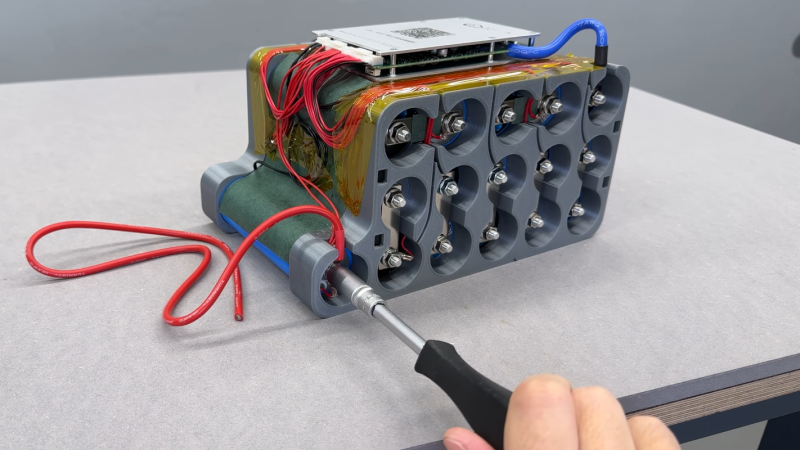
Lithium batteries have taken over as the primary battery chemistry from applications ranging from consumer electronics to electric vehicles and all kinds of other things in between. But the standard lithium ion battery has a few downsides, namely issues operating at temperature extremes. Lead acid solves some of these problems but has much lower energy density, and if you want to split the difference with your own battery you’ll need to build your own lithium iron phosphate (LiFePO4) pack.
[Well Done Tips] is building this specific type of battery because the lead acid battery in his electric ATV is on the decline. He’s using cylindrical cells that resemble an 18650 battery but are much larger. Beyond the size, though, many of the design principles from building 18650 battery packs are similar, with the exception that these have screw terminals so that bus bars can be easily attached and don’t require spot welding.
With the pack assembled using 3D printed parts, a battery management system is installed with the balance wires cleverly routed through the prints and attached to the bus bars. The only problem [Well Done Tips] had was not realizing that LiFePO4 batteries’ voltages settle a bit after being fully charged, which meant that he didn’t properly calculate the final voltage of his pack and had to add a cell, bringing his original 15S1P battery up to 16S1P and the correct 54V at full charge.
LiFePO4 has a few other upsides compared to lithium ion as well, including that it delivers almost full power until it’s at about 20% charge. It’s not quite as energy dense but compared to the lead-acid battery he was using is a huge improvement, and is one of the reasons we’ve seen them taking over various other EV conversions as well.











One of the big disadvantages that prevents using LiFePO4 in automotive applications to replace lead starter batteries is that it pretty much refuses to charge below 0 C. You can do some serious damage if you try, so the commercial batteries have nickel strip heaters between the cells to bring them up to temp after starting the vehicle.
Even at 0 C you can lose couple percentage points of capacity per cycle if you try to charge fast, so charging below 0.05C is recommendable. In practical terms, that means about 10-20 minutes to charge up what you lost cranking the engine up if the BMS allows charging at all.
That in turn presents another problem: with the mass of batteries to heat up, it takes time before it will take charge. When it’s really cold out, it takes 10-20 minutes to get the temperature up, but then you don’t have enough time left in your commute and you end up running the battery flat if the cold spell keeps on.
Lead acids charge and discharge as long as the electrolyte stays liquid, which is down to -54 C when the battery is full, and down to -25 C when half discharged, so they pretty much just work even in the arctic. Lithium-ion batteries struggle discharging at -20 C or below, and LiFePO4 generally likes it warmer.
Many new ICE cars (especially from EU) are now 48V Lithium start battery… and have been since 2020 or so. A bunch of kit comes with that “mild hybrid” (very mild!) to manage it under the various temperatures and conditions. Of course, with 48V available, devices normally driven by a surpentine belt are now electrical. Personally… I avoided this and bought a 2019 until the wrinkles get ironed out… which I believe is now the case.
Regarding BMS, many projects only require one LiFePO4 cell and if you do not want 100% capacity, you may find that 90-95% can be achieved by float-charging:
http://www.tycorun.com/blogs/news/lifepo4-float-voltage-guide
Genuine question, but I wonder how much of that article is AI gen.
The info seems generally accurate, but disorganized, drawn out, and repetitive. Not a good internal structure.
The pictures are definately AI.
I wonder sometimes how the internet is going to play out going forward. So much of what you find these days is now AI……
(As someone who has worked with and built large lifep04 packs, and read some accedemic literature on the topic)
“primary battery” ? lithium can be used in primary and secondary batteries, lead only in secondary. These are called accumulators. Maybe Bryan wanted to highlight proportion between usage of Li and Pb chemistries.
And of course flawed HaD reply system, able to randomly assign replies.
“So much of what you find these days is now AI……”
I am generally unconcerned about AI articles provided that if I suspect “misrepresentation” that I have sufficient references provided by the AI response to do my own follow-up research. With references I can continue as if I did a Google Search and satisfy any doubts I may have.
Of course, one must be familiar with the subject matter to ‘catch’ a misrepresentation; thus, a broad background of the topic is most useful. Sadly, I do not see AI assisting non-technical individuals when referencing technical dialog: giving AI the benefit to use the word “dialog” rather than the word “regurgitation”.
IMO, nothing has really changed; I have always referenced multiple sources when doing Internet research. Even in older times, some technical manuals were outdated and required a trip to the library to secure a recent reference book. The biggest issue with AI is that the “I” should have never been used in the acronym; AI is simply not intelligent as we humans have previously defined intelligence. It is however a great research tool.
Not really, and sort of at the same time – the problem is these “AI” are getting everywhere, and can be making major mistakes that have very little to do with the core of the subject so you can be familiar and still not know!
To take an example I recent ran into every single webpage in the first 3 pages of results (but the handful of cobblers/cosplay shoe vendors) was clearly (after wasting at least 5 mins reading as it was looking convincing) in part or perhaps whole AI slop and all of them making the same mistakes. In this case it was a sideline curiosity about medieval shoe construction and every single one claimed they used a variety of faux leather and not real leather at all! Only a few hundred years before fake leathers even exist, but web page after webpage source after source telling almost the exact same lie, presumably because all the LLM used have a similar screw loose. So unless your area of expertise has enough history of plastics/medieval industry in it you’d have no way to know, and it doesn’t matter how many sources you reference if they are all wrong!
Worse still when they are all wrong in similar ways it is both rather more convincing and very unhelpful in looking for the alternative resources – if just one of them actually said something else or cited a real source or two, perhaps a museum or collection that has a surviving example you have a stepping stone to learn just how wrong it is…
Not to mention that asking AI for sources will lead you down to false chases.
It’s a random babble generator. When it offers you a source, both the answer it generates and the source are separate statistical matches. It’s basically just googling it for you and giving the first result. It’s just plain luck if the source and the AI both actually say the same thing.
The AI adds an extra step between you and the primary source, because it butts in between when searching for stuff. It pays no money to read an AI generated article because you have to doubt every word.
You used to get direct search results to reputable sources, but now you have to dodge the AI generated websites to find them. That makes the search process slow to start with. If you land on one, it’s just wasting your time to actually bother reading it, because you have to repeat the search for the actual source anyways.
Well done, [Well Done Tips]! You’ve given me a few ideas and a reason to spend a little money.
I worry a bit about the center of gravity of the ATV, however. If the new battery pack is much lighter than the original, and given that this is a light weight vehicle to start with, I’m concerned that stability has been reduced leading to easier rollovers and loss of control on rough terrain. Just thinking.
My biggest question with all these battery projects is where do you source genuinely good quality cells for reasonable prices?
There’s a million dodgy ones out there for dirt cheap but when the failure mode is that something I love burns down I am going to be quite picky about sourcing.
Just saw that bluetti (spelling?) now sells a portable power supply thing with sodium batteries, that work to -25C and charge at downto -15C.
Seems that sodium battery technology is in rapid development now.
Of course I’m sure in the US you get a government grant if you use lead or coal or asbestos or PFAS technology instead.
I have an original 6volt 13 plate Ford Model A battery case and would like to know if anyone can advise me if I could replace the lead plates with these cells and if the original generator or 6v alternator would charge as it do in the original set up. Kevin in NZ