

What filament is strongest? The real answer is “it depends”, but sometimes you have a simple question and you just want a simple answer. Like, which material makes the best 3D printed wrench? [My Tech Fun] printed a bunch of options to find out — including some expensive filaments — and got some interesting insights in the process.
His setup is simple: he printed a bunch of 13 mm open-end wrenches, and tested each one to failure by cranking on a clamped digital torque meter until the wrench failed by breaking, or skipping.
[My Tech Fun] tested a total of eighteen filaments, from regular basic PLA, PETG, ABS and ASA, and a variety of carbon fiber-infused filaments including PPA-CF. TPU is included for fun, and there’s also a wrench printed with continuous carbon fiber, which requires a special printer. More on that in a moment. First, let’s get to the results!
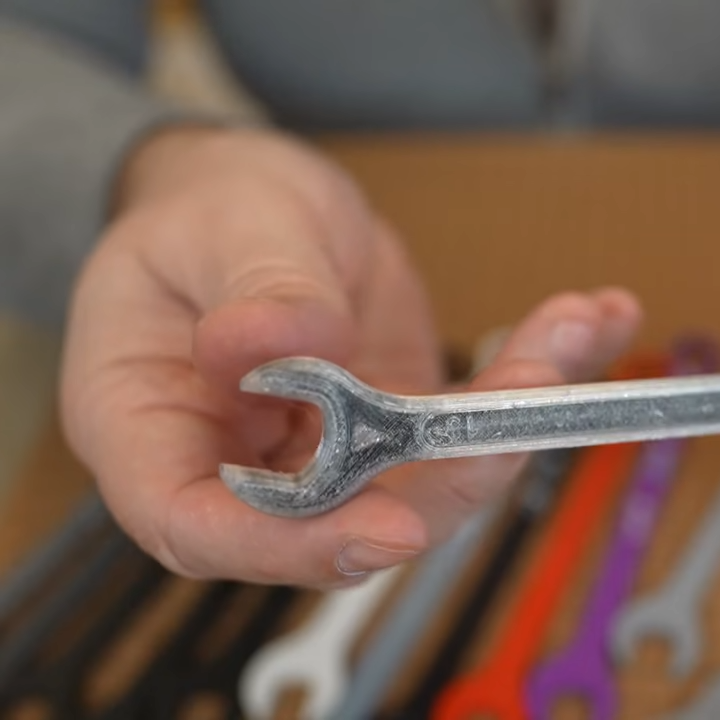
Unsurprisingly, TPU fared the worst at 0.8 nM which is roughly “unscrewing the cap of a water bottle” territory. Top performers included the wrench printed with continuous carbon fiber reinforcement (failing at 3.7 nM) and a couple printed in expensive PPA-CF (high-temperature nylon filament with carbon fiber) topped the list at 4.3 nM. Everything else landed somewhere in between, with plain PLA surprisingly outperforming some CF blends.
The continuous carbon fiber wrench was printed on a FibreSeeker printer, which reinforces a print with solid fibers embedded into the plastic instead of chopped particles, and such prints are noticeably more resistant to bending. Check out our earlier coverage for a closer look at what the FibreSeeker does.
This is a good time to mention that the wrench 3D model used is not at all optimized for best results with 3D printing. But that’s okay; this is really about the filaments, not the wrench.
The wrench model is just a way to test things in a familiar and highly visual, relatable way. You can see each one in action in the video below, and seeing [My Tech Fun] turn the wrenches gives a very good idea of just how much force is involved, with a relatable display of just how strong the different filaments are.










A newton-meter, a measure of torque.
Yes, it is. Well, the vector product N x m is, anyway. The scalar product N • m is a measure of energy.
But the article repeatedly says it’s measuring nanomoles.
A nM of wrenches would be interesting to see. That would make a medium-size asteroid or so.
Hey, holy jolly wrenchers, make finally something with your comment system. It indicates 5 comments and I see only one. But yes, I like this site.
The comments you are not seeing might be under review.
The problem is the same old one: The materials you use are only readily available in your country.
Videos always end up being useful for a couple of countries worldwide.
The rest of the world doesn’t use those brands for printing.
Would be interesting to know what effect slicer settings have. For instance, make just the jaws of the wrench, where it always broke,100% infill. Or use concentric pattern on top and bottom surfaces to get the longest lines of filament. What’s the gain from additional wall loops?
I’ll save you click. This is the one frame worth looking at, the results table: https://imgur.com/a/jmGOP8V
The part that means something to me is that most filaments cluster around 2 Nm, with a hand-full at 1Nm and 4Nm each. Depending on your perspective, that’s “pretty good for a single-use plastic wrench” or “laughably weak, like it was made out of plastic.” And i can see both of those sides but the thing is, i see it the same at 1Nm as at 4Nm. I’m pretty sure 1 and 4 are the same number.
Now i know, there’s designs where you can shave dimensions based on strength, where that difference will really matter. But overall, i look at it as a “can i do this with 3d printing?” binary question and i really think 1 and 4 are basically the same number.
A plastic FDM spanner is barely useful for a few tasks (in my case, it was removing plastic paint plugs), and whether you use bargain PLA or PPA-CF, you’ll find basically that same experience.
The tests were very subjective, just pulling until it snapped. Objective testing with a long needle pointer on the torque meter aligning with a graduated mark on the spanner handle would show deformation before breaking. Also could have applied force with a sliding contact so as not to twist it up or down. Simple improvements like these would have made for a more quantifiable series of tests.