
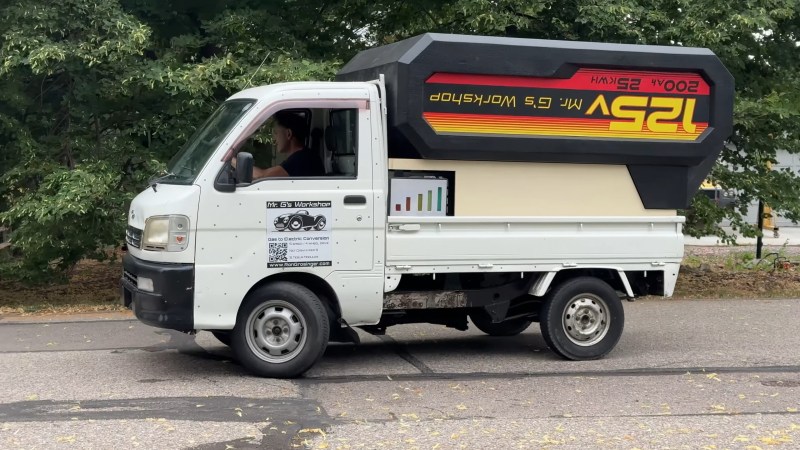
Kei trucks are very versatile vehicles, but their stock powerplant can leave a bit to be desired. If you need more power, why not try an electric conversion?
[Ron “Mr. G” Grosinger] is a high school auto shop and welding teacher who worked with his students to replace the 40 hp gas motor in this Daihatsu Hijet with the 127 hp of a Hyper 9 electric motor. The motor sits in the original engine bay under the cab and is mated to the stock transmission with a custom adapter plate made from plate steel for less than $150. We really appreciate how they left all the electronics exposed to see what makes the conversion tick.
The faux battery was made by a foam sculptor friend out of urethane foam shaped with a carving knife and then painted. It slides on a set of unistrut trolleys and reveals the 5 salvaged Tesla battery modules that power the vehicle. The fold down sides of the truck bed allow easy access to anything not already exposed if any tweaking is necessary.
We’ve seen a kei truck become a camper as well or an ebike powered with actual power tool batteries. If you’re thinking of your own electric conversion, which battery is best?











So it’s a transformation from a utility vehicle that have a bed that can transport things, to an -electric- non-utility vehicle that can only transport its own batteries ? that’s pretty moot.
I wanted to say this but was concerned about being called a party pooper :D
But yes, a truck that has been modified so it can’t carry any cargo left me unimpressed too.
Instead of the useless fake battery that looks cool, that space could have been used to be useful, but then these days looks takes precedence over function.
I was waiting for the battery to lift up like a trunk lid or have a door in the back, revealing a spacious enclosed cargo space, but nope. Did some neat work to make what could have been a cool build but ended up with a high-powered parade float.
Also is it just me or is the stereo separation on this video painful? The main guy is blaring into my left ear while occasionally bleeding into the right, cameraman keeps talking into my right ear, sound fx are all center-panned…
The battery packs aren’t that big. At least one of them could’ve been split in two and put on the sides between the front and back wheels. The other could’ve been put up against the bulkhead like a toolbox.
It looks like some of the electronics is still on a breadboard.
Well you are a bit of one, plus given the tiny size of a Kei truck turning one into a longer range personal mobility platform rather than ultralight working vehicle isn’t really that crazy – a little further refinement to this execution (like adding a door and perhaps shelves inside of the faux battery so it becomes a storage compartment) and you could easily have a vehicle with more cargo space than most small city EV, and it likely has longer range too.
But still this is apparently a student project, which means ultimately as long as they learned something it is a victory, and probably a more useful one than many of the motor racing programs in higher education around the world – they all still seem to focus on ICE powertrain which is fine, even in many ways the right choice for racing, however the complexities of Electronics are starting to become the more sought after skill set and are skills likely to be more useful throughout the students life.
Ford AA truck was about the same size, made and sold 100 years ago.
It all just rewinds and erases.
Yes, but there’s a lot more power in this one’s Tesla battery than in an AA 🙂
(What fortunate serendipity that the Ford truck had that model name, in a discussion about electric vehicles…)
There is sizable demand for these compact kinds of trucks in the US, and has been for some while. Both Ford and GM and (what’s left of ) ex-Chrysler kept pretended it never existed because everything had to be SUV-sized and SUV-priced.
Power-wise Ford AA was reasonably good when compared with its then competitors, of which there were plenty, who forced innovations to happen as soon as possible. There were a lot of them, Studebakers, REOs, International Harvester, Diamond, Mac, etc etc.
Obviously, things had moved forward since, and same truck size now can be easily upgraded to include everything under the sun.
Prime market for these seem to be everywhere, and it is a pity that the country that invented these no longer makes or sells these, compact, modern and AFFORDABLE kinds. This kind.
I’d say we don’t need new GMs and Fords, we need new Bantams, Willyses, Tuckers, in short, top-light companies with as few managers as possible, agile kinds run by engineers, that can run circles around top-heavy enrons. Proper competition.
BTW, 40hp for this kind of truck is about as good as it gets, since it is small and not meant to constantly pull heavy loads – though, upgrading the same to about 100hp is completely doable, with the obvious needed frame upgrade and the back axle stiffening. I see no good/sane reasons why both models couldn’t be locally made and locally sold for $15K flat, including sales tax in all 50 states. These will easily outsell anything in this size class within the first year of trying.
Obviously, this kind is NOT built for US highway speeds, and it is also obvious that it will NOT be made or sold in the US any time soon as a highway-rated kind, only inner city / country roads, where it is already present in form of aged imports. Pity, because not all country roads are built for the Ford extended cab megamonsters, nor there is a demand for Ferrari-priced (sorry, Mr, Enzo for using your name again) monsters of yesteryear, there is real demand for moving forward, inventing better trucks that would cost less while delivering more.
I agree for the most part, especially in terms of price/presentation. There is absolutely no reason a small, affordable work truck should not be a thing in this country. Beyond that, if a base-model full size truck is comparable in price to a small house and statistically highly likely to be subject to several recalls and breakdowns shortly after purchase, what exactly is my incentive to buy it?
For reference, I’m your standard WNY redneck that doesn’t have a real NEED for a truck vs any other vehicle, but the handful of times a year that I do need one nothing else would do. Currently own a 05 silverado, 07 ranger, and 88 s10.
I love my little trucks, and absolutely shudder at their modern incarnations – modern ranger and chevy colorados are abominations – its like they took the worst features of compact and full size and used them for design guidelines. Not even going to comment on electronic “features” and infotainment control pannels, my taste in vehicles pretty much stops at 08.
One thing that is often left out of the discussion is weight and distribution in vehicles and its impact on handling in adverse conditions. Small, unladen, rwd trucks tend to SUCK in snow/slush/ice and mud. Even with comparable tires, there is a night and day difference in handling and capability between my silverado and ranger. An extra thousand pounds with a signifigant portion of that difference behind the front axle is very noticable.
Same can be said for SUV’s and such – the extra body material and seats etc. further shift the center of mass towards the back. 4wd/awd also help here, but are not miracles.
. . . I suppose that was more opinion than actually contribution to the conversation. I’m curious, though, how drivers of all sorts are handling the weather this month in the southern states of the US that don’t generally get any snow. I always find it funny that while the lifted, coal-rolling Rams and F-2/3/450’s with Texas and Florida plates have no problem leapfrogging through traffic any other time up here, they all but disappear when the roads transform from black to white.
Here’s a great video explaining why small trucks are not made anymore. (psssssst it’s all about wheel base. shhhhhhhh)
https://www.youtube.com/watch?v=azI3nqrHEXM
RE: lurker – ALL excellent points, and these did contribute useful info to the discussion.
I’ve driven both, front-end and back-end trucks and cars, and the usual “fix” for RWD sedans was “concrete blocks in the trunk”. This sure is a lame way of approaching it, and that’s why we need R&D and innovations to happen, 4WD that automatically weighs itself and sensibly distributes the power needed. I mean, pretty much all cars/trucks now have anti-slip breaking, so it is just a matter of expanding the same logic and adding intelligent tranny.
We’re forced by our network of laws and incentives into making really stupid decisions, like spending $1000/month for 72 months on trucks with grills that seem to have been designed to plow down children while also having beds too small to hold a sheet of plywood. And most people driving trucks are just cosplaying working stiffs. I’ve found, however, that I can get most of the utility of a small truck by driving a Subaru with a roof rack. The back is big enough to hold a normal sized refrigerator if you can strap down the hatch and you can haul 16 foot four by sixes and sheets of plywood on the roof rack.
I second Subaru Forrester as Present-day Compact Truck (sort of).
I used to have an Outback and it had little metal loops welded to the undercarriage where I could hook on my tie-down straps. The Forester I now drive has more headroom in the back (great!) but lacks anything like those loops. I keep meaning to weld my own down there but usually what happens is I end up having to tie things onto bits of the suspension, which is a terrible thing to have to do. But if I already have 200 pounds of lumber on the roof, what else am I going to do?
Subaru Forester/Outback with the wagon roof sawed off : – ] Return of the Subaru Brat : – ]
Of course, I am kidding, unibody won’t allow for an easy “downgrade” with the sawed-off roof, the integrity of the unibody compromised, so such thing would probably fold once hitting one of those rural PA potholes, it needs good frame underneath instead. Rollbars doubling as a frame :-?
I’ve seen just that, unibodies with their roof sawed off, obviously, only on rural roads, away from the scrutiny, and that kind of describes the demand that’s there.
It would have been really interesting to make the battery removable so you could switch it for a fresh one in minutes.
Just imagining the sheer weight at that height… yikes.
I saw this truck at Lead East 2025. Not every day something you saw up-close and personal ending up here on HaD.