
Although at its face the results seem obvious, a recent study by [Sandrah Eckel] et al. on the impact of electric cars in California is interesting from a quantitative perspective. What percentage of ICE-only cars do you need to replace with either full electric or hybrid cars before you start seeing an improvement in air quality?
A key part of the study was the use of the TROPOMI instrument, part of the European Sentinel-5 Precursor satellite. This can measure trace gases and aerosols in the atmosphere, both of which directly correlate with air quality. The researchers used historical TROPOMI data from 2019 to 2023 in the study, combining this data with vehicle registrations in California and accounting for confounding factors, such as a certain pandemic grinding things to a halt in 2020 and massively improving air quality.
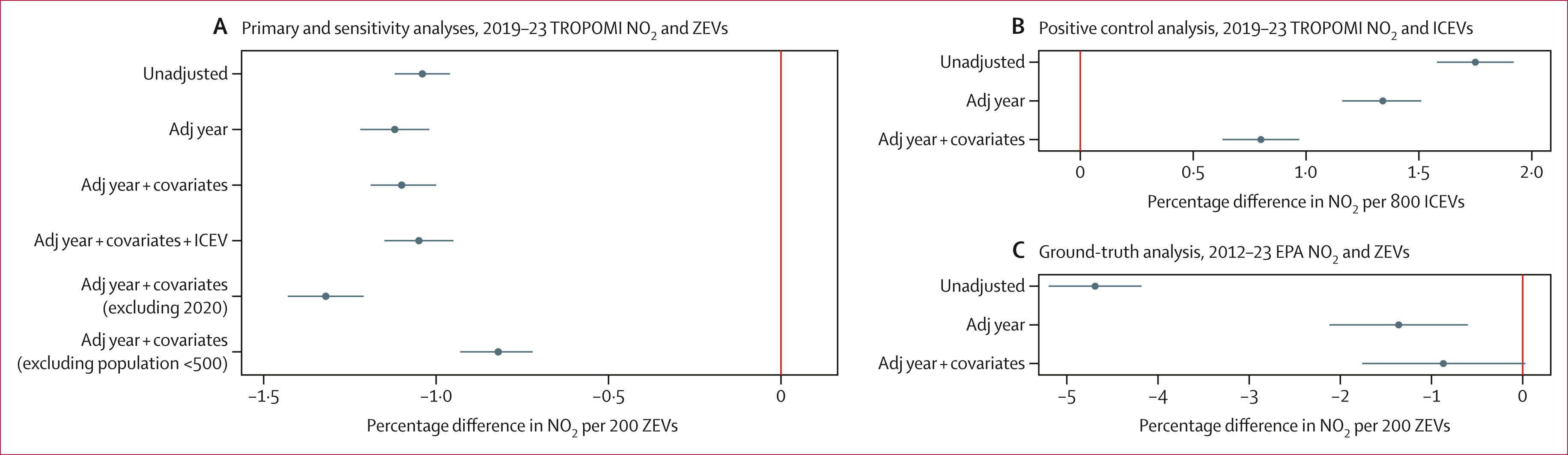
Although establishing direct causality is hard using only this observational data, the researchers did show that the addition of 200 electric vehicles would seem to be correlated to an approximate 1.1% drop in measured atmospheric NO2. This nitrogen oxide is poisonous and fatal if inhaled in large quantities. It’s also one of the pollutants that result from combustion, when at high temperatures nitrogen from the air combines with oxygen molecules.
Considering the massive negative health impact of nitrogen dioxide on human health, any reduction here is naturally welcome. Of course, this substance is only one of the many pollutants generated by cars. We are also seeing a lot of fine particulate matter (PM2.5) generated from car tires, with a significant amount of microplastics coming from this source alone.
Add to this the environmentally toxic additive 6PPD that is added to tires along with e.g. carbon black, all of which help to make tires last longer and resist e.g. UV radiation and ozone exposure. While 6PPD isn’t necessarily directly harmful to humans, the PM2.5 pollution definitely is. As for carbon black and other additives, they’re still the subject of ongoing research.
One of the things that make statistics exciting is that of nuance from understanding the subject matter. Without that the adage of ‘Lies, Big Lies and Statistics’ applies, with spurious correlations being often promoted due to either ignorance or for unsavory purposes.
In the case of this study by [Sandrah Eckel] et al., it would seem that they did their due diligence, and the correlation makes sense objectively, in that having fewer ICE cars in favor of non-ICE cars would improve air quality. That said, as the tires of electric vehicles tend to wear faster due to their heavier weight, it remains to be seen whether it’s a net positive.












Better air quality where the car is operating, but when you factor in the manufacturing process, product life span and source of the initial energy production. I do wonder if it’s not just moving the issue.
No, it isn’t. Because: Many countries (Germany, as an example) already generate more than half of their electrical energy from renewable (and no/low emission) sources, big power plants have better filters than most cars, and even if it were only moving the issue, it’s much better to not generate the pollution where the most people (especially kids) are affected.
Here:
https://www.dw.com/en/how-a-chinese-firm-ran-a-billion-euro-carbon-credit-scam/a-71010148
Also:
https://www.echemi.com/cms/1939901.html
You’re out sourcing your chemical production to China because you’ve made it impossible to produce those things in your own country.
You’re destroying jobs and your county’s manufacturing base.
So what if the air is nice, you can’t afford to breathe it!
That’s but one name. There are plenty more doing it.
not even tackling geopolitics of recycling batteries and the hundred of thousands tons of garbage wind and solar will generate after the ~ 25 year old lifespan
PET plastic is 100% but go tell that for the committee of turtles
s/PET plastic is 100%/PET plastic is 100% recyclable
Solar isnt as bad as people make it out to be. After 25 years, a panel will generally operate at 75%–85% of its original efficiency continuing to reduce by around 0.5-1% per year. So lets say you install 40 300w panels (12KW) ~6.6X10 meters coverage. 25 years in youd only have to add another 10 panels (1.65X10M) to restore your original capacity. Unless a panel is damaged and stops producing entirely you really dont HAVE to scrap them.
Now battery longevity is another issue. The trend towards Li-ion, and LifePo4, which arent really servicable makes sense in automotive applications. In stationary installations where weight is of no real concern, the serviceability and longevity of NiFe might be outweigh its inefficiencies.
Meanwhile, a single medium-sized natural gas plant will burn about 5 million tons of natural gas over the same period.
Recycling batteries…
Oh lets look at other outsourced recycling industries and what that does to the nations and people where it takes place where we pretend we cannot see it happening.
Like ships for example.
Being beached on the shores of far away 3rd world lands so other humans we dont care about can die of Asbestosis.
Like battery recycling is going to be any different long term.
“You’re out sourcing your chemical production to China because you’ve made it impossible to produce those things in your own country.”
Exactly, “environmental arbitrage” leading to a dangerous dependence on another country for essential things and the destruction of a native industry.
Q: Since the US has no shortage of rare earths are environmental regulations why they aren’t processed in the US?
Yes, the United States has substantial reserves of rare earth elements (REEs) — it’s one of the countries with significant deposits, such as the Mountain Pass mine in California, which is the only major active REE mine in the US and produces a meaningful share of global mined output (around 15% in recent years). The US is not short on the raw resource in the ground.
However, the main bottleneck is processing and refining these elements into usable forms (like separated oxides, metals, or magnets), not mining the ore itself. Very little full-scale processing happens domestically, and the US remains heavily dependent on China (which controls ~90% of global processing/refining capacity).
Q: Describe the type of government in China. Is it what can be called a police state?
Grok 3 AI: China can reasonably be called a police state due to its intrusive, high-tech controls over society, speech, and behavior—more advanced in surveillance than the USSR ever was.
The Soviet Union was always doomed to fail because of its economic system while China is a police state on capitalist (mercantilist) steroids. Since money (capital) only cares about any legal means to make MORE money, short sighted or not, that goal will have, unless prevented from doing so by national governments which unfortunately are bought by that money, the effect described in an old communist adage found in various forms
which is the fundamental message of a much longer Vladimir Lenin quote: “A capitalist will sell you the rope you hang him with.”
Germinal has the dirtiest avg electricity generation in Northern Europe.
F autocorrect! GERMANY has the dirtiest avg electricity generation in Northern Europe.
Reality does not matter.
Still wrong, that would be Poland.
Poland is generally considered to be Eastern Europe, no?
And yet it’s still much better than burning fossil fuels in cars.
the guy from engineering explained did a pretty cool video explaining the numbers. I don’t fully remember the number, but even using full coal energy, if both cars do something like 180k km (i think the number is around this, but do check the video), it would start being better having an electric car. if the energy is full renewable, it drops to something like 120 i believe, but again, i don’t remember, check the video please.
now, also we must keep in mind that manufactoring any car causes emissions, though, yes, electric is higher, but we always keep forgetting to take into account everything else regarding petrol, we always only count vehicle emissions, and manufactoring emissions, but, what about large ship spills in the pacific, that unfortunatly do happen, and though not very often, happen too often, also, petrol extraction emissions, terrible handling of petrol wells by the companies that explore them when it comes to end of life, improperly plugged wells, fires, and all the issues that come from that, so yeah, taking all of that into account, i think the polution resulting from lithium batteries has maybe a lower impact than all the ice infrastructure.
better laws could also possibly reduce the impact of lithium exploration, but unfortunatly companies tend to go to poor countries explore those resources where they won’t create laws for proper mining, so the companies can do whatever they want, but i guess we could come up with better ways of mining that don’t concentrate polutants…
But renewable energy production drops off at night when people charge their cars.
too bad there isn’t a way to put naturally hot rocks into a concrete building to boil water to spin turbines to generate electricity.
Hor rocks are a better solution. You can rely on it.
Why do you think everyone is so high as a kite on the idea of V2G and vice versa.
That’s going to do wonders for the EV range.
But why invest in “the grid” when you can force consumers to do it for you through them investing in mobile batteries that the grid will use and charge them monetarily asynchronously for the privilege of wearing out their storage capacity?
EV’s are overall less polluting even if the electricity comes from an old coal-fired power station because of how much more efficient the whole system is – Engineering Explained has a good video on this.
It’s not like producing an ICE vehicle is free of pollution.
This is such a common pattern among skeptics of electric cars and green energy, pointing out that it takes energy and produces pollution to produce the car, panel or turbine in the first place. Well.. yah! But it’s not like producing the alternative didn’t also require energy and produce pollution!
As for energy production the actual numbers all depends on how you produce it. But even with dirty coal most actual engineers running actual numbers that I have heard of said the increased efficiency of electric over gas means it’s less polluting even when power generation is considered.
While electric cars in general are heavier which leads to more tire wear, brake dust is vastly reduced due to electric cars favoring regenerative braking over using the brake pads. See the report from EIT urban mobility, which put the figure at 83%.
https://www.eiturbanmobility.eu/knowledge-hub/mastering-mobility-with-non-exhaust-emissions/
and
https://www.eiturbanmobility.eu/knowledge-hub/non-exhaust-emission-study/
If I speculate a bit, I believe that the average electric car weight will decrease, since car companies currently favor more expensive, larger, heavier cars. They will probably need to make more reasonably sized cars to stay relevant going forward.
Customer range anxiety is a big factor driving car weight too – people who have never driven not done a longer than 40 miles round trip in the last 2 years still worry that a 200 mile range is insufficient. It’s not entirely irrational, so I don’t have any good suggestions for dealing with it for one-car families. For multi-car families, a cheap and light weight electric with an 80 – 100 mile range between charges seems like a no brainer though
If they don’t have anywhere to charge it at home, then a 200 mile range may well be insufficient. A regular car can do 600 miles on a tank of diesel, so if you’re commuting 40 miles a day, you only need to stop off to fill it up once a fortnight. With a 200 mile range on an electric car you probably need to go to a public charging point (and spend 20-30 minutes there) 3 times in the same period.
If you buy electric cars, the charging will pop up on its own. Some countries are past the 50% EV mark, and they haven’t imploded due to lack of grid or charging points. Humans are good at solving problems. Just because there is a problem doesn’t mean it can’t be solved, and pretty easily at that.
Texas is flat and nearly empty for up to 900 miles in places. Why and how would charging infrastructure appear. One might say in West Texas, why would charging stations appear among the forests of oil wells?
Maybe, but you can’t pretend it isn’t an issue for plenty of people right now (well, you can, and lots of people do). Housing stock is also different between countries.
In the Netherlands the grid is full. New homes and new businesses cannot be connected to the grid anymore. Due to mass migration, big data centers, heating homes with heat pumps (because the government plugged Europe’s largest gas well), and charging EV’s. Supply cannot meat demand. It turns out if all your policies are wrong then your country goes to shit. Who knew?
“Some countries are past the 50% EV mark”
Sweden, Denmark, Norway, and China.
China is an incomparable beast filled with state funded microcars, A low per capita vehicle ownership rate, and a huge divide between urban and rural populations.
Sweden, Denmark, and Norway being over 50% isnt really that impressive as they rank 88, 114, and 116 by country population. Sweden only has 5,682,251 vehicles registered, Denmark 3,222,575, and Norway 483,482. There are 8 US states with more vehicles registered than those 3 nations combined.
The US has the most extensive road network in the world with ~6,586,610km paved. Sweden has 573,134km Norway has 95,999 and Denmark only has 75,000km. The grid and charging network needed to cover such a small area and number of vehicles is insignificant in comparison to what the US would require.
Grapes and watermellons may be similar in shape and color but thats about the end of their similarities.
Some countries?
Like… ?
It’s false equivalence.
Norway for example.
Oh yeah, happy to embrace EV’s = reasons.
Now you go list out the reasons why and then show how you can realistically repeat that in other countries.,,,
I’ll never forget rocking up to a gas station in Saudi and finding that the petrol was cheaper than a bottle of water.
“A regular car can do 600 miles on a tank of diesel”.
No, because a Regular car doesn’t run in diesel.
You’re cherry picking your data and arguing it’s the only true data.
While diesel cars have lost major market share among new registrations, the total fleet numbers in the EU are still around 30-40% diesel.
I’m just by myself. An 80-100 mile range sounds horrible. That’s 40-50 mile in the winter. That’s a 20-25 mile trip if you also go back, so in 3 years when the battery degrades, that’s a 10-15 mile trip in winter and I couldn’t even go to work with that. Last Saturday I drove 458KM/284Miles to do grocery shopping and visiting a friend. Just going to see my sister is a 180KM/111 mile trip. Most of my trips aren’t that long, most of them are short, but occasionally I drive longer distances and a car needs to do that too.
I live in (according to several statistics I’ve seen before) the highest populated country for electric car chargers. It’s still a disaster. I can’t even charge it near my house.
Say I go to a concert, and it’s somewhere I have to drive to, I have to park, put the car on the charger, but then I can’t just go to the concert. Because then I’m at the concert and the car is full so I have to leave the concert, go to the car, move the car, find a new parking space, then go back to the concert and I just missed half the concert because of it. You can’t leave it because more and more places are charging by the minute after the car is full.
EV’s are a luxury item for people who don’t use their car, or for those who are forced to because of municipal laws. I’d personally rather move instead of buying an EV. And sure, upkeep sounds cheap, if you buy a crazy expensive Tesla where the battery actually lasts a long time. But if you buy a cheaper car, like a Fiat or a Renault with an average battery life of 3 years, you have to factor in that after 3 years the car is considered totaled and it can go into the shredder, where my Toyota will go on for decades as long as I don’t crash it.
Besides that, several EV enthusiasts on a tech platform in my country did the math last year and driving an EV is more expensive, even with the tax benefits.
I’m waiting for ammonia powered cars. Until ammonia powered cars are here, I’ll be driving good old reliable gasoline.
Do you have more info on the cases of Renault and Fiat batteries dying after 3 years? I’ve been collecting info on how long EV battery seem to be able to last.
Sites like Recurrent place the lifespan of the Nissan Leaf battery pack around 10 years. MIT Technology Review had an article on Chinese EV battery recycling that seemed to indicate a similar 10 year maximum lifespan for many of these. Supposedly the liquid cooled batteries Tesla and some others use can do better, but there’s not much data out there.
Right now I drive a 13 year old gas powered car and my wife has a Diesel the same age. I would feel a lot more comfortable with buying an EV if there were a lot of examples of 20 year old BEVs out there on their original batteries, but even if that’s possible, it will take quite a while before for proof to come in.
Anecdotal data point: I have two friends with Priuses with 10+ year batteries in them. Granted that’s a different duty cycle.
For full electric: the Renault Zoe has been around since 2013, and there are a ton of them on the road here in Europe. https://en.wikipedia.org/wiki/Renault_Zoe That would be where I’d look for statistics. They guarantee the battery out 8 years or 100,000 miles.
Still, I don’t understand the insistance on keeping the car running with the original batteries. You don’t require the tires to last for 10 years, right? Just rebuild or swap out when it goes bad. It’s still going to cost a lot less than repairs and running cost on a gas or diesel over the same time period.
https://www.caranddriver.com/shopping-advice/a32494027/ev-vs-gas-cheaper-to-own/
Whether that evens out the intially-higher purchase price depends on a lot. If I were in the market, I’d pick up a one-or-two year old EV, which has already gotten over the worst of the depreciation. (Plot twist: we did exactly this two years ago.)
It would also be a different battery. They switched from nickel to lithium in 2016.
NiMH can easily last 20 years if managed properly.
Because buying a new battery for a 10+ year old car makes no financial sense whatsoever. It’s very expensive, and the car won’t last as long as the battery would, so it’s just money down the drain.
Tires only cost a few hundred euros.
“Still, I don’t understand the insistance on keeping the car running with the original batteries. You don’t require the tires to last for 10 years, right? ”
@Elliot – thats ridiculous.
Comparing swapping out the batteries to swapping out the tires.
Are you mad?! Or just being disingenuous?
Compare swapping out the batteries to swapping out the fuel tank? lol
No. Compare swapping the batteries to swapping out the ENGINE AND TRANS.
Now we are being realistic. You aint.
Re: swapping out the battery in an old EV. I’ve kept gas-burners on the road with a new transmission, with a complete motor rebuild, and in one case with an entirely different motor (out of a scrapped donor).
Our last car was a diesel, and needed a new pump and motor work that cost around $2,500 at 12 years, but we were routinely tossing a few hundred at it per year.
If a battery swap/repair costs $10k, it’s a big cost for sure. But if the running costs up to then are low enough… Ask me in 8 years. It’s an experiment.
The reason I would want the original battery to be able to last 20 years is that right now a battery replacement is looking like a $12,000 repair on a $6,000 car. This is especially a problem if battery deterioration depends on time instead of probability. When replacing an engine, a mechanical can grab a used engine, run a few simple tests on it, and reasonably expect it to last a good length of time in service. If batteries degrade automatically over time (I’m not sure how much of degradation is due to time, charging cycles, etc), a used replacement won’t be much better unless you are able to use one from a much newer car.
They have to find a way to control the cost of a battery replacement to avoid having electric cars being scrapped after a decade. Especially considering the average age of a car in the US is over 12 years old.
@Matt Kramer
I own a 1970 chevy nova. I bought it for $1500, rebuilt the engine and transmission, stripped the paint inside and out and resprayed, Recovered the seats, replaced every bit of worn out this and that. I had no labor costs because it was all DIY. Ive got $18000 invested in it. Im not selling it anytime soon but when switching to a new insurance company this year the agent found 6 comparable sales between $30-50K. and encouraged me to insure it with a replacement value of $40K.
Condition matters
2026 model year electric vehicles are entering the market with prices ranging from approximately $30k to over $90k.
A 20 year old EV being sold with its original battery at $6k is taking the impending need to replace into its price. We will see those kind of “not really a bargain” vehicles hitting the market, but we will also see a midrange “reconditioned battery” price (maybe $12K), and a higher range “new battery already installed” (maybe $18k) price becoming the new market norm as more and more of these vehicles age.
This is how things work with used hybrids already, although the price difference between them are less significant as they use much smaller lower capacity and lower priced batteries than BEVs.
@InvisibleMan: A scenario where the $12,000 battery cost gets added to what the vehicle is could sell for doesn’t so much solve the problem of buying and keeping an EV on a budget so much as state it another way.
If there isn’t a practical way to buy a used EV on a tight budget and keep it working for a reasonable amount of time, buyers at the lower end of the market aren’t going to switch to EVs.
I’ll hold my hand up and say I’m one of those who does very few miles commuting and a small / low-range EV would be great for me – but if an elderly relative was to have some sort of emergency I need to be able to hop in the car and drive >50 miles right now which is trivially easy to maintain in almost any ICE car as long as the fuel light isn’t on when you set off.
I have no way to easily charge an EV at home without trailing a cable across the pavement so can’t just leave it on charge each night. In the middle of winter in a small EV that was last charged a couple of days ago it could mean having to sit at the nearest charging station for 15-30 minutes before setting off, and although it’s a rare (hopefully never) scenario, it’s the one that plays on my mind when browsing the affordable/used end of the EV spectrum where ranges hover below 150 on a good day.
As batteries get better and ranges improve the day will arrive that it’s not an issue, I’m sitting out the early adopters and waiting for the better generation to trickle into the used market for sensible money.
I repair cars , Ev and Petroleum most of my customers fear needing the vehicle for something important and a forgotten charge could be devastating to the next day’s business or event, I really believe the hybrid vehicle will be more attractive so fear of not being able to get power becomes a minor issue
“This nitrogen oxide is poisonous and fatal if inhaled in large quantities”
This applies to everything. The dose makes the poison (or causes lack of oxygen if inert).
“What percentage of ICE-only cars do you need to replace with either full electric or hybrid cars before you start seeing an improvement in air quality?”
If all old ICE-only cars are replaced by modern ones there would also be an improvement.
So the comparison should only be made between modern ICE-only cars and hybrid/EV.
“In the case of this study by [Sandrah Eckel] et al., it would seem that they did their due diligence, and the correlation makes sense objectively, in that having fewer ICE cars in favor of non-ICE cars would improve air quality. That said, as the tires of electric vehicles tend to wear faster due to their heavier weight, it remains to be seen whether it’s a net positive.”
Tires of EV’s do indeed emit particulates. But additionally the energy they use during manufacturing and charging is not 100% clean either. Sometimes it is, but in many of those cases it’s only clean on paper. They just buy clean energy certificates on paper making the other electricity dirtier, so not net benefit.
Exactly. The system only works when you game it.
You had the carbon credit fiasco where Tesla was making billions from rebates (hey I dont blame them!).
Now you’ve got the Chinese dumping EV’s on the market to destroy global competition – as they do in every single industry they want to dominate.
Vehicle life expectancy is going to shrink. Recycling them doesn’t make them green, using them longer does.
But we’ll get more weasel words to justify it.
China has done the best from this race towards “green energy” by exporting most of the equipment used to transition.
That’s not saving the planet, it’s propping up a totalitarian state.
I actually think we might get longer vehicle lifespans as no-one can use the emissions argument to push scrappage schemes, anti-repair BS, or other nonsense.
Plus EV’s are a simpler machine – swapping motors, batteries, inverters between cars or even selling “universal” versions of those to fix dead EV’s is a far easier and more attractive prospect than covering the vast range and complexity of ICE powertrains.
No matter how much you tune your EV you’re never going to be rolling coal or waking the neighbours with a loud exhaust, and barring rather specific and picky safety arguments there’s really not much bad actors can get hold of to make the argument to prevent people fixing, building, modifying EV’s.
Meanwhile, where all the elements are being mined and processed…
Lets also ignore all the knock on effects of where all that electricity is coming from.
And the processing which goes into the machines/plants which generate that electricity, their lifespans and replacement cycles.
No, let’s just look at one thing in isolation to “prove it’s green”
This is the net zero propaganda con in full swing.
Out source the pollution to places you dont care about.
This isn’t proof that non-ICE is better, its’ justification to try and ban ICE vehicles – so you all have to spend your money to replace things you already have.
“its’ justification to try and ban ICE vehicles ”
So, do your dead level best to assure that there’s no control group?
That theme sounds familiar somehow. As though I’ve encountered it somewhere in the last 5 or 6 years.
Even Trump’s EPA says that less pollution is generated over the lifetime (cradle-to-grave) of an EV than ICEV. I don’t understand why people like you are a so resistant to making the world better.
I’m reading the same old arguments against EV’s over and over again.
People totally overestimate the amount of electronics that’s needed for an electric car, and underestimate the amount that’s already in your cars, mostly doing things that aren’t even necessary, only nice to have. And the amount of resources that this wastes, for absolutely no reason.
Source: I work for an automotive supplier.
Also, people complain about too heavy EVs, while buying hopelessly oversized SUVs and Pickups.
Take a step back and dial down the social media driven ideology a bit.
Sort of. A Tesla Model 3 weighs in at about 3500 lbs (4000 for the long range version). A VW Jetta weighs in at 3000 lbs.
The model 3 is halfway between the similarly-sized Jetta and the much larger Nissan Pathfinder (4600 lbs).
So, compared to other vehicles of the same size, yes EVs are heavy. For 600 more pounds, you might as well get more interior room and a much larger towing capacity, to say nothing of range.
600 additional pounds isn’t “hopelessly oversized” in my book.
Could not agree more on the over complexity of cars. Every time I have to change a fuel pump I have to drain and drop the tank and I spend the entire evolution cursing the engineers that made the decision to put the pumps in the tanks. The same goes for starters put in places where I can’t get a wrench and oil filters in places where they drain all over everything but the drip pan.
I long for a world where the fuel pump is still installed in the engine bay and I have room to get my hand and tools into the places I need to work.
The oversized pickup issue is a direct result of the chicken tax imposed by LBJ in 60s. He was not a good man or president. Full stop.
It would certainly be interesting to see how cars would (have) evolve(d) if favor were given to serviceability vs ease of manufacturing.
I’m clueless as to how one would go about conducting such a study/speculation but I’d certainly be interested.
Porsches are designed for serviceability. You just have to a proper autoshop, lift, and specialized tools because their designed for dealership serviceability.
I subscribe to the idea that when the Matrix said they emulated the best point in human history; it was around 1999.
Thus when it comes to working on a car, around 1999 is about the cut off point when it started tipping the wrong way for the shade tree mechanic.
But hot damn there are some amazing cars from that era.
And you can keep them running for pennies.
If it has a CAN bus it’s junk.
I installed a sealed, removable panel in my Jeep because I had two pumps go out in a relatively short period of time. Now I can get to the pump without a lift, so long as I’m careful about things. All neatly under the carpet.
Of course, haven’t had problems with the pump since [eyeroll]
This is brilliant, I am going to do this in the next 1-ton pickup I buy/build. That or just remove them and put a 12V lift pump under the hood to prime the mechanical p-pump.
I have this dream build of taking an 85 crew cab and dropping in a Cummins 6.7L mated to a ZF6 manual, then adding in only the modern amenities I need. Don’t really care if its a Ford, GM, or Dodge body so long as its straight and the metal is good. I’m going to spray it in bedliner anyway.
“… mostly doing things that aren’t even necessary, only nice to have …”
A lot of it is not even nice to have.
I would much prefer a sound system with physical buttons and knobs for tuning, volume, and a tiny bit of bass/treble adjustment instead of navigating menus on a screen.
I would prefer to have a ventilation system that I could set for “just bring in outside air” without gaming it by turning the heater thermostat to its lowest setting.
If I care about tracking my gas mileage, I prefer to do it by recording the odometer and how much gas I pump.
And I would prefer to have a vehicle that doesn’t present a network attack service to bad actors.
While you’re at it, can you add to your list tail lights that don’t cost thousands of dollars to replace? Sure glad I didn’t buy one of those Ford pickups.
Buy a 90’s classic and spend he money on fixing it not servicing the debt on repayments.
Or learn from 30yrs of peoples experiences on how to fix it yourself and gain a new skill.
What’s this? Rationality and critical thinking in a comments section? BURN THE WITCH!
That car in the title image is in desperate need of a visit to the alignment rack.
(yea, I am the type of person who gets incensed when the IMSA/WEC in-car cameras are pointed anywhere other than straight ahead – or worse, when they try to be all fancy and swivel them around.)
Ground-level ozone causes roughly 1 million premature deaths annually and 30% of “global warming” is attributed to methane (80x more potent than CO2.) With 66% of global warming attributed to human supporting activities, fossil fuel combustion is only 35% of that 60%. (For reference, 40% of human supporting methane comes from agriculture.)
Ref: 2024 Global Methane Budget and UNEP data.
Consider: I own a hybrid (4 door sedan) for the past 30 months and have put 32,000 on the vehicle. I have consistently gotten no less than 49 MPG city-highway combined with the average across all 32,000 miles. I still have the original tires but will replace them in another 5,000 miles based on dealer recommendations. Each full tank of regular gasoline provides greater than 500 miles of driving. I never worry about fuel and my most recent dealer inspection during a visit for synthetic oil change indicated that my brakes were only 20’ish% worn – attributed to regenerative breaking assistance.
Based on the public data regarding methane and multiple posts here about EV charging anxiety, I would never consider owning an EV if I can maintain the current vehicle economics. Of course LiOn batteries degrade over time (2.3%/yr on average) so I can accept that at some time in the future, I will need to address that expense, but my first 10K miles averaged 51 MPG, my second 10K miles averaged across the total at around 50 MPG, and now I’m into the 30K+ range with 49 MPG.
Ref: http://www.geotab.com/blog/ev-battery-health/
SOAPBOX:
The issue IMO is that instead of generic/proprietary LiOn charging stations being clustered in strange locations, every petro station should have at least 1 charging station to completely eliminate driver anxiety.
EV penalities:
http://klrd.gov/2025/01/17/states-fees-for-electric-and-hybrid-vehicles/
As I’ve stated before, really only hybrids make any sense (today). Pure electric just isn’t there yet for most of us. Even then there is still a battery that will need to be replaced, but at a less cost. Seem to last longer too (from what I read in a couple of articles).
Given that about 80% of scientific papers prove to be unrepeatable, the best response is probably indifference at this point.
[Citation needed]
With (LLM’s posing as) AI, we can now make up citations as easily as we’ve historically been able to make up statistics. Apparently.
[Citation needed from a reliable source?]
I know that there’s a lot of noise out there, but those of us producing the signal are still trying to fight the good fight.
or all the people that was electric cars are no carbon emission free because the electricity is genereated using fossil fuels:
When burning fossil fuel in an ICE the carbon footprint is not just the CO2 from the fuel itself. You also have to factor in that the fuel must be produced and transported before it can propell a car.
If all the fossil energy that is used to provide the fuel for ICE’s is to generate electricity it is already possible to move some electric car.
Sadly i can can not join the electric realm because of my specific personal situation and requirements.
Just as an Example: There are small EVs out there that would have enough range (120km per charge) for my daily business but since i live in an area with good puplic transport i rarly use my car for daily business and those small EVs have a leasing battery that would cost me more money than to fill up my ICE car at least once. Filling up my small car gives me a range of 500 – 700km (depending on driving style). I usally only fill up my car once per month
So such small EVs are currently(!!!) out of scope for me(!) but this might change in the future.
The best option would be to ditch my current car and rent a car when needed.
But currently i am willing to pay to the luxery(!!) to have a car at hand that could move me several hunderts km when required (this requirement might change in future as well)
You’re ignoring line losses in transporting that electricity to charge that vehicle plus the wear and tear on the generation of said electricity.
Or the cost of paying wind power not to generate because the grid cannot handle it.
You called it on ICE, you ignored it on EV.
How green of you.
Hello bob,
You are right that i have not mentioned losses in tranfsformation and wear and tear of the required equipment. This article is about the question if EVs can help to have a locally better air quality. When in some comments it was mentioned that there are remote(!) polutions when providing electrical power i just wanted to point out that for provinding fossil fuel locally there are also remote polutions involved.
For the problem with cutting of wind parks (and solar parks as well sadly) because the grid can not handle the power: Yes this is a point. Most electrical grids where build under the (simplified) asumption of some big power plant and many small consumer. But this is kind of a historical problem. Currently there is a (usally) good infrastructure for devlivering fossil fuel and a kind of underdevelopt infrastructure for electrical power distribution.
To tackle this there are several sollutions:
a) update the grid to handle the power
b) build local puffers (electrical batteries, spinning discs, …) to smothen out peaks
c) build more time independent stearable electric power consumption options
d) ….
=> the best solution would be a combination if this.
Is here a safe way to share personal conact information? then we could discuss the pro and cons of switch from ICE to EV in details without bloating but this place here.
Have a nice day.
“Lies, Big Lies and Statistics”. Come on get your probably apocryphal quote right. It should be
Lies, Damn Lies and Statistics!
I swear this comment section would oppose banning leaded gas
Come on, Leaded gas and lead based paint fueled some of the most interesting and exciting decades in our history. Seriously, what has microplastics done for culture?
I’ve seen people on a couple forums argue for exactly that… And you’d have a lot more if anyone proposed getting rid of the carve-out for race gas. Although there are now some decent 110 octane unleaded options.
My concerns are economic: Can I afford to buy and maintain an EV that meets my current needs, on my current budget? Right now the answer appears to be no. And if I can’t, with a relatively average US income, what does that mean for the EV market at large? These concerns only bleed over into environmental concerns if you end up with a scenario where people who can’t afford new-ish EVs end up keeping gas or Diesel cars in service much longer than expected, removing broken emissions equipment to keep them on the road. Or those people might just elect a government that won’t push environmental standards as hard.
So much negativity, geez.
I drive a Renault Zoe with a 40kw battery (Non rental). In wibter time (-10 – +10) the range is indeed shorter, butI can still manage 200 – 250km range.
My workplace is between 90 and 100km (depending on the route) per direction and I don’t have the DC charge option. Sometime I drive to/from work 5 times a week.
I do not have my own drive way, only a 15 amp single phase charger that needs 12 hours to charge to full, and I try to charge only at home, which seems to have been fine in the last 2 years of owning it..
For my commute its absolutely fine, but In also choose this solution. Doing long trips (more then 350km in summer is not feasible with this car, and that is well known.
I get the range anxiety, charge anxiety discussion, but its also not really a problem. But maybe that’s before even owning a car, we did everything by bike, public transport or rental car. I guess we are too spoiled and panic to easily? For fossil cars, what if you must leave, have a full car but it wont start? What if the engine break’s on you just as you need to go? There’s plenty of similar arguments to be made.
So let’s stop making this argument so polarizing and accept the fact that this revolution is happening and we’ll see what it means. If it turns out it was a bad idea, we’ll solve the problem? We tend to be pretty decent at that, right?