
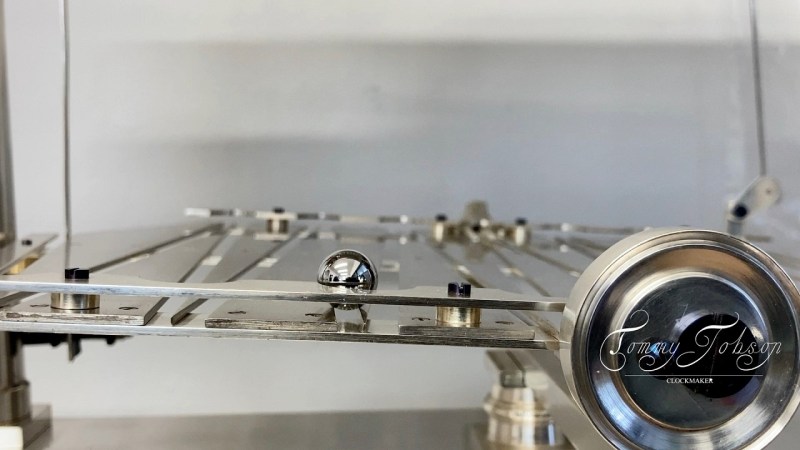
The classic design of a mechanical clock generally consists of a display, a way to store energy, a way to release that energy at regular intervals, and a mechanism to transmit it where it needs to go. Most of us might be imagining a pendulum or a balance wheel, but there have been many other ways to maintain a reliable time standard with a physical object beyond these two common methods. This clock, for example, uses a rolling ball bearing as its time standard and [Tommy Jobson] discusses its operation in depth during a restoration.
The restoration of this clock, which [Tommy] theorizes was an amateur horological project even when it was new, starts by dismantling the clock nearly completely. The clock was quite dirty, so in addition to being thoroughly cleaned it also needed a bit of repair especially involving a few bent pins that stop the table’s rotation. These pins were replaced with stronger ones, and then everything in the clock’s movement was put back together. The tray carrying the ball bearing needed to be cleaned as well, and [Tommy] also added a lacquer to help preserve the original finish as long as possible. From there it was time to start calibrating the clock.
The ball bearing itself rolls back and forth along an inclined plane on a series of tracks. When it gets to the end it hits a lever which lets a bit of energy out of the movement, tilting the table back in the other direction to repeat the process. This is a much more involved process for getting an accurate time interval than a pendulum, so [Tommy] had a lot of work to do here. But in the end he was able to bring it back to life with an accuracy fairly close to a pendulum clock.
Ball bearings are a pretty popular medium for clock builds even in the modern era. This one uses them in a unique display, and a more recent version goes even further by using marbles to display digits directly.
Thanks to [Keith] for the tip!












the clock is actually a model of the Congreve Rolling Ball clock
https://en.wikipedia.org/wiki/Congreve_clock
I made one of these many years ago from a john wilding book, the fusee profile does not look right, should be the same profile as an extended thumb. dust collected on the track and slowed it down, made a lovely brass edged glass case, but still slowed down over time.
I would say it uses a bearing ball, possibly a ball bearing ball, or, you know, just a ball… I do not see a rolling bearing there (there are most likely bearings on the axis, but they are not essential to the oscillation).
+1
Interesting clock. Scratches all my itches. :)
However, how on earth can anyone decide to make the clock silver, instantly turning such an interesting clock design into a piece of kitsch!
If you want something to look expensive, you really have to add some baroque carvings, or use different colors and patterns. Maybe some gilding. To at least make it look as if a lot of attention was given to the finish. :)
Now I look at it, and all I see is the unholy child of the Acropolis, a kitsch 60’s car dashboard and one of those labyrinth games where you tilt the labyrinth in different directions to move a ball from start to finish.
:D
May the clock benefit from a https://en.wikipedia.org/wiki/Tautochrone_curve?useskin=vector as runway, slightly tilting back and forth to keep the ball moving?
Well this going to keep me up at night. Much like Calvin trying to make sense of the inside of the record moving slower and in sync with the faster outside edge.
Wow ! Now that is an incredible time piece and method of escapement (?). Great restoration video ! It was very interesting ! The clock reminded me of the Ball Bearing clock that was a thing back in the 70s where clustering balls represented time. My brother had one he put together. After 6 months of running mom unplugged it because mainly at midnight the ball reset sounded like a bowling alley. 😁