
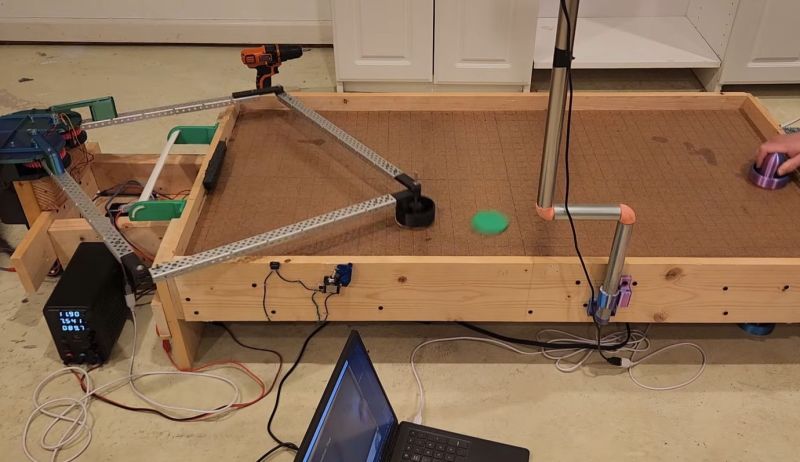
Air hockey is one of those sports that’s both incredibly fun, but also incredibly frustrating as playing it by yourself is a rather lonely and unfulfilling experience. This is where an air hockey playing robot like the one by [Basement Builds] could come in handy. After all, after you finished building an air hockey table from scratch, how hard could it be to make a robot that merely moves the paddle around to hit the puck with?
An air hockey table is indeed not extremely complicated, being mostly just a chamber that has lots of small holes on the top through which the air is pushed. This creates the air layer on which the puck appears to float, and allows for super-fast movement. For this part countless chamfered holes were drilled to get smooth airflow, with an inline 12 VDC duct fan providing up to 270 CFM (~7.6 m3/minute).
Initially the robot used a CoreXY gantry configuration, which proved to be unreliable and rather cumbersome, so instead two motors were used, each connected to its own gearbox. These manipulate the paddle position by changing the geometry of the arms. Interestingly, the gearbox uses TPU for its gears to absorb any impacts and increase endurance as pure PLA ended up falling apart.
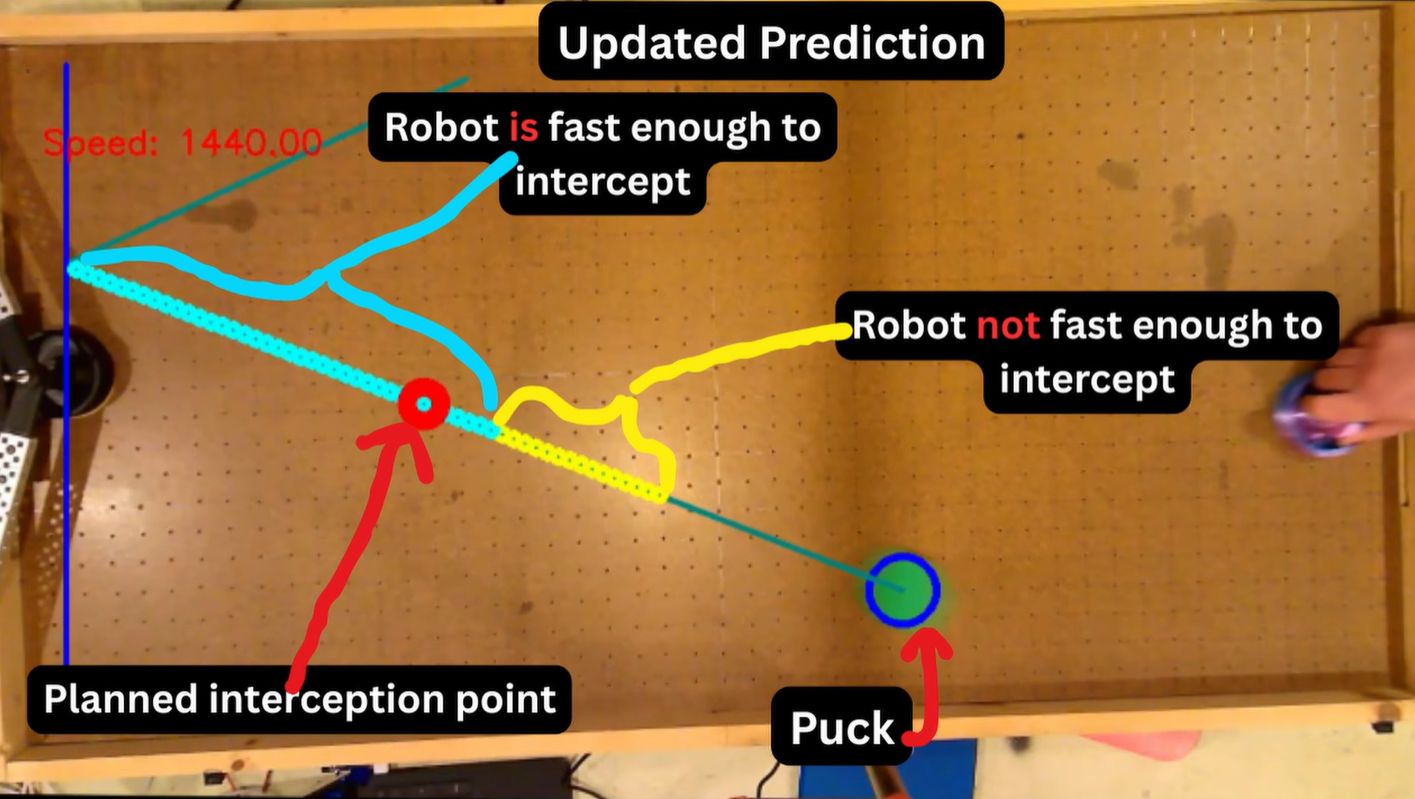
The position of the puck is recorded by an overhead camera, from where a Python script – using the OpenCV library running on a PC – determines how to adjust the arms, which is executed by Arduino C++ code running on a board attached to the robot. You could just copy this code yourself, but as the video makes clear, this is basically cheating as you don’t get to enjoy doing all the trigonometry and physics-related calculating and debugging fun.












When Brunswick did a table the used melamine.
The trick is to micro drill the holes then lacquer the backside and then re-drill them from the front again.
Sometimes if the backer on the melamine was coarse, they would do it twice, then you can drill more holes and they shaft up nice and clean inside.
I found a sheet of it from a drawer bottom and made a vacuum vise with it… it had MDF backer.
Another thing is, If you use thin T&G flooring that is face smooth you can piece together a nice wood grain top that would take the micro drilling well, one quick coat of clear on the inside and a re-drill done.
It also should play System of a Down’s “Lonly day”.
Man I really miss playing this at the local mall arcade