
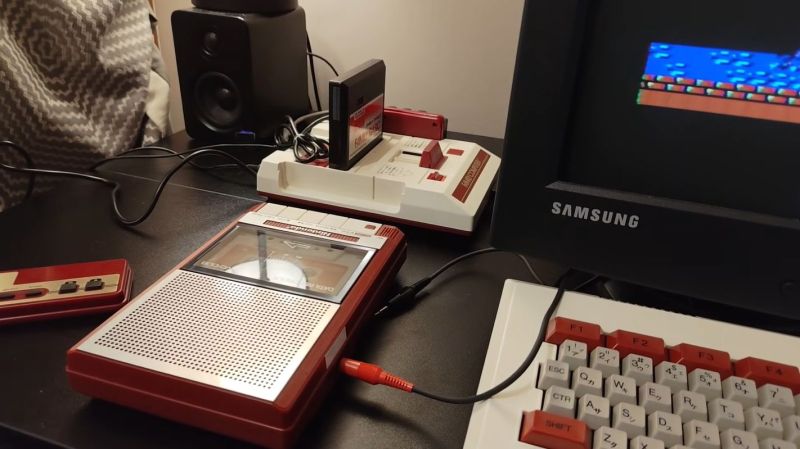
Back in the 1980s, your options for writing your own code and games were rather more limited than today. This also mostly depended on what home computer you could get your hands on, which was a market that — at least in Japan — Nintendo was very happy to slide into with their ‘Nintendo Family Computer’, or ‘Famicom’ for short. With the available peripherals, including a tape deck and keyboard, you could actually create a fairly decent home computer, as demonstrated by [Throaty Mumbo] in a recent video.
After a lengthy unboxing of the new-in-box components, we move on to the highlight of the show, the HVC-007 Family BASIC package, which includes a cartridge and the keyboard. The latter of these connects to the Famicom’s expansion port. Inside the package, you also find a big Family BASIC manual that includes sprites and code to copy. Of course, everything is in Japanese, so [Throaty] had to wrestle his way through the translations.
The cassette tape is used to save applications, with the BASIC package also including a tape with the Sample 3 application, which is used in the video to demonstrate loading software from tape on the Famicom. Although [Throaty] unfortunately didn’t sit down to type over the code for the sample listings in the manual, it does provide an interesting glimpse at the all-Nintendo family computer that the rest of the world never got to enjoy.











The rest of the world enjoy this. Only USA did not.
One nice thing about the 8-bit and MS-DOS machines: Most computers had some flavor of BASIC, so you COULD write a program out-of-the-box.
The 20th-century Macs and 21st-century Windows prior to adding PowerShell out-of-the-box, not so much.
I recall having to use HyperCard on a Mac Classic to do codey stuff as a kid before I knew wtf I was doing.
i grew up with BASIC and was frustrated by how difficult programming became as OSes advanced in the 1990s. it was Javascript that exposed a significantly large programming surface to get me programming again. and now, 28 years later, I write low-level code in c and have all the tooling I need to alter just about any software where I have the source code (and some where I don’t)
Visual Basic was a hit in the 90s, but MS then messed up with .NET technology in early to mid-2000s.
VB3 was very popular on 16-Bit Windows, while VB6 continued to be beloved on Windows 9x/NT line.
But again, then .NET technology was enforced by MS and the user base vanished (VB .NET syntax was too complicated).
VB Classic was ideal for prototyping and bedroom programmers.
It provided a certain level of abstraction from the mess that Win-API was.
And the Visual Studio 6 IDE was very compact and tidy, too.
That’s why many VB6 clones appeared (also on other platforms).
There was ROM BASIC on IBM PCs, originally.
It was used primarily in the days when the IBM PC had too little RAM to run DOS or CP/M-86, even.
Then eventually came BASICA, which was a DOS program that extended the ROM BIOS.
Later, GW-BASIC shipped with some versions of DOS. It needed no ROM BASIC, ran on clones.
By late 80s, the compilers/interpreters (IDE) Turbo Basic and Quick BASIC got popular.
Both could do proper code without line numbers.
(On Amstrad PC1512/1640, graphical Locomotive Basic V2 was shipped with GEM.)
Turbo Basic then became Power BASIC in the 90s.
Sideways, there also was PDS 7.x and Visual Basic for DOS.
Both extended on Quick BASIC 4.5 syntax.
QBasic in DOS 5/6 is a limited interpreter version of QB45.
Then there was Turbo Pascal..
It was used in higher education and version 3 was very popular in mid-80s.
It could create very small and very fast COM programs. Also on CP/M and CP/M-86, not just DOS. Had overlay support.
Version 4 added EXE support and had Turbo Graphix Toolbox (optional).
By turn of the decade (89-90), Turbo Pascal 6 and 7 were popular.
There also was Borland Pascal 7, which was like a professional edition of TP7.
It also had a Windows compiler, that was based on earlier Turbo Pascal for Windows.
TP7 also made the Turbo Vision TUI available to users, I think.
Ok, strictly speaking there also was MBASIC or BASIC-80/BASIC-86 in the early 80s.
It originated from CP/M platform and also had a compiler version.
On DOS, Microsoft BASIC was a compiler package that was different from BASICA/GW-BASIC.
The popular Clipper Summer ’87 also was used for creating DOS applications.
There was a dBase converter tool that used to be popular.
Clipper/dBase used xBase language, I think.
i did enjoy BASIC built-in to computers, whether it was in ROM like on the IBM PS/2, or GWBASIC or QBASIC. But i don’t feel like we really lost anything when it stopped being included ‘by default’, because that happened almost simultaneously with the rise of networking. Installing an interpretter or compiler over the network got a lot easier so it didn’t hardly matter what was built in.
I just like the fact that the facts matter…when computers only had what was in the box, the box had to include more things.
In addition, the default BASICs shipped with often weren’t that great to begin with.
Be it C64 BASIC (Commodore BASIC V2) that really needed SIMONS BASIC for serious use.
Or the IBM PC’s ROM BASIC which was very limited.
Or the Sharp MZ-80K Basic, BASIC 5510, which often was being substituted by S-BASIC (Super BASIC?).
The list goes on. The TI99/4 had an optional “Extended BASIC” that was better than the default one.
Same goes for the Thomson TO7-70, which too had an optional “Extended BASIC” on a cartridge.
I think the built-in BASIC always was a trade off between cost and functionality,
because ROM space was expensive not just in terms of money.
It occupied a big part of 6502 or Z80 address space that could be better used otherwise often.
What many people miss from the past, I think, is that the BASIC found on home computers also served as a firmware or command-line.
Which was very comfortable and part of the experience.
That worked well until the hardware was expanded.
Once that happened, the default BASIC nolonger was adequate for handling certain tasks.
If only PCs of the past 20 years only would have had shipped with Open Firmware and an interpreter of a high-level language.
Because unlike UEFI, Open Firmware relied on a console and had features of a debugger or monitor program.
Pretty cool. I got Family Basic from Japan to play with music and BASIC. The keyboard is super brittle now, it barely survived shipping.
I didn’t get the data recorder HVC-008 though. It’s is a rebranded Panasonic Slim-Line RQ (not sure exactly which model) which are cheap on US eBay. The only thing special about that model is that the main speaker doesn’t mute when headphones are plugged in. You can also just plug it into a computer 3.5mm jack.