

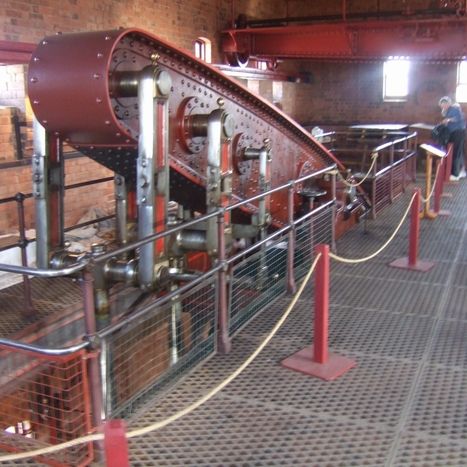
Although infrastructure like a 19th-century pumping station generally tends to be quietly decommissioned and demolished, sometimes you get enough people looking at such an object and wondering whether maybe it’d be worth preserving. Such was the case with the Claymills Pumping Station in Staffordshire, England. After starting operations in the late 19th century, the pumping station was in active use until 1971. In a recent documentary by the Claymills Pumping Station Trust, as the start of their YouTube channel, the derelict state of the station at the time is covered, as well as its long and arduous recovery since they acquired the site in 1993.
After its decommissioning, the station was eventually scheduled for demolition. Many parts had by that time been removed for display elsewhere, discarded, or outright stolen for the copper and brass. Of the four Woolf compounding rotative beam engines, units A and B had been shut down first and used for spare parts to keep the remaining units going. Along with groundwater intrusion and a decaying roof, it was in a sorry state after decades of neglect. Restoring it was a monumental task.
The inventor of the compounding beam engine, Arthur Woolf, was a Cornish engineer who had figured out how to make this more efficient steam engine work. While his engineering made pumping stations like these possible, the many workers and their families ensured that they kept working smoothly. Although firmly obsolete in the 21st century, pumping stations like these are excellent examples of all the engineering and ingenuity that got us to where we are today, and preserving them is the best way to retain all this knowledge and the memories associated with them.
For that reason, one can really congratulate the volunteers who turned this piece of history into a museum. It features a static display of the restored machinery. If you want to see it running, there are seven demonstrations of the station operating under steam every year, during which the six-story tall machinery can be observed in all its glory.
Top image: Claymills Pumping Station in 2010. (Credit: Ashley Dace)











Good that restoration on such things happened.
In the Netherlands, the Woudagemaal (https://en.wikipedia.org/wiki/Wouda_pumping_station) is the largest existing steam pumping station in the world. It is a volunteer-run museum, but the station is very much in active duty: it has to supplant the newer electric pumping station in times of high rainfall, generally a few days per year. When it starts running, this usually makes the national news.
It is a UNESCO world heritage site, and very much worth a visit, especially on the heritage days when they run the engines lightly and the engineers have time for tours and questions.
That what a nice video.
+++
For anyone who visits this place, the modern Sewage Treatment Works (directly opposite) regularly offer tours. Amazing seeing how far it’s come, just watch out for the skips full of sweetcorn husks and the leeches everywhere.
I get the same satisfaction watching a massive beam engine come to life, as I do watching a Starship launch. And all those smaller engines…. [sigh]. A well-made flywheel with gracefully-curved spokes, in motion, is a thing of absolute beauty.
Boilers, however, are frightful creatures. The potential energy in even a small boiler, while fired up, defies casual comprehension. When a large boiler lets go, buildings disappear… not to mention the people inside.
Google the “Grover Shoe Factory disaster” and check out the photos. I’m thinking the boiler involved there is roughly comparable to those at Claymills. Mad respect.
I didn’t want to watch it at first when I saw the AI thumbnail. AI thumbnails tend to generate some negative vibes for me due to all the bad cheap looking AI shit going around these days, but your comment made me doubt my poor judgement and I was glad to see some real and historical footage. The love for the project really shines through.
This. I hate AI with a passion.
I tried to respond to the comment of “Jan Prägert” but apparently I pressed the wrong button creating a new comment instead of a reply.
hmmm… it appears that the reply button is broken…
always_has_been.png
Somebody at Hackaday loves that bug. It’s the only explanation. It’s been stochastically broken for so long that it must take active maintenance to keep it around.
Not broken.
I can life with that.
(covert reply test.)
As soon as I saw the cover photo I thought that looks like Claymills. Such a landmark for rail users in the East Midlands.i wonder if a similar campaign to retain the 1960s cooling towers at nearby Ratciffe on Soar power station will gain similar traction?
“Although infrastructure like a 19th-century pumping station generally tends to be quietly decommissioned and demolished” – tends in primitive countries perhaps. In more civilized countries these are made into monuments and preserved for eternity.