
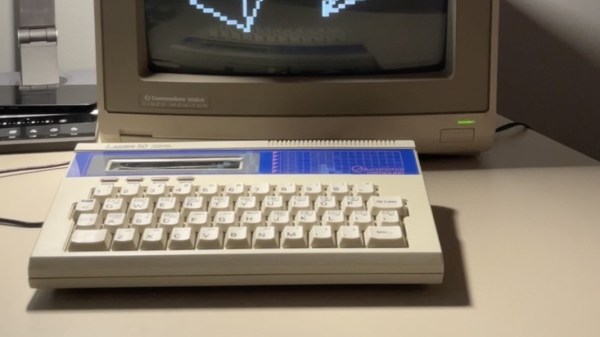
Three Arduinos Team Up To Make 80s-Style Computer

Back in the 80s, buying a home computer could easily mean an inflation-adjusted cost of thousands of dollars (or your equivalent currency unit of choice), and all for an 8-bit machine that might not have a hard drive and almost certainly didn’t connect to a network. Here in the future it’s easy to get spoiled by all the computing power and inexpensive devices practically falling into our laps, but using some modern low-cost microcontrollers can connect us to our early computing roots like [Joe]’s latest Arduino-based computer.

Taking design an engineering cues from computers like the Timex Sinclair 1000, Commodore PET, and TRS-80 MC-10, this computer uses a trio of Arduinos to accomplish what the best computer manufacturers once did with tons of integrated circuits. An Arduino Due handles all of the processing and traditional computing tasks, including a somewhat customized BASIC implementation, while an Uno performs audio processing duties. Taking care of the video processing is the much more capable Arduino Mega, outputting 40×25 monochrome NTSC composite video at 8×8 character resolution. There’s even WiFi courtesy of an ESP32 — certainly an upgrade compared to the source material.

After booting it up, the user gets a Commodore-like experience that replicates the 80s computing era quite well, and is even built inside its own keyboard case just like that era of computers usually were. [Joe] plans to release all three firmware images and the Python script used to get files onto the faux-retro machine, so keep an eye out for that.

In the event that you used rubles instead of dollars to pay for your expensive 8-bit machines back in the 80s, this computer might be more up your alley instead.
Retrotechtacular: Mr. Wizard Jams With IBM

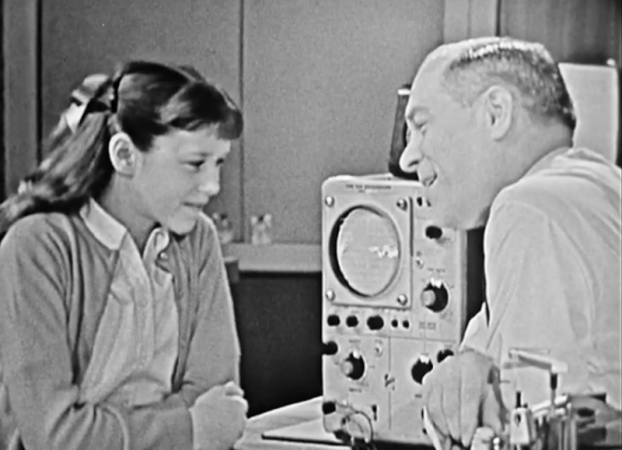
You may not remember [Mr. Wizard], but he was a staple of nerd kids over a few decades, teaching science to kids via the magic of television. The Computer History Archives Project has a partially restored film of [Mr. Wizard] showing off sounds and noise on a state-of-the-art (for 1963) Tektronix 504 oscilloscope. He talks about noise and also shows the famous IBM mainframe rendition of the song “Daisy Bell.” You can see the video along with some extras below.

You might recall that the movie “2001: A Space Odyssey” paid homage to the IBM computer’s singing debut by having HAL 9000 sing the same song as it is being deactivated. The idea that HAL was IBM “minus one” has been repeatedly denied, but we still remain convinced.

Continue reading “Retrotechtacular: Mr. Wizard Jams With IBM”

Building A Granular Sampler Synth

Synthesizing sounds from scratch is all well and good, you just use a bit of maths. However, the latest build from [Daisy] eschews such boring concepts as additive or subtractive synthesis, instead going for a sample-based approach.

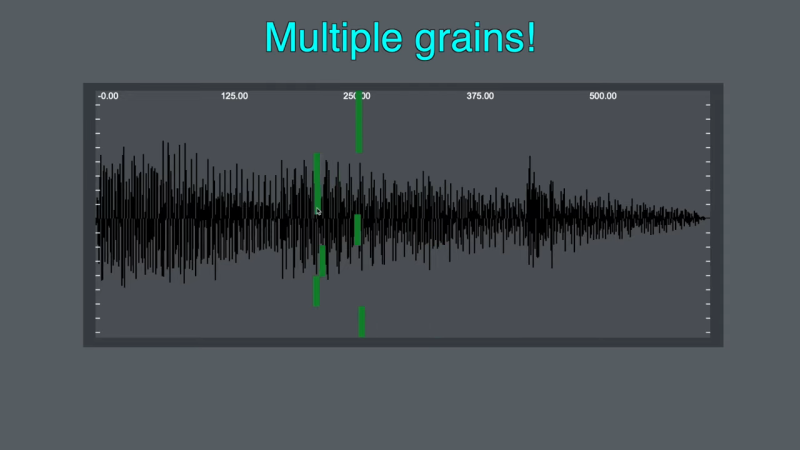
This build is based around the Daisy Seed microcontroller platform. It was actually inspired by an earlier project to create a ribbon synth, which we covered previously. In this case, the ribbon potentiometer has been repurposed, being used to control the playback position of a lengthy recorded sample. In this build, the Daisy Seed is running its audio playback system at a rate of 48,000 samples per second. It’s capable of storing up to 192,000 samples in memory, so it has a total of 4 seconds of sample storage. The Daisy Seed uses an analog-to-digital input to record two seconds of audio into the sample buffer. It can then be replayed by placing a finger on the ribbon at various points. Playback is via granular synthesis, where small sections of the overall sample buffer are used to synthesize a new tone. The video explains how the granular synthesis algorithm is implemented using the Plugdata framework. Design files are available for those eager to replicate the build.

Once you start tinkering in the world of synthesis, it’s easy to fall down the rabbit hole. Video after the break.

Continue reading “Building A Granular Sampler Synth”

Talking Poker Timer

[youtube=http://www.youtube.com/watch?v=k8iIuPnXzm8]

This interesting box of buttons is a talking poker tournament timer. Full of useful tools like a binary time display, words of wisdom, countdowns to the end of the game, and even good old “bicycle built for two” mode (around 1:20).  While we find it fairly difficult to understand, we applaud the feature list, especially the song.  He used an Arduino with a voice shield, so there’s not much to the electronics side, but you can download his source code from his site.

[via Makezine]









