
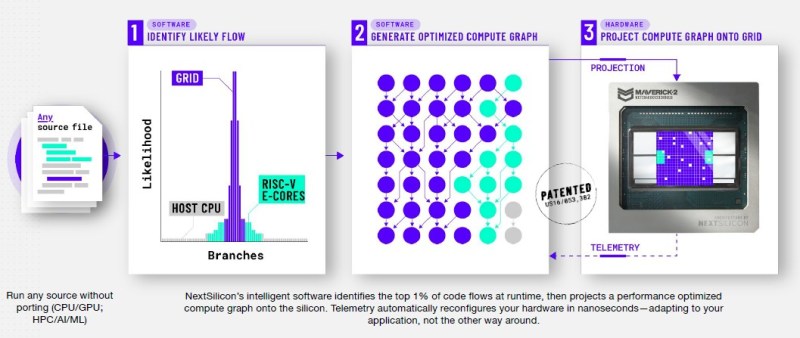
A few months back, Sandia National Laboratories announced they had acquired a new supercomputer. It wasn’t the biggest, but it still offered in their eyes something unique. This particular supercomputer contains NextSilicon’s much-hyped Maverick-2 ‘dataflow accelerator’ chips. Targeting the high-performance computing (HPC) market, these chips are claimed to hold a 10x advantage over the best GPU designs.
The strategy here appears to be somewhat of a mixture between VLIW, FPGAs and Sony’s Cell architecture, with a dedicated compiler that determines the best mapping of a particular calculation across the compute elements inside the chip. Naturally, the exact details about the internals are a closely held secret by NextSilicon and its partners (like Sandia), so we basically have only the public claims and PR material to go by.
Last year The Register covered this architecture along with a more in-depth look. What we can surmise from this is that it should perform pretty well for just about all applications, except for single-threaded performance. Of course, as a dedicated processor it cannot do CPU things, which is where NextSilicon’s less spectacular RISC-V-based CPU comes into the picture.
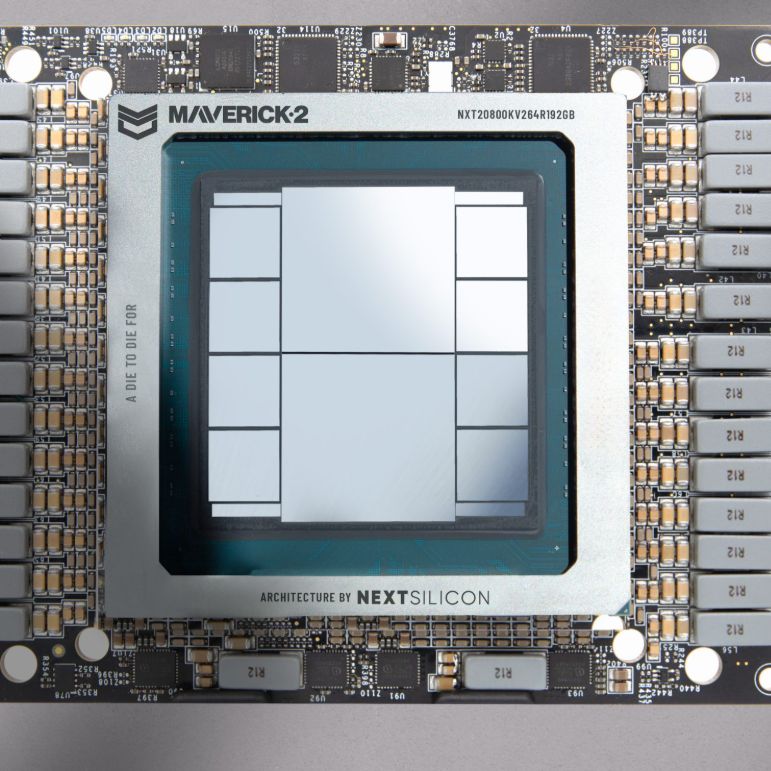
What’s apparent from glancing at the product renders on the NextSilicon site is that these Maverick-2 chips have absolutely massive dies, so they’re absolutely not cheap to manufacture. Whether they’ll make more of a splash than Intel’s Itanium or NVIDIA’s brute force remains to be seen.












“Ultimately, the team wants to know how the system handles national security-related tasks such as advanced fluid dynamics simulations, which help assess the safety and reliability of the nation’s nuclear deterrent without underground testing.”
In other words simulating the implosions within nuclear warheads.
It will break the budget if it needs RAM.
Loot Area 51 for the resources.
Surely with it being it being end of life part, it is truly the Itanic. (Even the Linux kernel dropped support for it back in 2023 with the 6.7 kernel when they removed over 65000 lines of code. There is more chance of the dodo coming back to life. It is a dead parrot.)
That is an ex-parrot!
Just a note… Look at all that UNUSED real estate on that Maverick2 chip.
VLSI is going to have to start working BOTH sides of a wafer,
Right now you are leaving 54% of the die unused…
Work on it.