
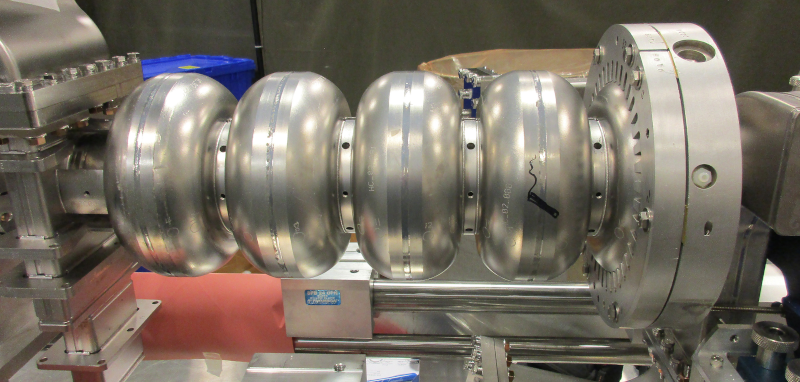
One of the issues with nuclear power plants is that they produce long-lived radioactive waste. Storing spent nuclear fuel is a real problem. However, researchers at the Department of Energy’s Thomas Jefferson National Accelerator Facility have made strides not only to produce more electricity from spent fuel but also to break it down into shorter-lived nuclear waste. [Aman Tripathi] shares the details about NEWTON, a program to fire high-energy protons at a target to produce a flood of neutrons that can interact with nuclear waste. You can read the original press release, too.
Short-lived, of course, is a relative term. Unprocessed spent fuel may be dangerous for about 100,000 years. After the proposed processing, the danger period is down to “only” 300 years. On the plus side, the process generates a lot of heat, which you can convert to electricity in the usual way.
While 300 years is a long time, it isn’t difficult to imagine storing waste for that period of time. So why isn’t this a no-brainer? The process is not efficient. You need cryogenic cooling for superconducting, although there is work to make higher-temperature alternatives.
The other hurdle is power usage. You probably have a microwave oven with a magnetron. The magnetron in this project needs 10 megawatts of power. Researchers hope to process all of the US nuclear waste within the next 30 years.
If you haven’t heard of Jefferson Labs, don’t feel bad. But their YouTube channel is full of fun physics demos that would work well in a science class or with any group of kids. For example, check out “Can it Roll” below.
If you think locking up waste for 100,000 years is easy, keep in mind the oldest Egyptian pyramid is about 5,000 years old. Another alternative is to find a way to use the waste, but that can be challenging as well.












I find it a little disturbing that someone drew what looks like a Looney Tunes stick of dynamite with a sharpie on the side of that machine…
It looks an awful lot like an Illudium Q-36 Explosive Space Modulator
cant be, it doesn’t say acme on it
And thank you, Greenpeace, for conflating radioactive half-life with radiation danger. Put a mole (Approx 6.022*10^27 molecules) of Pu-238 (Half life of 87.7 years) in your left hand and a mole of Pu-244 (Half-life of 8.13×10^7 years) in your right. Excluding criticality results, which one will kill you faster? If you believe Greenpeace’s rhetoric, the Pu-244. If you understand physics and know that half-life is a -decay- rate, the Pu-238.
just what i thought. a half life means its dimmed to 50%. its still lethal after that, only less so.
An half life of 10 millions year is stable enough for our point of view. You are very unlikely to see a decay event from it in your whole life (how course, depends on the number of atoms you’re holding to). Yet, it doesn’t make Pu less toxic. It has the bad tendency of being concentrated in your liver, is carcinogenic, mutagenic and teratogenic. It’s the same kind of material you don’t want in or close to your body (like mercury, or cadmium). If it can be broken up to smaller actinides, which are less chemically active, it can still be a huge saver for life, even if not speaking of radioactivity.
slow rate of decay is safer than a fast rate of decay. its the difference between lighting a match and lighting a blow torch. both can burn you, but one does a much better job.
besides most of what we call high level nuclear waste could be burned in a breeder reactor to make electricity and other useful isotopes. 10k year storage doesnt make sense because after only a few hundred years you end up with something you can put back into a more run of the mill reactor.
also the problem with waste storage is not the storage part its the logistics, nobody wants spent fuel shipped through their town. turns out the best place to store spent fuel is near a nuclear power plant.
Is it though?
Reactors are usually built near bodies of water to supply cooling.
It would be nice to keep stored waste as far from wetlands as possible.
Using it until there is nothing usable left however.. that would be much better.
“After a few hundred years…”
We haven’t figured out record keeping on that timescale.
That’s the problem.
How many buildings do you think modern governments have lost in the last 50 years?
I don’t mean destroyed. I mean “hold on, we own that building? For how long? What’s even in it?”
We lose classified records.
We lose track of people being paid.
Assuming we have perfect records of anything as long-term dangerous as reactor waste is insane.
Heck, assuming we will even have the same countries 500 years from now is pure fantasy.
Do you think a peaceful and complete transfer of records is the top priority during a regime change, civil war, annexation, balkanization, or whatever other political change happens?
No way.
We ARE going to lose track of some nuclear waste that has already been made sometime in the next 500+ years. Hopefully it only kills a small town and doesn’t poison the water table to a megacity.
Just because it doesn’t make a Geiger counter explode in 500 years doesn’t mean it’s cool to build a reservoir on it.
It is utterly crazy that “*shrug. Future generations will figure it out.” Is our go-to answer to big problems nowadays.
Considering that Pu is an Alpha emitter, neither isotope puts you into any great danger.
Wrap them in a paper bag and you are 100% safe.
The daughter isotopes of most transuranic wastes are NOT alpha emitters and are not effectively shielded with anything short of lead and thick concrete.
Well, that mole of Pu-238 is about the size of a ping pong ball, and kicking off 135 watts of heat. Maybe not quite enough to ignite that paper bag, but enough to cook your hand after not too long.
Greenpeace have a long and noble history of unscientific hysteria and generally being better at seeking publicity than doing anything meaningful or helpful.
That is very good. Process the material, and cut the time to 300 years.
Before that time has passed, new methods will appear that can finish the processing and turn the material not dangerous.
But if nothing is ever started, nothing will ever be finished.
But is you solve all problems people will have nothing to complain about!
“We are looking for the nuclear wessels.”
Or use a breeder reactor to run on the same “waste” fuel and render it down to something with the same half life (a few centuries).
A significantly easier source of fast neutrons.
Yeah. The IFR would have been able to power the US for a century using only the LWR waste stockpiles we had in the 1990s. The end waste after the IFR cycle was complete would have been “hot” for only 300 years.
Yes, it would have been “extremely hot”, but there would have been far less of it per TWh of electricity generated and it’s a lot easier to manage something for 300 years than 10k.
If only Al had thought to add a link in the story to another HAD story about breeder reactors. What a wasted opportunity.
/s
Its the shorter halflife isotopes that pose the danger. You can handle Plutonium and Uranium in your hands without shielding.
They’re not just radioactive, they’re biotoxic (not related to their radioactivity). You can handle them in your hands, but, depending on oxide layers and other things, it may be pretty dangerous to do so. Same reason you should avoid huffing mercury oxides, even though those aren’t radioactive/
Last time I tried to buy Plutonium, I just ended up with a crate of used pinball-machine parts!
Maybe don’t buy from somebody looking like a confused, retired math teacher, next time?
Besides, how are things going in Libya these days?
The human experimentation, on poor people with less than 10 years left to live, by the US government in 1945 as part of the Manhattan project was lowered from 5 micrograms of Plutonium to 1 microgram after Animal testing revealed it was far more toxic than initially expected.
So if I were to handle Plutonium-239 (half-life of 24110 years) it would be with gloves in an inert atmosphere. Some shielding of thin sheets of paper would be nice, but hopefully the gloves would be good enough to block the alpha particles.
Uranium-235 (7.04×10^8 years) I would insist on the same measures because it accumulates in bone, liver, kidney, and reproductive tissues. But I would happily skip the thin sheet of paper.
Shielding is not really the issue, toxicity and bioaccumulation on the other hand is a major issue.
I remember visiting the Trojan nuclear plant in Oregon as a teenager. My immediate impression was most of the power output from the plant must be going to all the fancy lighted displays in the elaborate visitor’s center.
Trojan has since been demolished.
A time traveller goes 10,000 years into the future.
“What! You’re still burning coal?” he says after observing a city.
“Yes” replies someone. “In the past, people made all of the nuclear material safe.”
“So we’re on coal right now, but we expect to have fusion plants in another 30 years.”
so. if someone did this, say in 1726, the suff would now be only half radioactive.
Do we have man made structures that survived undisturbed this whole time? not toched by war, earthquakes or fires?
Some of the inner chambers of some of the pyramids went thousands of years without being disturbed.
they were only breached with dynamite. can’t put that cat back in the bag. Although the high power draw is a downer it has an advantage that it can be varied at will to compensate for load conditions, which is a flaw in renewable energy.
that is to say, i assume the process is not catastrophic if the power is disconnected.
Waste is only an issue if you make it one. Government policy could be to pile it in the desert somewhere and put a couple guard towers around it, and nobody would be any worse off. It’s a problem of our own invention.
That is nonsensical. Please study the realities of criticality before spreading this sort of dangerous disinformation.
I don’t care.
Video unrelated. It’s about static electricity attracting empty soda cans.
If we can store insane tons of trash/year surely we can store 1ton of nuclear waste/year, drill a hole in a mountain if you must…
Grab your Segre Charts, everybody!
DARPA also keeps asking for more “radiovoltaics” R&D, so maybe we’ll also get some decent power crystals one day.
If you haven’t heard of it maybe it’s because it was Continuous Electron Beam Accelerator Facility. Apparently TJ now accelerates protons as well, hmmm. That thing pictured is, IIRC, a niobium microwave resonator accelerator. Originally, rather than being accelerated on curves, electrons were accelerated on straights and coasted around curves. Too tight a curve and they shed energy as photons. So why not add a wiggler and make a tunable free electron laser? They did. This is from ancient memory; pardon me if I got something wrong.