

In science fiction, the use of gunpowder-based weapons is generally portrayed as something from a savage past, with technology having long since moved on to more civilized types of destructive weaponry, involving lasers, microwaves, and electromagnetism. Instead of messy detonating powder, energy-weapons are used to near-instantly deposit significant amounts of energy into the target, and railguns enable the delivery of projectiles at many times the speed of sound using nothing but the raw power of electricity and some creative physics.
Of course, the reason that we don’t see sci-fi weapons deployed everywhere has arguably less to do with today’s levels of savagery in geopolitics and more with the fact that physical reality is a very harsh mistress, who strongly frowns upon such flights of fancy.
Similarly, the Lorentz force that underlies railguns is extremely simple and effective, but scaled up to weapons-grade dimensions results in highly destructive forces that demolish the metal rails and other components of the railgun after only a few firings. Will we ever be able to fix these problems, or are railguns and similar sci-fi weapons forever beyond our grasp?
The Lorentz Force
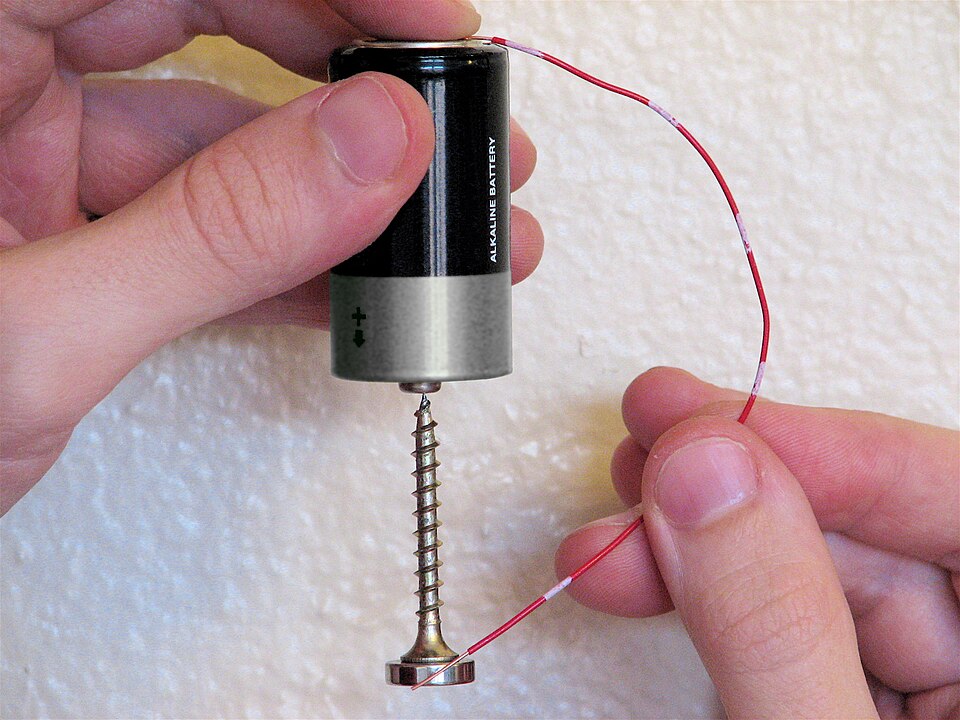
The simplest way to think about a railgun is as a linear motor. At its core it consists of two parallel conductors — the rails — with an armature that slides across these rails as it conducts the power between the two rails. This also makes it the equivalent of a homopolar motor, which was the first type of electric motor to be demonstrated.
In the photo on the right you can see a basic example of such a motor, with the neodymium magnet providing the magnetic field and the singular wire the current that interacts with the magnetic field. Using the right-hand rule that was hammered into our heads during high school physics classes we can thus deduce that we get a net force.
With this hand-held demonstration the screw will rotate when current is passed through the wire. For stand-alone homopolar motors with the magnet on the battery’s negative terminal and a conductor loosely placed on the positive terminal while touching the magnet, the Lorentz force will cause the wire to rotate around the battery.
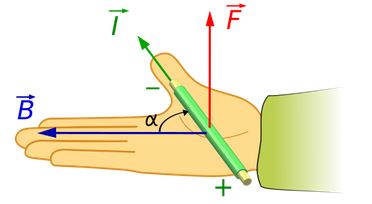
We can visualize this interaction between the current-carrying wire (I), the magnetic field (B) and resulting force vector (F) in such a homopolar motor fairly easy, but how does this work with a railgun?
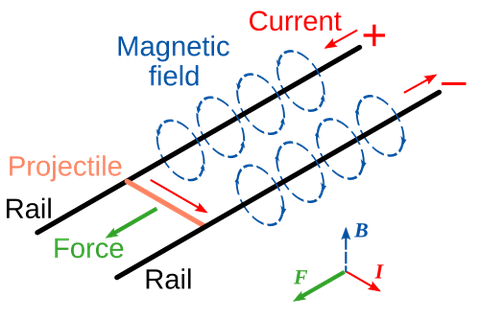
Rather than a permanent magnet or a complex electromagnet on each rail using many windings, a single current loop is used in a railgun. This means that massive amounts of currents are pumped through one rail, which induces a sufficient strong magnetic field.
The projectile, playing the role of the armature, is located inside the generated magnetic field B, with the current I coursing through the armature, resulting in a net force F that will push it along the rails at a velocity that’s proportional to the strength of B.
Crudely put, the effective speed of a project launched by a railgun is thus determined by the applied current, so unlike it’s close cousin, the coilgun, there is no tricky timing requirement in energizing coils in a sequence.
This also provides some hints as to what major obstacles with railguns are, starting with the immense currents that have to be immediately available for a railgun shot of any significant size. If this is somehow engineered around using massive capacitor banks, then you run into the much more significant issues that have so far prevented railguns from being widely deployed.
Most of this comes down to wear and tear, because going fast comes with certain tradeoffs.
Making Big Stuff Go Fast
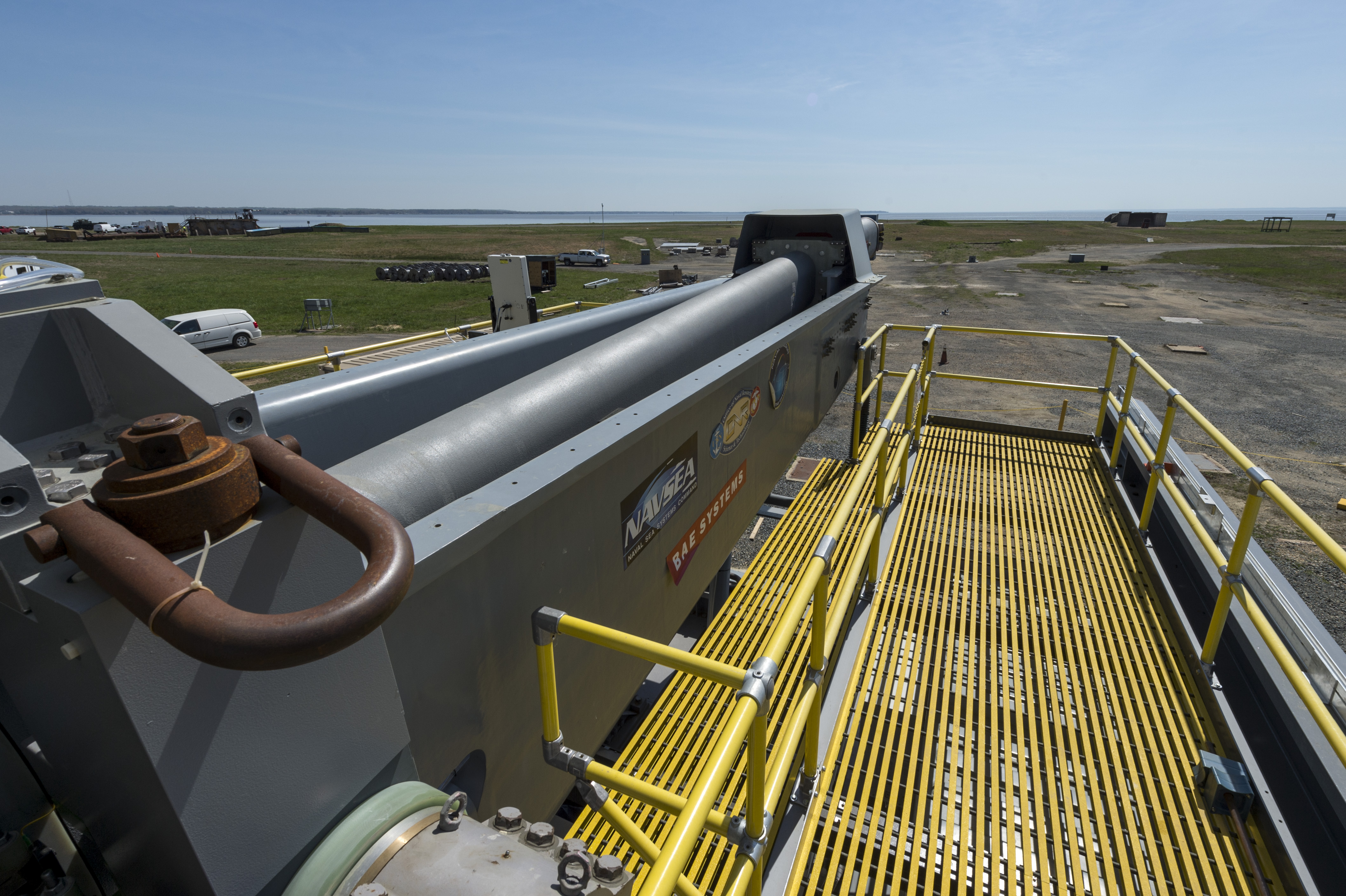
Theoretically you can just scale everything up: creating railguns with larger rails and larger armatures that can launch larger projectiles with increasingly faster speeds. This has been the impetus behind various railgun projects across the world, with notable examples being the railguns developed and tested by the US and Japan.
Railguns were invented all the way back in 1917 by French inventor André Louis Octave Fauchon-Villeplée, when the issue of the massive electricity consumption kept further research on a fairly low level. Even the tantalizing prospect of a weapon system capable of firing at velocities of more than 2,000 m/s couldn’t get into deployment during the time that Nazi Germany was working on their own version.
Ultimately it would take until the 1980s for railgun designs to become practical enough to start testing them for potential deployment at some point in the future, seeing a surge of R&D investment for it and other new weapon systems that could provide an edge during the Cold War and beyond.
Yet despite decades of research by the US military, no viable design has so far appeared, and research has wound down over the past years. Although both China and India are testing their own railgun designs, there are no signs at this point that they haven’t run into the same issues that caused the US to mostly cease research on this topic.
Only Japan’s railgun research seems to so far offer a viable design for deployment, but their focus is purely defensive, for countering ballistic and hypersonic missiles in a close-in role. The size is also limited to the current 40 mm prototype by Japan’s Ministry of Defense ATLA agency.
Physical Reality
In a perfect world with zero friction and spherical cows, railguns would be very simple and straightforward, but as we live in messy reality we have to deal with the implications of sending immense amounts of currents through a railgun barrel. A good primer here can be found in a June 1983 report (archived) by O. Fitch and M. F. Rose at the Dahlgren Naval Surface Weapons Center in Virginia.
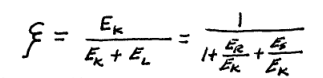
Much of this comes down to efficiency as you scale up a basic railgun design. The two main factors are basic ohmic resistance (ER) and system inductance (ES). These two factors limit the kinetic energy (EK) and set the losses (EL) of the system, with the losses being in the form of thermal and other energies.
Reducing these losses is one of the primary points of research, and factors like the rail design and alloys as well as the switching of the current pulses play a role in affecting final efficiency, and with it durability of the railgun’s ‘barrel’.
Naturally, that was all the way back in 1983, and since then a few decades of technical and material science progress having occurred. Or so one might be led to believe, if it wasn’t for current research papers striking a rather similar tone. For example Hong-bin Xie et al. in a 2021 paper as published in Defence Technology.
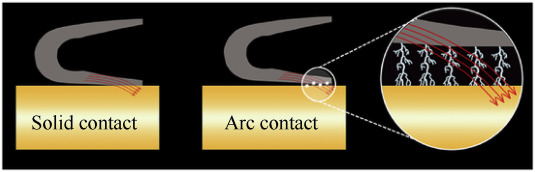
This review article covers the common issues of rail gouging, grooving, arc ablation, and other problems, as well as the current rail materials in use today and their performance characteristics.
Many of these issues are somewhat related, as the moving armature rarely maintains a perfect contact with the rails. This results in arcing, localized heating, ablation, and grooving due to thermal softening. All of these effects result in a rapidly degrading rail surface, and higher currents result in more rapid degradation and even worse contact with subsequent shots.
Various rail metal alloys have been or are being tested, including Cu-Cr, Cu-Cr-Zr and Cu/Al2O3, replacing the pure copper rails of the past. None of these alloys can resist the pitting and other wear effects from repeated railgun firings, however. This has pivoted research towards various coatings that could limit wear instead, such as molybdenum (Mo) or tungsten (W).
Fields of research involve electroplating, cold spraying, supersonic plasma spraying and laser cladding, using a wide variety of coatings. The authors note however that these rail coatings have only begun to be investigated, with success anything but assured.
Defensive Benefits

Quite recently railguns have surged to the forefront in the news cycle courtesy of certain ill-informed fantasies that also involve destroyers which identify as battleships. In these feverish battleship dreams, railguns would act as a kind of super-charged version of the 16″ main guns of the Iowa-class, the last active battleships in history.
Instead of 16″ shells that ponderously arc towards their decidedly doomed target, these railguns would instead send a projectile at a zippy 2-3 km/s towards a target. As tempting as this seems, the big issue is as we have seen of repeatability. The Iowas originally had a barrel life of a few hundred shots before their liner had to be replaced, but this got bumped up to basically ‘infinite’ shots after some changes to their chemical propellant.
A single Mark 7 16″ naval gun fires twice per minute, and this is multiplied by nine if all three turrets are used. The range of projectiles launched included high-explosive, armor-penetrating, and even nuclear shell options, with a range of 39 km (21 nmi) at a leisurely ~800 m/s. To compete with this, a naval railgun would need to be able to keep up a similar firing rate, feature a similar barrel or at least acceptable barrel life, and have a longer range for a similar payload effect.
At this point railguns score pretty poorly on all these counts. Although range of a projectile falls between that of a missile and a Mark 7 naval gun’s projectile, barrel life is still poor, power usage remains very high and the available projectiles at this point in time are basically just relying on their kinetic energy to cause harm, limiting their functionality.
Taking all of this into account, it would seem that the Japanese approach using railguns as a very responsive, close-in weapon is extremely sensible. By keeping the design as small-caliber as possible, reducing rail current, and not caring about range as long as you can hit that hypersonic anti-ship missile, they seem to be keeping rail erosion to a minimum.
Since the average missile tends to perform rather poorly after a 40 mm hole appears through it, courtesy of it briefly sharing the same physical space with a tungsten projectile, this might just be the defensive weapon niche that rail guns can fill.












HaD could also cover building guns and explosives from the anarchist cookbook.
Yeah they could, Fail Of The Week is always a popular installment of HAD
Just a quick reminder.
‘The Anarchist’s Cookbook’ is often deliberately wrong.
If you follow it’s instructions you will die.
And we will laugh at your dumb hippie ass.
Much better bet is downloading WW2 era Sten gun instructions or one of the CIA’s unconventional warfare books.
Frankly, if you haven’t already built guns (at least potato) and made explosives (at least black powder), you are at the wrong site.
Come back after you finish middle school.
I was about to say, the very first things I did with a drill press would have landed me in prison for aeons but I didn’t know that at the time because I was like 8
You know, nobody is forcing you to read this article, let alone comment on it.
Might be better to not discuss making weapons. Seems less like hacking and more like well you know hurting people. I think, and could be wrong, most hackers aren’t interested in weapons. It might also draw in the wrong crowd of people. Psychopaths and their interest in dismantling people is a serious illness that has cost us all so dearly.
Magnetic accelerators and even cannons have a lot of applications besides just warfare. Materials testing, UAV launchers, manufacturing applications etc.
Even if warfare was the primary application of something that doesn’t inherently mean it should be censored or undocumented.
As for the “wrong crowd” that’s so poorly defined as to be pointless imho. And for psychopaths it’s totally irrelevant as they are the one’s who are often in political power anyway.
Good point. If we don’t talk about it nobody will do it. Just like racism and genocide.
But, this is a technology forum. If the technology concerns projectiles then we should discuss it. Like any technology it can be used for good and bad.
Literally anything is a weapon in the hands of the determined.
This article discusses technology WELL outside the budget, experience, usability, or practicality of anyone outside the G7.
It’s not talking about IEDs,.
It’s talking about scifi weapons, and why they don’t exist IRL.
This isn’t even really a weapons article.
Railguns and coilguns are interesting engineering problems and there are many hackers that are interested in such problems.
Just because you see something about projectile acceleration and immediately start fantasizing about “dismantling people” doesn’t mean everyone else does.
Honestly I would love that. You don’t have to be interested in weapons, but in my experience many if no most men are.
It really isn’t exclusive to men, most people with an interest in engineering also like things that blow up or go fast, these do both.
There is a commercially available man-luggable railgun with performance around that of a 22lr (at full battery voltage).
It’s cool that we are at a point where railguns can actually do something, but the sci-fi fantasy is not here.
Savage 64 F .22 LR Rimfire Semiautomatic Rifle $150
.22 LR ammunition typically travels at muzzle velocities between 1,000 and 1,650 feet per second
Coil Accellerator Next Gen $1500 220 – 250 fps
Bkackrose firearms CA09 $2500 80 – 145 fps
Arcflash Labs GR-1 Anvil $4000 120-240 fps
Nowhere near .22lr performance despite the braggadocios claims of their makers.
Slingshots typically achieve speeds between 150 and over 300 feet per second and cost $10-20. Much better deal.
Depends on the size of the feet. A Canadian Big Foot’s feet is worth at least 2 to 3 US’s President feet.
Oh my God you’re obsessed you lost the hockey game get over it
To further your point:
Lithium battery 1 kJ/g
Gunpowder 3 kJ/g.
Lithium battery: fire, recharge, fire. Gunpowder: fire, flee.
Bullets usually come with a suitable portion of gunpowder included.
Takes minutes to recharge the capacitors as well.
Lithium battery: overcharge, throw, dive into cover.
A cheese sandwich is somewhere between 10-14kJ/g, so you’re better off throwing the projectile, energy wise.
To compare we would need the kinetic energy of the projectile, not only the speed.
E = v^2*(m/2)
I’m surprised. I understood that railguns vaporized the armature and the resulting plasma was what interacted with the magnetic field to propel the projectile. Now I’m wondering if that would work.
That is/was one mechanism: it allows a thin metal plate on the back of a (e.g.) plastic projectile to get it to much higher velocities. No more energy, just higher velocity on less mass.
I’ve always wondered why bother using purely magnetic forces for this. Put a few dozen kilojoules into a small slug of water and you’ll have a pretty effective and very cheap propellant to push a projectile down a barrel.
The potential gas velocity is even higher than even normal chemical propellants, because the molecular weight is lower, and there’s no particular limit how much energy you can put into it.
Ah, an ETC gun. A man of taste.
Username checks out.
I’ve seen some interesting stuff about building what you’re describing, hybrid systems using thermal expansion of water instead of smokeless powder. It does produce a lot better performance, but in the end people using weapons don’t want them to have so many fiddly inputs and points of failure, and guns already work outrageously well. Also the steam (and excess velocity) will erode the barrel.
I still want to have some kind of gonzo version of a light gas gun, where you have a comically huge cartridge with a teeny-tiny bullet (think eargesplitten loudenboomer) but most of the case is filled with hydrogen and there’s a plunger inside that compresses the hydrogen ahead of smokeless powder or some other expanding force. I want to try out a gun that has such outrageous muzzle velocity that the ballistics are totally flat and the rifling gets completely polished off after a couple shots. Would be fun.
The molecular weight of helium or hydrogen is lower still, and to get (very light, like pingpong balls) projectiles quite easily up to impressive speeds, you can build a vacuum cannon in your back yard.
And great fun, except for having to build a new one all the time. At least that’s why I moved on to other things.
The article glosses over it, but Japan basically bought the shelved US railgun plans and have made very substantial improvements in reliability and wear.
Now they have to figure it out how to build that floating space battleship (Yamato) around it.
They’ve already mounted it on a ship named after an anime character and shot holes in a ship with it.
I read that the US navy is planning to use a railgun on new ships but that they are relying on Japan to develop and deliver it.
I’m not so sure that will pan out.
Japan built it, mounted it to a ship, and proved it works by shooting holes in other vessels. Now comes the much harder part, negotiating with the USA.
We made one in high school. It used a series of progressive electromagnets wherein the projectile itself was the conductor that completed the circuit for each set of coils. After dealing with some geometry issues, we settled on a ring-shaped projectile riding on in low-friction inverted “barrel” cylinder. We did manage to accidentally put a hole in a cinderblock wall, but for all of that, it was horribly inefficient. Very “sparky”. I forget the figures, but the working energy only translated to about 10% going to actual kinetic energy instilled into the projectile.
The “trigger” was just a mechanical release that let the projectile go on its way through the pre-energized coil array with the initial motion provided by closed-circuit coils.
We found that the power supply had to have as little DC ripple as possible. Lots of 00 wires, lots of big caps, some massive rectifier diodes out of an old Lambda supply. Took about half an hour to energize for a shot.
Oh – and in this application, petroleum-based lubrication: bad idea. Keep a fire extinguisher handy.
That’s a coil gun, not a railgun fyi. Railguns are much harder to build.
Newbies trying coilguns take a while to realize that, if you use a magnetic or magnetizable slug, that once your magnetic field is high enough, you hit a fundamental wall: You saturate the magnetics and can’t impart any more force on the projectile. All your extra energy just goes into heating the coils.
Wait, could you combine them, to save power andcwear on the rail part?
Was wondering if running duel spiraling embedded pos and neg tracks down the barrel and then staggered points on the projectile have been tried. I imagined a projectile sitting ready until you pull a lever that moves it forward while rotating it all via mechanical motion into the energized tracks the initial rotation is just to introduce it as it enters the energized area the projectile would theoretically be suddenly accelerated maglev style and expelled spinning like a conventional bullet. Ive ondered if anything similar was tried, I would expect so but have never seen anything on it that I can remember.
A popular style to look at, but not fun to build at all, not sure if I ever got it to functional level before burning out on it burning up.
Bro… Get out of here with that LLM slop. It we want to know what LLM thinks about it we will ask it.
One of the Strategic Defensive Initiative projects was to use a railgun to shoot down incoming warheads at close range. IIRC, the goal was to accelerate a 5g copper slug to mach 30. There was a building with special electromagnetic shielding built at Ft. Monmouth, NJ for this work. Last time I looked the building was sitting derelict.
Yeah, because it was cancelled. The Japanese bought the plans, refined it, tested at sea and have some deployed now.
I say we bring back Teleforce.
Macron guns for the win!
I wonder if instead of trying to prevent damage to the rails, you could instead look at ways to either refinish the rails between shots, or somehow make part of the rails expendable (in the same way that bullet shells are)?
To have the performance of a .22lr a coil gun would need to be throwing a projectile of approximately the same weight as a .22lr slug at approximately the same speed as they are fired from a gun.
So speed alone is enough to NOPE the statement made.
Tossing a projectile that weighs 100X as much as a .22lr slug at 1/10 the speed is not an equivelent performamce DESPITE having a comparable kinetic energy. Ill take my chances with a 1,8X weighted 99mph fastball over a bullet anyday.
HAD Comment glitch strikes again
This was made waaaaay up there in response to another comment about kinetic energy. Please delete while I give it ANOTHER shot.
To have the performance of a .22lr a coil gun would need to be throwing a projectile of approximately the same weight as a .22lr slug at approximately the same speed as they are fired from a gun.
So speed alone is enough to NOPE the statement made.
Tossing a projectile that weighs 100X as much as a .22lr slug at 1/10 the speed is not an equivelent performamce DESPITE having a comparable kinetic energy. Ill take my chances with a 1,8X weighted 99mph fastball over a bullet anyday.
yeah youd really think HAD would have better coding than this.
I give up. This is in response to Megol “To compare we would need the kinetic energy of the projectile, not only the speed.”