
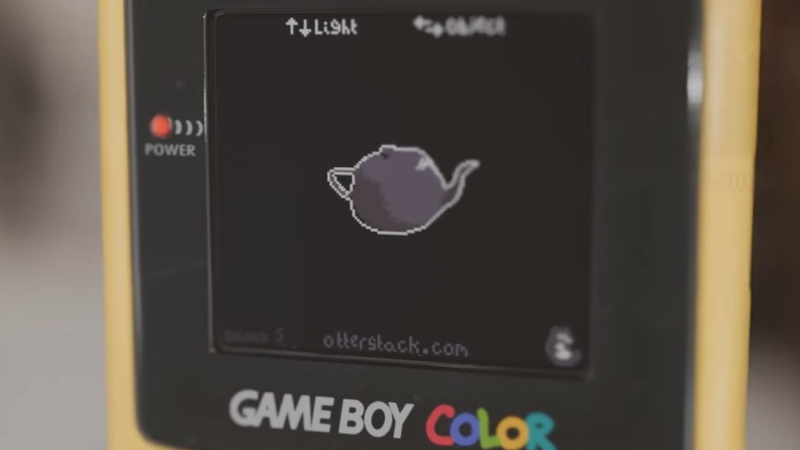
[Danny Spencer] has a brilliant graphical demo that, like all great demos, flexes a deep understanding of the underlying system: a real-time 3D shader on the Game Boy Color.
 If you’re not familiar with shaders, they were originally mathematical lighting models (hence the name) and are an integral part of the modern 3D graphics pipeline. One no longer draws pixels directly to a screen to represent objects. Instead, 3D object data is sent to the Graphics Processing Unit (GPU) which handles the drawing. Shaders are what control things like an object’s lighting, textures, and more.
Implementing even a basic real-time shader in software on a Game Boy Color is pretty wild. Not only is it a pixels-and-sprites (and not 3D graphics) kind of system, but the Game Boy’s SM83 CPU doesn’t even have a multiply instruction, nor does it support floats. As [Danny] puts it: given that the entire mathematical foundation of his shader rests on multiplying non-integer numbers, he had to get creative. That makes his demo a very round peg in an extremely square hole.
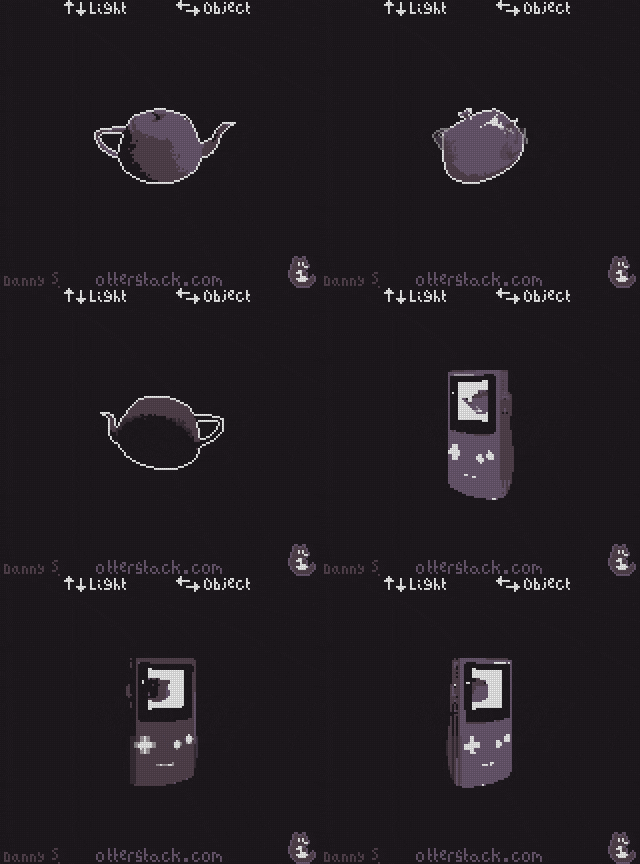
In the case of [Danny]’s demo, the user can manipulate the position of, and lighting around, a classic Utah teapot in real time. He explains the workflow and shows how the process can be applied to other objects. The ROM is available on GitHub and there’s a video, embedded below.
[Danny] is no stranger to performing feats of technical prowess that are as creative as they are playful, like implementing a working adding machine in a DOOM level.












wow, nice !
any chance we port Ignacio Quilez’s ShaderToy and/or SDFs to the game boy color ?
I think it is important to note that the 3D scene is pre-rendered. It’s only the light shading that is done realtime on top of that, still impressive!
Thanks for pointing that out. Realtime rendering would be more impressive, but this could still add a lot of interesting detail to game, if used correctly. Definitely a technique I want to study.
This is also quite reminiscent of a really old demoscene technique where a complex image is rendered into a couple of lighting offset tables. A whole bunch of old demos did this to do faked realtime lighting and reflection and such. Still really cool to see it done on a gameboy though.
This would have been a better article if it mentioned Python. But seriously, pretty cool!
The author is to be commended for explaining what this thing he’s going to be talking about is.