
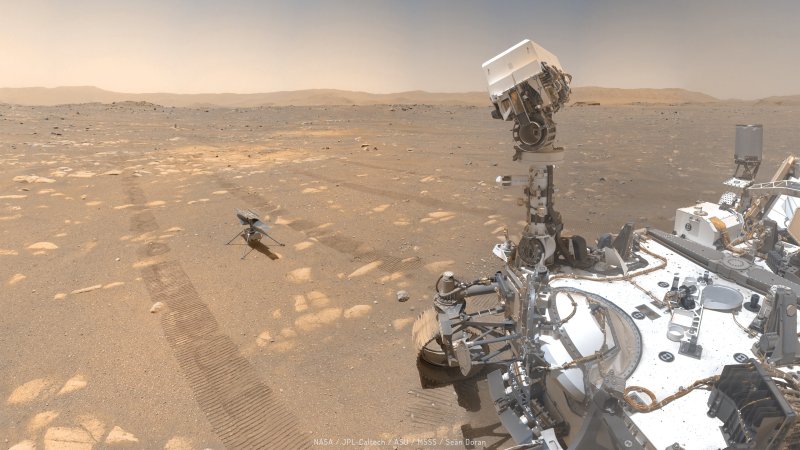
Unlike on Earth there aren’t dozens of satellites whizzing around Mars to provide satellite navigation functionality. Recently NASA’s JPL engineers tried something with the Perseverance Mars rover that can give such Marsbound vehicles the equivalent of launching GPS satellites into Mars orbit, by introducing Mars Global Localization.
Although its remote operators back on Earth have the means to tell the rover where it is, it’d be incredibly helpful if it could determine this autonomously so that the rover doesn’t have to constantly stop and ask its human operators for directions. To this end the processor which was originally used to communicate with its Ingenuity helicopter companion was repurposed, reprogrammed to run an algorithm that compares panoramic images from the rover’s navigation cameras with its onboard orbital terrain maps.
Much like terrain-based navigation as used in cruise missiles back on Earth, this can provide excellent results depending on how accurate your terrain maps are. This terrain mapping process used to be done back on Earth, but for the past years engineers have worked to give the rover its own means to perform this task.
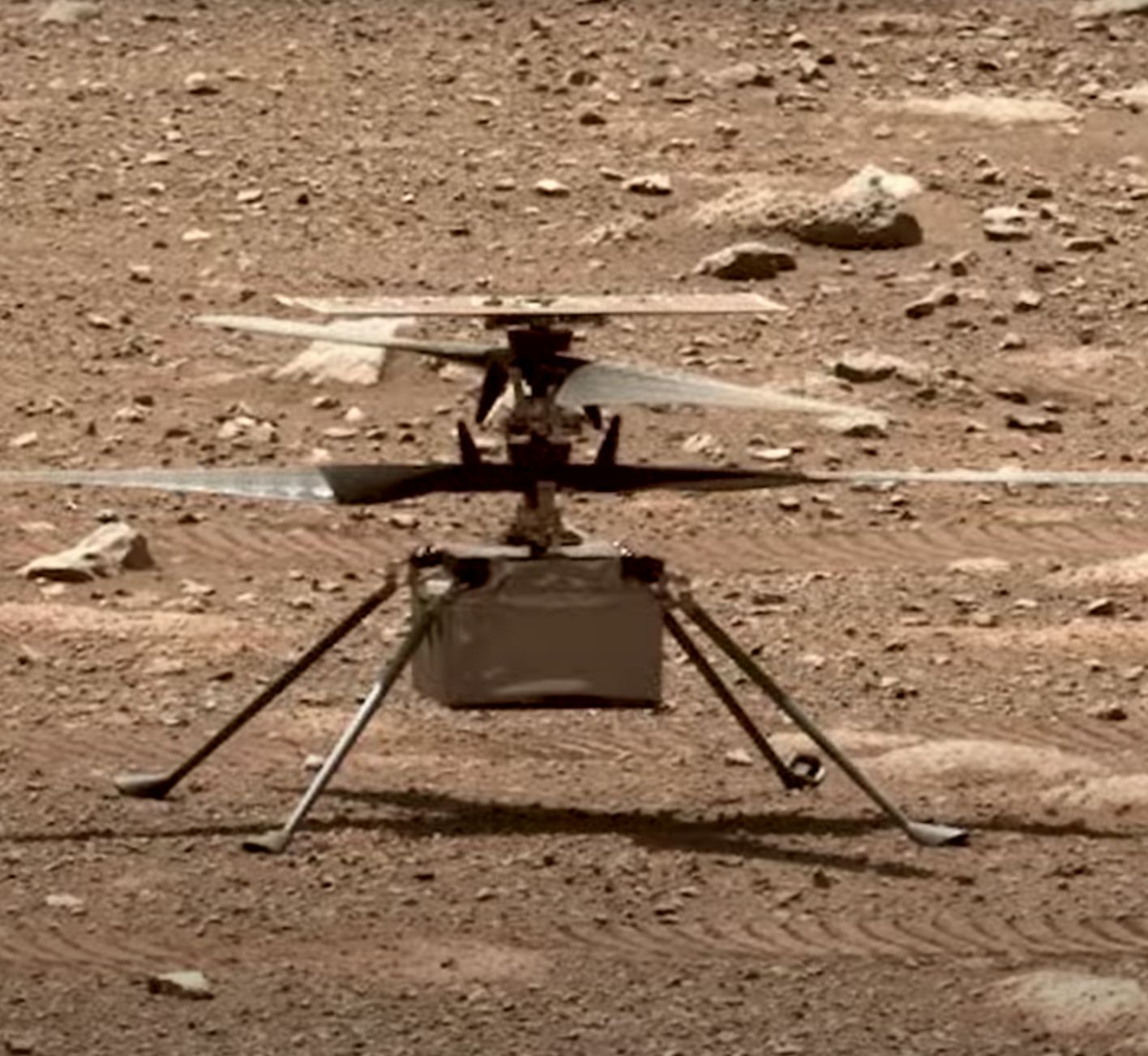
Because the off-the-shelf processor in the rover’s Helicopter Base Station (HBS) is much faster than the custom, radiation-hardened processors that control the rover, the decision was made to try the algorithm on the HBS, especially since Ingenuity was left behind after it fatally damaged its propeller during a rough landing. This left the HBS unused and free to be repurposed.
Repurposing such OTS hardware also provided a good way to check for radiation damage to such standard hardware that was never certified for high radiation environments. To validate reliability the algorithm was run multiple times on the HBS, with the results compared by the main computer. This found some discrepancies, attributed to damage to about 25 bits out of 1 GB of RAM.
By isolating these damaged bits, the algorithm could run reliably, while giving another nod to the genius of the Ingenuity program that enabled such new features with what was at the time an unproven and relatively low-budget side-project tacked onto the Perseverance rover.
Thanks to [Nevyn] for the tip.











Always amazing!
It’s another planet!
This sort of terrain recognition was originally developed for missiles.
It’s good to see it having a role in exploration and science.
Blah blah blah, same bullsh*t excuse. There is always ZERO money that is spent for improving lives of poor people. If that program wasn’t run, the money will have been sucked by “investors” (understand, friend of friend of governments allies). Poor people will still be poor, and still have miserable lives. In fact, meanwhile, they have become poorer and their lives harder. If you are rich (even if it’s not your money), you are NEVER going to waste it in an empty hole.
Money isn’t real.
It’s an IOU, but since people started making them from thin air at the push of a button, the value has lost all meaning. Now it’s just a way to stop the poor consuming too many resources.
At the end of the day, the exploration has people pushing it for a lot of reasons, some for discovery for it’s own sake, others for resource gain or to push the development of new technology.
The curiosity of intellectual minds seems like a better driver for innovation than relying on hardship or conflict.
A quick check on the the web suggests the Mars rovers have so far cost us around a billion dollars that, to your point, could be spent on other things.
On the other hand, we’re looking at roughly NINE billion in welfare fraud–in Minnesota alone. That’s almost an order of magnitude greater expenditure, with even less benefit to the poor, than Mars exploration. Now multiply that waste figure times the number of Minnesota-like welfare programs in operation around the country. It would appear we
spend more on fraud than the GDP of small countries, elsewhere.
If the poor aren’t getting the help they need, it’s not because we don’t spend enough on their behalf… and it certainly has nothing to do with some robots on Mars.
An occasional space mission to better understand our cosmic neighborhood is not a big ask.
Actually, money from the “welfare fraud” comes back into the local economy because people buy cars, phones, even food and homes. Money dumped on Mars in the form of Preserverance Rover is literally money sent to the gas chamber. It disappeared and will not come back because it’s on another planet.
To @Rick who said:
“…Actually, money from the “welfare fraud” comes back into the local economy…”
An odd line of reasoning. “Fraud,” by definition, does not go to the intended recipient, so why would you defend that? Some of that stolen money in Minnesota was literally funneled to Somalia… and in some cases the Taliban. Sorry. NONE of that went into the “local economy.”
“… Money dumped on Mars in the form of Preserverance Rover is literally money sent to the gas chamber. ….”
Bizarre metaphor…. But no money was “dumped on Mars.” The Mars hardware was built by people with jobs here on Earth. It bought groceries, made house/car payments, and paid for summer camp and braces for their kids. You could argue it a kind of welfare program in its own right, I suppose, but at least these people work for their paycheck and humanity as a whole derives demonstrable benefit.
The budget of NASA is almost insignificantly small compared to literally every other federal program in the US Gov’t. (0.35% of the total federal spending in 2026)
The amount of return on that investment has been discussed and studied before and it is somewhat absurd how there is still so much belief that the spending is wasted.
https://www.space.com/nasa-economic-impact-us-2023-report
Were I American, rather than complaining about the work that scientists do with the metaphorical pocket change of the country… I would be more inclined to scrutinize why pocket change is able to launch unfathomably complicated machines into space and land on another planet, while the other trillions are unable to provide jobs, housing, education or healthcare to the wider population.
Money spent on NASA eggheads playing with a remote controy toy car on Mars could be used to fund anti-Tr*mp NGOs who would lead a fight that would not allow the b*stard to be elected in the first place. We wouldn’t have war in the Middle Eastern again. And millions of refugees in 2030s.
May I suggest a Snickers bar?
sigh it’s not a very unique name, there’s even someone with the same full name in my city, but i’m sad to say the day has come when my name here is taken by someone else
You have to be joking
Why not do that with the money spent on AI instead and get a 2000x larger payout?
NASA has a really cool website that highlights space technologies that have found new applications here on Earth: https://spinoff.nasa.gov/
Thanks ! I’ll check that spinoff website out .
I miss the old, printed, “Nasa Tech Briefs” magazine.
Inside were fantastic ideas, inventions, and research to read about.
I used to love reading it… though over time, I remember it getting thinner and thinner… and filled with more non-tech tripe. I eventually stopped receiving it because it wasn’t worth the effort to fill out the free subscription card.
Just looked and see that it’s still around, albeit online. I might have to start thumbing through it again.
https://www.techbriefs.com/