

If you’ve been paying any attention to the renewable energy space, you’ll know that generation isn’t really the problem anymore. Solar panels are cheap, and wind turbines are everywhere. The problem is matching generation with demand—sometimes there’s too much wind and sun, and sometimes there’s not enough. Ideally, you could store that energy somewhere, and deploy it when you need it.
The answer everyone keeps reaching for is lithium-ion batteries, and they work just fine. However, there’s a competing technology that’s been quietly scaling up in the background—the vanadium flow battery. It has some unique advantages that could see it rise to prominence in the world of large-scale grid storage.
The Juice That Stores Juice
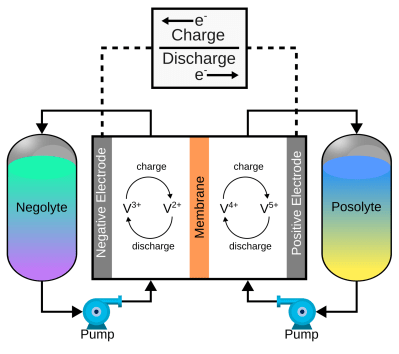
Flow batteries are beautiful in their simplicity, storing charge in huge tanks full of liquid electrolyte rather than in gel-like materials sandwiched between solid electrodes as per a regular battery. Specifically, two big tanks of vanadium ions, typically dissolved in sulfuric acid. By pumping the electrolyte through a cell stack where the electrochemical reaction happens, you generate electricity. Getting more power is as simple as adding more cell stacks, while increasing the battery’s capacity is as simple as getting bigger tanks full of more electrolyte. The two variables are almost entirely decoupled, which is an extremely elegant property for a grid-scale storage system. It makes right-sizing the system a cinch, it’s simply a matter of scale. These batteries also have the property of surviving tens of thousands of charge cycles without damage, and lifespans measured in decades.
The chemistry itself works out quite tidily. Both the positive and negative electrolyte use vanadium, just in different oxidation states. The positive side hosts VO2+ and VO2+ ions, while the negative side works with V²⁺ and V³⁺ ions. These solutions are pumped through a cell, either side of a permeable membrane that allows proton exchange. When the battery is being discharged, electrons leave the anode electrolyte and are transferred through the external load to the cathode electrolyte; this is balanced by the transfer of protons across the membrane. During charging, the opposite occurs.
A neat side-benefit of this is that because the battery uses the same element on both sides of the membrane, cross-contamination between the two tanks — an inevitable consequence of some ions sneaking through the membrane over thousands of cycles — doesn’t actually kill the battery. The electrolyte merely needs to be rebalanced and normal operation can resume. This single-element trick also means the electrolyte has a very long service life. It doesn’t degrade in the way an electrolyte in a regular battery might. A well-maintained vanadium flow battery can run for ten to twenty years with minimal capacity loss, and at end of life, that vanadium electrolyte still has value. It can be sold, recycled, or reprocessed as needed. Meanwhile, the electrodes in the cell stack and the pumps and machinery that moves the electrolyte around can be serviced or replaced as needed. It’s a very different scenario compared to lithium-ion cells, where recycling the raw materials involves great mechanical and chemical complexity.
There is a complexity gain versus traditional batteries, in that moving all the electrolyte around requires mechanical pumps that in turn draw power to operate. These batteries are also not particularly compact, nor efficient in terms of energy-to-volume ratio. However, these problems are offset with the ease of scaling and maintaining them.
Deployment
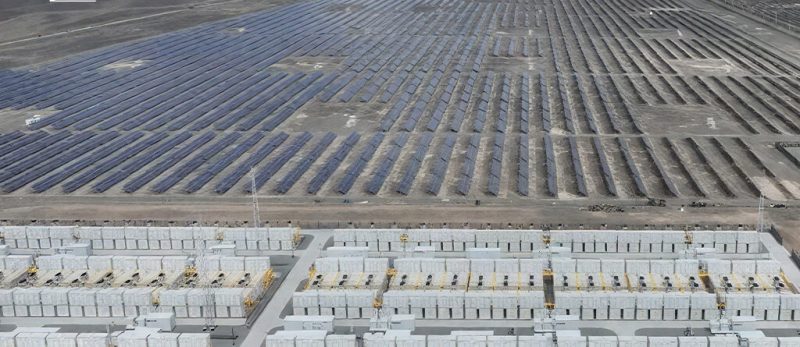
In the real world, vanadium flow batteries are starting to hit the big time. The largest example in the world is a Chinese project, consisting of a 200 MW battery in Jimusaer, with a total capacity of 1000 MWh, built by Rongke Power. The second largest installation, installed in the city of Ushi in 2024, has a capacity of 700 MWh and can discharge 175 MW to the grid, and was constructed by the same firm. These batteries are comparable in power output to the Victorian Big Battery, a lithium ion installation that outputs 300 MW at peak, but far larger in capacity, as the Australian installation tops out at just 450 MWh by comparison. These installs build upon a previous effort to install a 100 MW battery in Dalian with 400 MWh capacity, along with smaller projects in Shenyang and Zongkyang that operate at sub-10MW levels. The batteries are intended to be used to support grid stability in their local grids. They also have grid-forming capabilities, which means that the flow battery can be used to do a black start, helping to bring traditional thermal generation units online in the event of a total grid collapse.
Australia has also been leaping to adopt vanadium flow battery technology, too. The country is well known for having a huge install base of rooftop solar, which has created a difficult-to-control grid at times. The abundance of sunlight and solar generation during the day has lead to huge peaks where power prices at times turn negative, and the goal is to add storage so that this power can be stored for more effective use over longer time periods.
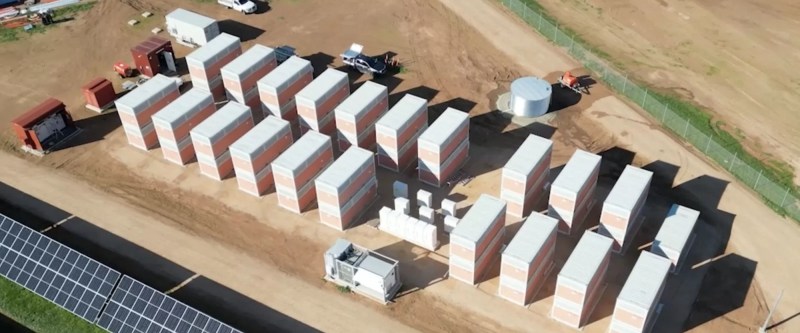
In South Australia, a small project has proven the viability of vanadium flow batteries in local conditions. The Co-Located Vanadium Flow Battery Storage and Solar project in Neuroodla was installed by Yadlamalka Energy, and combined photovoltaic generation and storage into a single site. The project’s goal was to demonstrate the value of vanadium flow batteries for providing both simple energy storage and frequency control services to the grid. It’s a relatively small installation, of just 2MW output and 8MWh capacity, paired with 6MWp of solar panels on site. The build was located adjacent to the Neuroodla substation for easy connection to the grid. The project faced some challenges in terms of power derating during the hottest local conditions, and with some limitations on power deployment and energy trading based on the inverter capabilities at the site. Ultimately, though, the project was able to generate serious revenue even with its limited capacity, thanks in part to energy price volatility in the local market as solar peaks and troughs occurred on a regular basis.
Over in Western Australia, sights are being set much higher. The state government has put out an expression of interest for a 50 MW, 500MWh vanadium flow battery to be installed in Kalgoorlie. The project is backed by $150 million in government funding, and hopes to offer a mighty 10-hour discharge capability to the grid. The project hopes to be up and running by 2029, relying on locally-produced vanadium to fill the tanks.












This is cool!
Any idea of the installation cost per MWh delivered after say 1000 or 10000 cycles, compared to a Lithium battery installation?
My understanding is the cycle count is ‘infinite’ as the nature of these systems lends itself to ongoing maintenance as needed. Though how the costs work out with that I have no real idea, not sure anybody really does as the systems are so rare outside of the lab and the precise flow chemistry used likely matters.
But I’d suspect pretty well as nothing in the ‘wear’ parts should be crazy complex to replace if its designed right and shouldn’t be hugely expensive in the part price either.
Price the key functional membrane by the square meter and see how you go…
Sure not the cheapest possible part, and it seems crazy expensive for something that sounds and even looks rather like it is just a sheet of paper. However it is still dirt cheap for infrastructure of this scale and by comparison to the other methods that tend to be wholesale replacement of the entire system…
Not sure how long they last, would matter a lot. The ceramic membranes are more robust but thermal cycling may be a driver of failure in them too.
Rare? China has upward of 2 GWH’s of Vanadium Flow Batteries installed. One an 800 MWH installed project since 2024
The question is rather, how many cycles will you do in a year and how many years does the device last before the upkeep and maintenance cost equals building another one? You can think of the maintenance cost as equivalent to building the next battery for the next 20 years, since what you’re doing is slowly replacing the parts to keep it “good as new”.
So you have the technical lifespan of the battery as the time it takes to replace it, and you have the energy throughput over that lifespan, and you have the investment cost that went into it, so you calculate throughput over cost, and that’s your answer.
Or, if you keep it running forever, you can simplify by calculating throughput in a year over maintenance cost over a year. The cost will eventually approach that value. Usually it’s something like 3-5% of the investment cost per year. Depending on how quickly you cycle it, it could be something between $30 – $300 per MWh.
Or, if you’re using the tanks for seasonal energy storage, it could be way higher, $30,000 per MWh or something like that – because you’re basically paying the maintenance just to keep the lights on instead of actually utilizing the battery. The throughput will be minimal.
In that application basically no grid scale battery makes any economical sense. It would be far better to use the energy for anything else, no matter how inefficient or trivial.
Doesn’t that depend how much the energy costs? $30,000 per MWh is on par with the cost of natural gas, but you get the benefit of not burning natural gas.
$30,000 per MWh is on par with the cost of natural gas
Yeesh, I knew the was was increasing prices lately, but a factor of 1000 kind of ridiculous. (Unless you’re interpreting that comma as a decimal separator.)
It does, but we’re not counting that in this case.
We’re talking about the unit cost of energy produced, or in this case put through the battery. Natural gas is closer to $30/MWh at the power plant, depending on the plant and source of gas of course. Then you would add transmission cost and profit, etc. to end up at the retail price – but that’s not what we’re looking at here.
Suppose you buy a battery that holds 10 Wh and costs $10, like a cellphone battery, and you use it exactly once and throw it away. That’s a cost of $1/Wh or $1000 per kWh, or $1,000,000 per MWh for the throughput. That is what we’re counting. It’s the cost of storing that much energy, that the user would end up paying on top of the cost to charge it up in the first place.
Now, if you managed to cycle this battery ten thousand times, it would cost you $100/MWh or 10 cents per kWh, which would be a good price, especially if you got the power “for free” as surplus that you otherwise couldn’t use. But, that depends on the fact that you actually make the 10,000 cycles. If you try to use the battery very slowly, like charging it up in the summer and discharging in the winter, it would take you 10,000 years to reach that point, and that’s obviously not going to happen.
You’re being ridiculous. Lowest Levelized Cost of Storage in the industry per Lazard ABB and others who’ve studied researched and inspected the systems
Different use case.
$0 cost per cycle as you get into long durations. Lloyd’s of London provides warranty wrap for unlimited cycling for 20yrs which can be extended. Life of system projected to be 33yrs. It has the highest throughput energy and lowest LCOS – Levelized Cost of Storage – per ABB and Lazard. Yes your have maintenance cost but no augmentation or replacement like lithium. And the electrolyte doesn’t ever degrade and can be sold or reused at end of project life. Upfront cost is higher but mitigated by no restrictions on use and ability to charge and discharge atnthe same time. Impact: more revenue; better IRR
That’s absolute nonsense.
Periodic rebalancing by electrolysis or total mixing of fluids is required, and removing contaminants, which costs you money and energy. It’s not a fire-and-forget system.
I didn’t know anyone had shipped a GWh flow battery! Something like 4,000 tons of vanadium metal in there. Amazing!
They ship the equipment and vanadium salute seperate. The weigh comes from the water which is local. 1 MWH contains 9.9 tons of Vanadium Pentoxide salts nowhere near what you stated
There is easier method of storing energy with liquid: just place two enormous tanks in such a way that one is higher than other. When there is surplus of energy, use pumps to move that liquid from lower tank to higher. When there is need for extra energy, reverse the direction and turn pump into turbine with generator. I think this even has a special name: pumped-storage hydropower plant…
Good if you have the space and geography to support such a thing, and can tolerate the low efficiency, and don’t mind the minor earthquakes as you move many millions of tons of water around on a daily basis.
But seriously, it is a good solution, within the constraints. Good for diurnal storage, filling the gap between flywheels (seconds-minutes), batteries (minutes-hours), pumped storage (hours-days), stored chemicals (days-weeks).
Yes we have pumped Hydro in some parts of Australia too. They pretty much just modified existing Hydro setups for some.
This is even more impressive when you consider that Australia is the flattest continent on the planet.
But yeah, as others have pointed out, geography matters. There is no one silver bullet. We will need pumped hydro, flow batteries, and even hot sand like they have in Finland.
| |~~~~~~~~~~~~~~~~~~~~~
| |° °
| | ° °
| |______________________| |
|Pump | | Generator |
|¯¯¯¯¯’ ‘ ‘ ‘¯¯¯¯¯¯¯¯¯¯|
| |
¯¯¯¯¯¯¯¯¯¯¯¯¯¯¯¯¯¯¯¯¯¯¯¯¯
edit: argh, whitespace trimming. Well, you get the idea: Just put it under water.
| |~~~~~~~~~~~~~~~~~~
| |
| |
| |__________________| |
|Pump || Generator |
|¯¯¯¯¯’ ‘ . ‘ ‘¯¯¯¯¯¯¯¯¯¯|
|______________________|
Laughs in Switzerland
Seriously, we’ve got this kind of storage all over the place. Here’s one example I had the opportunity to tour back in late 2024:
https://www.youtube.com/watch?v=K18-jAIYsUY
100%
chemical batteries are dumb, dangerous and polluting.
🤣😂
heh the word ‘just’ is almost always inappropriate, and in this case it runs smack into a monumental case of mis-under-emphasizing the subsequent word ‘enormous’
Flow batteries are beautiful in their simplicity
Really? For a lousy few hours of storage this seems like a really clumsy and failure-prone arrangement.
Not only do you have the batteries themselves, you also have the complexity, expense and risk of storing and pumping toxic, corrosive and energy-dense fluids around.
On the face of it, you’d think just packing everything into a nice tidy cell would solve a lot of logistics and engineering problems, and mitigate a lot of risk.
Now, if you’re talking days or months of storage, it could make sense: Here, the volume of the relatively cheap storage tanks dominates the size of the smaller but more costly batteries themselves.
I’m sure people have run the numbers and it will all shake out.
And for a few decades of storage you just make the tank bigger and bigger without the cost changing very much at all, and if you need peak power to double just add another membrane unit and a tiny bit of pipe/pump – doesn’t make sense for a short duration of storage with very fixed needs over the battery in a cell format sure. But the scaling factor for longer term backups or seasonal storage is powerful and the best bit of systems like this IMO is you can scale and adjust it for more generation power or more endurance at any time relatively cheaply.
Maybe true if the vanadium “fuel” reactant was cheap, but it isn’t. Much more than a few days worth of storage starts to become the dominant capital cost.
It would be interesting to know if there’s any viable way to store energy for decades. Also interesting to know of a plausible scenario where that would be useful.
Vanadium is not the only option for flow batteries either there is also the much cheaper and safer zinc bromide option and others.
Redflow claims 20 cents per kWh or $200/MWh throughput cost, but on what terms is unclear.
The recommended retail price of a 10 kWh unit is $8,800 so that’s $880,000/MWh. Vanadium reflow is quoted at $350,000/MWh typical, so it doesn’t seem like zinc bromide is actually cheaper – but you have to remember we’re talking about vastly different scales for the units.
To put the point on it, the 20c/kWh price assumes we’re managing 4400 cycles through the battery unit, which may be the endurance limit of the reagents.
Again, in long term seasonal storage applications, it would take you thousands of years to reach that point, and the equipment will break down far sooner, so the quoted price just won’t apply.
If we take the higher estimate of $880,000 per MWh, and assume 100 cycles over 50 years of operation, the cost to the user of the energy would be $8.8/kWh. Burning candles for backup would be cheaper than that.
Ooops… and Redflow went out of business in 2024. Guess it was just hype.
Zinc is fraught with problems and lack the ability for bidirectional power flow
Even fossil fuels don’t offer “decades” of storage.
The world’s aboveground fossil fuel reserves are enough to power the world as we know it for a few months, tops. Coal, even less.
A while ago I read a report that the Netherlands needs only 8 days of electric storage to cover for the darkest, low wind conditions that have happened in the last 50 or so years.
And even less if you factor in prediction and price gouging for industrial users.
Strategic reserves still need to exist to account for major infrastructure breakdowns, wars and other supply shortages.
Also, does that count full energy use, or just electricity demand?
Because people have this habit of using other energy sources to the tune that electricity only accounts for a fraction of primary energy consumption.
Yeah I can’t see why anybody would really want to store decades of energy either really. Unless I suppose you have some sort of industrial process that needs 10 years worth of your available generation delivered in 3 months in which case a flow battery might well be the right move – charge it up with all your spare energy with just one or two membrane unit and then once you have enough in the tanks open the taps on the other membrane to get that power back out quickly. But how you would get into that position… You would need to be really really off-grid – perhaps on a moon/mars base or something as otherwise you’d just run a few more grid connections and perhaps a couple of local flywheels to handle the load and keep the grid stable.
The flow fuels and tanks are pretty cheap for what they are (and other options than vanadium exist) – yes bigger and bigger it is going to dominate the costs in the end for that shear volume, but that cost should end up vastly lower for a comparable energy storage.
We have that. It’s called a “lake”.
yes, there is, it’s called a DAM
you know, with water and turbines.
See the earlier reply: seasonal energy storage with this would result in ridiculous costs per MWh. The cost of building the system and keeping it operational to cycle the battery approximately once or twice per year at these system prices would results in energy prices starting at thousands of dollars per MWh at the output.
You wouldn’t be ONLY cycling it once as the seasons change though – its going to getting lots of discharge events when the grid demands more than the generation at this moment even though its the on net generation season. As on net its still charging but at those moments when demand is too high, which may only be for a few mins as everyone puts the kettle on in the advert break or when you get that unusual for the season weather for a week it will be discharging, but being the season of peak generation it will end the season nearly full having started no doubt fairly empty. It is more like the strategic petrol/gas reserves – you fill em up on average in the good times and drain it in the bad.
The amount that you keep for seasonal storage would be taken out of the pool, unusable for daily cycling, so for that portion your throughput cost is very high – as it’s just standing idle most of the time.
In larger systems where the storage capacity cost dominates over the power capacity, the situation is like having two batteries: one that is used frequently and therefore has a low cost, and another battery that is used infrequently and has a very high cost.
I’d say that is rather arguable – very much a bean counter/statistics to support your argument way of separating the costs of this system in a way to support one argument. Where in reality if you didn’t have this one system with the relatively cheap huge volume of capacity (which really is the point of flow battery storing more energy cheaply but at lower charge/discharge rates than other battery tech), then you’d end up needing lots of vastly more expensive less flexible options or many more separate systems to cover your needs, which will be more expensive too most likely. Though multiple solutions is a valid approach, and has some added benefits even if it costs more – you don’t have all your eggs in the one basket!
Even if you assume you ‘seasonal’ storage/energy needs ends up being “cheap” burning stuff methods be it fossil or synthetic fuels that is a great deal of additional cost to support a whole new separate infrastructure to ‘store’ your electric needs (though it would seem cheaper now in the short term as much of the fossil fuel type stuff likely already exists). However multiple systems that need upkeep tends to end up rather more costly than a single system that can do both the short and long term efficiently enough, which flow battery in theory at least will.
It’s just plain logic.
Suppose, if the daily swings only amount to 10% of the total capacity, then for the point of daily use you could get away with building a battery that is 10 times smaller and cheaper. The other 90% you build for seasonal storage is effectively standing idle except for one or two cycles a year.
Think of it like an electric car. If all you’re doing is 40 miles a day, why pay for a battery that goes for 400 miles? If 99% of your mileage would be handled by a small battery, and you only need the big battery for 1% of the miles, the marginal cost of adding that capacity, in dollars per mile, would be ridiculous. It would actually cost you dollars for every extra mile you could be driving.
When you increase the system size without getting significantly more throughput out of it, that is called diminishing returns. In this case we have very steeply diminishing returns, to the point that it doesn’t make sense.
With cars we may want or need to have “too much” capacity for other reasons and just eat the loss, but on the electric grid it’s not justifiable because the unit price must be something you can actually sell. All other considerations are void if people can’t actually afford to buy your electricity. Of course you can account all the cost on all the throughput, short and long cycle combined, to make the latter seem less like a stupid idea, but that would be increasing the short cycle cost by the ratio of how much capacity you allocate to each, and then the economics wouldn’t work for either, because it’s such a steeply diminishing return. Double the capacity, double the price. That is the main reason why nobody, and I mean nobody, is actually building seasonal energy storage based on any kind of batteries.
Which can nevertheless produce electricity at some tens of dollars per MWh, versus thousands of dollars. Unless the battery long term storage marginal cost goes way way way down, we simply cannot get rid of the present system.
Or call it the strategic oil reserve etc – Huge capacity without needing huge throughput and the excessively high costs that goes with it is largely the point! A tank of whatever chemistry you are using in your flow battery is virtually free compared to the complexities of battery cell packaging and all the supporting bus bars etc for the same energy storeage capacity! Yes the regular battery setup can probably charge and discharge faster, but that is entirely pointless if the point is to store
Sure, other than the added cost per mile pales into insignificance compared to buying, maintaining, and taxing a whole other vehicle, and while rental may fit your needs for those rarer journey nobodies real life is 40 miles and no more other than that one journey of 45 to 200 miles I can plan for to get the rental for a week in advance. Plus the cost of having that 200 mile battery is likely actually negligible in the total cost of ownership – if your battery is only 40 miles and you are creeping home with a completely flat battery every day you will cycle it death really early, where a less complete discharge staying in that sweet spot of charge level that doesn’t cause accelerated wear on the battery most of the time means the whole vehicle will just last longer.
And the cost of a whole new industry to maintain, which is usually rather more dependent on things like the Strait of Hormuz, or cheap Russian Gas adds huge costs and risks that drive the costs up unpredictably and rather unaffordable too…
Being able to store electricity that is effectively cost free per unit being filled with the renewable excess that drives the spot price down hugely is always going to be a profitable enough and affordable option – limited variability that is only impacted by the weather is way more reliable. Using gas only seems so much cheaper because its been the default for years and the infrastructure, financing structures etc are already well established and just don’t get considered – how much money was suddenly spent to import LNG in Europe to keep the lights on when Russia started its ‘special military operation’ for instance. You won’t get that problem with local even if slightly unpredictable generation and the storage to go with it.
I’d say not at all on that one – its not happening everywhere yet as these relatively cheap for huge capacity flow battery concepts are very very very under developed – and the exact same arguments apply if not even worse to the fossil fuel industry. As double the capacity you tend to more than double the price, as the cost build the storage vessel is probably a linear relationship but the cost to fill it almost certainly isn’t and is likely rather more chaotically impacted by world events. The Flow battery paired with its renewables just doesn’t have that geopolitical risk related to it – far too local, and once you build it the cost to fill it most likely remains bugger all, might even be getting paid to take the energy away for grid stability, its not unheard of…
The tank is relatively cheap, but what goes into the tank isn’t.
Present day estimate for vanadium flow batteries is around $350,000 per MWh installed, down to $150,000/MWh at the limiting cost of the active chemicals, or “what goes into the tank”.
That price is for the capacity, which is essentially the “once through and done” cost for electricity. If you then assume 2 cycles a year for 50 years until replacement, your throughput energy cost is still going to be $1500/MWh or $1.5/kWh which is ten times more than the going rate of electricity on the grid. Worse if it doesn’t actually last 50 years.
That’s the problem. The capacity is not “virtually free”, it’s actually very expensive.
To make the comparison, fuel oil (kerosene, diesel, heating oil, etc.) takes 100 times less space for the greater energy density compared to vanadium flow batteries, and costs you around 40 cents a kWh at the generator. The limiting cost for crude oil at big power plants would put that down to 4-5 cents per kWh system price. That’s what they’re able to sell at profit.
That’s why the strategic oil reserve makes sense. Oil costs very little by itself, and doesn’t take extraordinary volumes, so storing it in big tanks is reasonably cheap.
Sure, but that is with a few centuries of development in the tech of fossil fuels, and only true while the supplies last, which won’t be forever – dead dino is a finite resource that comes in many less practical forms you’d only use when the easy stuff becomes scarce and many of those are already in use! As rather evidenced by all the fracking and oil sands that are vastly less easy to extract from yet actively in use.
Also that requires you don’t give a damn about controlling carbon emissions, and the economic model of the nation isn’t in theory being transitioned away from it – which most governments globally are making some efforts towards. Slow and stumbling but as that changes and the systems are setup to priorities a greener sustainable economic agenda, which still won’t make the synthetic fuels cheap, just less ruinous in comparison to their naturally sourced alternatives.
Also that long history is hiding many of the real costs of the system in details that just don’t get considered, the big established players get so many tax breaks, have had so much in subsidy for generations to have huge economies of scale already operational, which all adds up to make the industry seem really easy and cheap. But it really isn’t that one sided in the real world, only in the e-paper fantasy that is money.
Yeah, sure, but at the end of the day when you’re asking consumers to pay three times more money than they would pay over running their own generators on what is already expensive fuel…
…they’re gonna say “nope”.
We use a special liquid nano technology to store energy in hydrogen bonds, the hydrogen is made safe to store and transport via attachment to a carbon monatomic filament, we call it diesel.
Must be some new definition of “safe”.
No energy source that humans have yet exploited is truly safe. Diesel burns in the atmosphere. Lithium batteries, the same. Ammonia (NH3, synthesised) is toxic. Splitting water to H and O results in a highly explosive H.
I’m struggling to think of how one could store energy (that can be retrieved) in a form that won’t – given the right conditions – go up in flames or render your life moot.
Would using rust fix your issue?
https://pubs.rsc.org/en/content/articlelanding/2024/se/d3se01228j
Just grabbing a commonly-quoted energy density number: 20 Wh/L, the scale of these things is, uhm, non trivial.
The 200 MW battery would circulate reactant at the rate of 2.8 tons per second. A large swimming pool per minute. Or about what a Falcon 9 burns through 9 Merlin engines at liftoff.
1000 MWh of storage would require 50 000 tons of reactant. If carried by tanker truck, that would be a bumper-to-bumper convoy 60 km long, dumping a truckload every 7 seconds.
Or you can look at in American Units as 40 acre-feet of lake. Which isn’t so bad. An equivalent pumped storage lake would be 50-100 times larger. But a pumped storage lake isn’t mostly sulfuric acid.
It reminds me of an old roman empire grain mill. they had a line of waterwheels all down the slope of a hill, each reusing the water of the one above, for tonnes of flour per hour.
I don’t know how the technology works, but if these tanks could be arranged on a hill, with one tank flowing to a tank beneath then you could minimize pumping losses, as well as use gravity in combination with a manual valve to power the fuel cells in the event of a grid blackout.
I rather suspect that the Romans weren’t pumping the water back up the hill at the end of its run.
It’s my understanding that the flow rate of the electrolyte is pretty high. If I’m correct, then the energy cost of continuously returning all that fluid to the top of the hill might be prohibitive.
Zinc iodide flow battery will have around 200Wh/L.
I worked with these- they have unacceptable self-discharge rates.
How do the ions stored in the liquid suddenly become neutral? There would have to be some source of electrons (or holes) to do that surely? Are you saying that the liquids used in vanadium flow storage contain elements that can neutralise themselves or each other? Surely then the chemistry is wrong?
Vanadium flow batteries typically experience self-discharge rates of 1–5% per day under ambient conditions, primarily driven by the crossover of vanadium ions through the membrane.
So self discharge in operation, but not in the “idle” state (without the pumps running).
A bit like saying that the turbine in your hydo is not made well and has a 5% leakage around the sides. Not a problem until the control valve opens.
The fluid in the tanks? Is that a “last forever” fluid – or does that ‘go flat’ like soft drink with the top taken off… or petrol (gasoline) after several years?
Agreed. My post was debunking craigs assertion that VFBs have unacceptable self discharge rates. Sorry if that was unclear. If the electrolytes are not in the central charge/discharge chamber. There is no self discharge if the negative and positively charged electolytes are kept isolated from one another.
It means the battery cannot be used slowly.
If you try to supplement the grid by slowly charging/discharging the battery over days and weeks, you get unacceptable losses. Using it at partial power wastes energy, so again it’s not suitable for long term storage, just short term adjustment.
Yes it can: you don’t have to use all your membrane area, only the part you need for the power to be delivered. That is the big advantage of flow batteries vs. regular ones.
@Dude “It means the battery cannot be used slowly.”
You misunderstand the nature of these systems.
There are two tanks, and a reaction vessel.
The positively or negatively charged electrolytes in their tanks do not self discharge. They have been shown to hold charge for years. Only the, relatively small amount of, electrolyte in the reaction chamber suffers self discharge. This actually makes the technology ideal for the seasonal storage you prattle on about all the time.
That’s fine for grid storage. They only need to store for 10 hours or so, until the sun rises again.
WHat do you need to store high amounts of energy in a liquid? Either high temperature, high Pressure or vast amounts of it?
An where do we have that space & pressure? In the sea.
So, why not create giant tubs on the sea ground, you can fill with air?
http://en.wikipedia.org/wiki/Stored_Energy_at_Sea
Aircraft carriers and submarines come with “decades” of fuel loaded into them when they are commissioned. 25- 40 years.
You can store literally decades worth of commercial nuclear fuel in a moderate sized warehouse. Some countries like to keep two full core reloads on site, to deal with ” supply chain issues”.
True, that. If it weren’t for the spacing and shielding (and cooling) employed in storage, a year of fuel bundles for a 800 MWe reactor would easily fit in a 2-car garage.
heh i’m gonna push back on the idea that lithium ion batteries work ‘just fine’. they work ‘well enough to be competitive in the current market’, perhaps. But i’m personally really disappointed that people who design massive lithium ion battery warehouses design them with cascade fire as a known and encouraged failure mode. Definitely not ‘just fine’.
more and more people are opting for lifepo4
While there are years worth of surplus auto and computer batteries to salvage, the cost of fresh lifepo4 has dropped so much its not really necessary anymore.
What will it take to go residential commercial?
Should I care for a blackout or total disruption of the grid in Europe this summer ?
We got the spanish blackout because or renewables and more and more energy providers are advertising for halfprice (and maybe free) electricity for the afternoons of this summer. Plus there are more and more alerts for negative pricing on bulk electricity which is the sign there is too many electricity (vs consumer) flowing the grid