
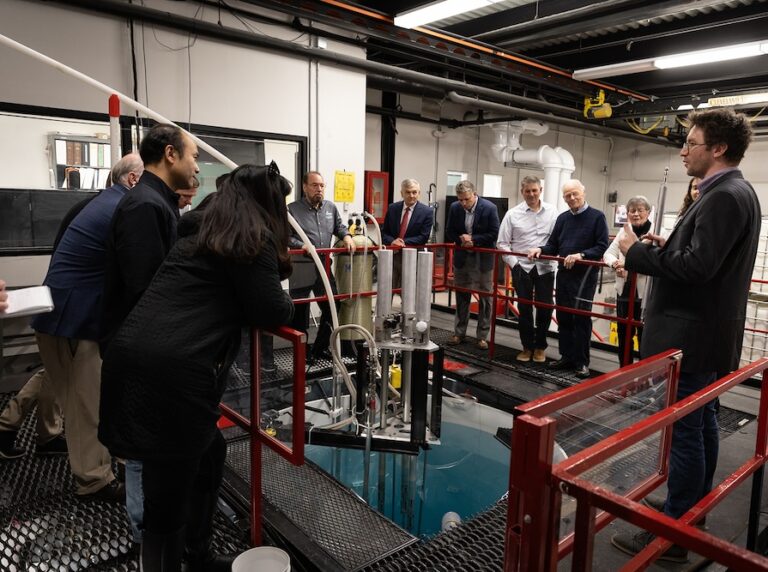
Research reactors come in many forms and sizes, with the TRIGA class being commonly found at universities. The TRIGA reactor at the University of Utah was installed in 1975, and for the past half century the thermal energy it produced was bled off into cooling systems. Now for a world’s first, the reactor will be used to generate electricity instead.
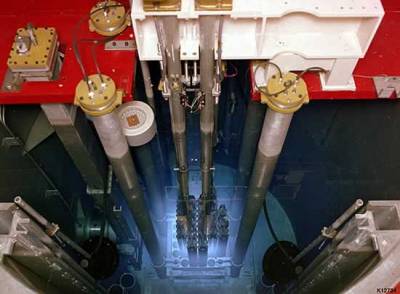
What makes the TRIGA design so practical for small research reactors is its inherent safety due to the use of uranium zirconium hydride (UZrH) fuel, which imposes a strong negative thermal coefficient on the reactivity. Along with no need for any kind of containment, these pool-type, water-cooled reactors thus allow for a pretty good look at the literal internals of the reactor core.
Their thermal power outputs range from 0.1 – 16 MWth, with the University of Utah reactor generating on the low end of the scale here, at 50 kWth. This energy will be partially used by a generator that has been developed by Elemental Nuclear, a startup company who looks to be trying to commercialize TRIGA fuel for microreactors with sodium coolant.
The installation at this TRIGA reactor should thus be seen as a proof-of-concept for Elemental Nuclear’s generator design, which uses a closed Brayton cycle with helium gas to generate an output of about 2-3 kWe from the ~13 kW generated by the turbine. This generated power will – of course – be used to power some racks with GPUs for ‘AI’ tasks. If successful, it could show the way for TRIGA-based microreactors to power datacenters.
Top image: the TRIGA reactor during a tour. (Credit: University of Utah)












good [ look ] at
Easter egg hunt?
allow for a pretty good at the literal internals of the
Seems like you forgot to add a word.
What are “MWth” and “kWe”? I’m unfamiliar with these units.
Thermal and electrical power, respectively.
Thanks! Now I feel like a dummy – should have been able to figure that out for myself.
yeah, it’s always good, when introducing an unfamiliar set of units (even if they only look different) to say what they mean. otherwise the reader who is otherwise fluent on matters of thermodynamics will be unable to tell if the proposed energy source is useful or if it’s just useful for generating clicks. in the real world, most technically-literate people understand kilowatts and kilowatt-hours without extra undefined letters appended to them
most technically-literate people understand kilowatts and kilowatt-hours
For some definitions of “most”, maybe. I’ll bet serious money that most people, even the self-selected “technically-literate” ones, can’t tell you the difference between power and energy, even when the definition is staring them in the face.
We should speak of energy in Newton-meters, and power in electron-volts per second. That way there’s no confusion between which unit is which.
I wonder if this is connected with the nuclear and data center projects cooking about an hour North of UofU in Box Elder County? I grew up there. In Brigham City. This is the same county where the Space Shuttle SRBs and their SLS SRB descendants are built at Northrop Grumman.
So many people are shorting out about it all. The irony is the simian screeching about the evil Stratos Project AI data center causing the sky to fall and dogs to have kittens happening on Facebook where, I kid you not, people are using AI to pull up wharrgarbl data to support their wharrgarbl conspiracy theories.
One even posted an AI-generated music video that I can only assume was supposed to be in mockery of the project and only served to prove there’s increasing demand for the kind of resources data centers provide. Where do they think this “cloud” where all their constant “look at me” diarrhea is hosted? Narnia?
“It’s not hypocrisy when I do it!”
Will someone please translate this comment into English? Or Klingon.
Tldr people on Facebook are complaining about AI nonsense and using AI generated “references” to back up their opinions.
So that is 2 kW electrical from 50 kW of nuclear thermal. What is the efficiency, below 5% ?
If someone says again that solar is inefficient, I will point them to here.
It says it will be partially used to generate electricity and that only about 13KWth will be used to generate the 2-3KWe so that’s more like 20%. My assumption (which could very easily be wrong) is that they aren’t necessarily putting a lot of effort into maxing out the efficiency since it’s being billed as a proof of concept. I would expect that 20% to increase with a proper implementation.
This article states that the turbine generates 13kW. So that seems to be mechanical energy in the shaft. How that translates to only 3kWe is beyond any normal range. The only conclusion I can draw is that this article is faulty somehow.
Read it again Marty. It’s 50 kWth, not 13 kWth. (and certainly not “13KWth”, whatever that is)
The turbine shaft output is 13 kW (mechanical), so already rather lackluster 26% right there.
Then it needs to drive the compressor and the cooling system, as well as drive the generator to produce the “about 2-3 kWe”.
Room for improvement in the efficiency, to be sure. But it’s just a demo.
“Just a demo” you write, but a demo of what? Getting from thermal energy to electricity is a well established technology, so if it’s a demo of anything, then it’s a showcase that it’s not useful to do it on a scale as small as this.
So unless I’m missing some obvious things (I have not looked closely at this), to me it’s starting to look like some sort of scam. Have there been significant subsidies to “develop” this?
It’s a functional demo by a company to show prospective investors that this type of reactor can be used to produce electricity.
Sure, it’s a dog and pony show. But it’s an important step in the modern world of startup financing, sadly. It’s universally acknowledged that it’s a demonstration, not actually practical, and not truly a reflection of what the ultimate product will be.
It serves its purpose. It’s not a scam, and not intrinsically bad. And, heck, maybe they’ll even get some useful engineering data out of it to inform the real design.
It’s like using a lemon “battery” to light up an LED and claiming that you just need VC money to scale it up.
Yeah I don’t get it either. The mechanical to electrical efficiency should be more like 70-95% with just like.. basic stuff. The fact that the turbine itself might not be efficient seems more reasonable. Turbines being as complicated as they are.
Maybe the plant itself requires 10kW, and the 2-3kW is just what’s left over.
That seems like a comically small output for a nuclear reactor. I would have aimed higher.
as far as reactors go, the output on this one is disappointing. but it is a research reactor, those usually are not build for energy production. usually the production of isotopes. so i guess this is just a bad retrofit. thats the output id expect from a next generation space fission reactor. terrestrial power reactors can do output in the gigawatt range.
ive always argued that you are buying a different thing when you buy a solar array vs a nuclear reactor. nuclear is still ideal for baseload in locations where you dont have access to hydro or geothermal. storage has nowhere near the capacity at this point to handle baseload. its worth maybe a couple hours at most. you cant even tank up on a nice day and burn it on a cloudy day because your storage capacity just isnt that deep. solar is however suited to the daytime peaks, at least on days you can use solar, when you cant use solar you are using fossil fuels. so the storage we have is mostly just to buy enough time to fire up a coal or gas plant when solar is being inadequate.
you buy solar but thats not enough, so you buy storage. both are land hogs. and that’s still not enough so you have a backup generator that runs too often to be called a backup generator. solar has side costs that are mostly ignored, and have carbon emissions because they dont deliver whats needed when you need it, so you need to use alternate means that almost always involves burning something.
It’s actually impressive they are getting even 26% thermal efficiency out of that reactor. The core is in a water bath, basically unable to get hotter than the boiling point. Carnot would say they need a cold side running near water ice temperatures (or colder) to get that 26% efficiency. Which might explain their mention of a cryocooler in the loop.
They claim their actual product will get 40% net efficiency, running a 10 MWe turbogenerator using carbon dioxide working fluid, at 700 C core temperature. Sounds perfect.
That U-ZrHx fuel can’t be cheap. Is France still the only supplier for it?
You cannot take any efficiency ratings quoted in these articles very seriously becsuse key data is rarely provided. Carnot efficiency is 1-(Tc/Th) and it is the best theoretical conversion from heat energy to mechanical energy possible. This is a consequence of the 2nd law of thermodynamics.
Th is the heat source absolute temperature (K or R not C or F) and Tc is the cold sink absolute temperature. Freezing is 273 K and boiling at 1 atm is 373 K so perfect efficiency would be
1-(273/373) = 26.8% if you used ice to cool your condensor. More realisticslly Tc = 300 K so you efficiency limit is 19.6%. Note that this efficiency limit is absolute and it does not depend which inverse entropy turbine, vacuum energy magnets or flux capacitors you use. It also assumes no losses or irreversible processes which is impractical for finite sized devices. It also leaves out losses converting mechanical power to electrical power. Any cycle operating from unpressurized boiling water heat will have much lower than 20% efficiency. In this case the hydrogen gas in their Brayton cycle is likely being heated to 1000K or more by direct contact with the core. The core must be significantly hotter than the boiling water and it is also under water where pressure is higher.
With much higher hot temperaures modern Brayton cycles can just exceed 60% for very large scales where energy losses are minimized by cube square effects and other scaling effects. A modern automotive engine is 20-40% due to the much higher temperatures the gas driving the piston achieves. i view thermodynamic efficiency claims over 40% with skepticism and anything over 60% with extreme skepticism. Thermal efficiency is very hard to measure, particularly at small scale, so most quoted values are educated guesswork at best.
The core here is only under a few meters of water. The boiling point, and thus the maximum temperature of the core, will be around 110 C.
Realistically, the only way they are getting even the efficiencies they imply is by having a Tc much colder than ambient air.
Their description “helium working fluid is compressed, heated using reactor pool water, expanded through a turbine generator, and subsequently cooled via a cryogenic heat exchanger.” is a bit of a tell. If they have a tank of liquid nitrogen behind the curtain to provide the heat sink, that would qualify as rigging the demo. A 500 L dewar would give this demo about a half hour of runtime.
Is there any danger with a Sodium cooling loop. And I do not mean from the water but from Sodium-23 by Neutron bombardment to become Sodium-24 similar to doomsday devices (cobalt, as mentioned in “Doctor Strange love”).
https://en.wikipedia.org/wiki/Salted_bomb
No danger in neutron sctivation of sodium. Sodium 24 has a 15 hour half life so after a week over 99% would have decayed back to Na 23. Also the sodium nucleus has a very small cross section across relevant neutron energy ranges so very little would be neutron activated in the first place.
I mean in worst a case failure mode. That Sodium-24 is so radioactive that even people living inside fallout nearby would be fully cooked, depending on the quantity released and distribution pattern.
Of interest
https://techxplore.com/news/2026-05-cooling-modular-reactors.html