
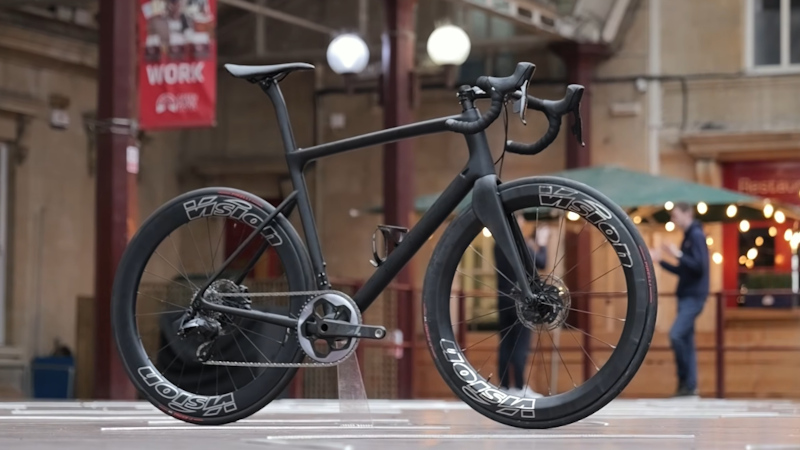
One of the ongoing rumors and scandals in professional cycle sport concerns “motor doping” — the practice of concealing an electric motor in a bicycle to provide the rider with an unfair advantage. It’s investigated in a video from [Global Cycling Network], in which they talk about the background and then prove its possible by creating a motor doped racing bike.
To do this they’ve recruited a couple of recent graduate engineers, who get to work in a way most of us would be familiar with: prototyping with a set of 18650 cells, some electronics, and electromagnets. It uses what they call a “Magic wheel”, which features magnets embedded in its rim that engage with hidden electromagnets. It gives somewhere just under 20 W boost, which doesn’t sound much, but could deliver those crucial extra seconds in a race.
Perhaps the most interesting part is the section which looks at the history of motor doping with some notable cases mentioned, and the steps taken by cycling competition authorities to detect it. They use infra-red cameras, magnetometers, backscatter detectors, and even X-ray machines, but even these haven’t killed persistent rumors in the sport. It’s a fascinating video we’ve placed below the break, and we thank [Seb] for the tip. Meanwhile the two lads who made the bike are looking for a job, so if any Hackaday readers are hiring, drop them a line.












20W might not look big but when you know they typically do around 150W… that’s a not trivial boost…
That puts the energy usage of incandescent lights in perspective. Turning on three 60w lights is like having an olympic cyclist chugging away in the room.
When I was a kid there was a local nuclear power plant that had a community outreach center, to try to make having a nuke in town a bit less scary. One of the things they had in there was an exercise bike with a generator hooked to a long line of 60W light bulbs. A bunch of friends of mine and I biked over there and two of the people I rode with could light all ten bulbs, which the person who kinda ran the information place said he’d never seen before.
But there are some fun youtube videos where an olympic track cyclist tries to power a (US voltage) toaster oven and gets just absolutely crushed.
watts/kg for various classes of riders https://cdn.shopify.com/s/files/1/0603/4027/3331/files/watts-4.png
So if a male pro can output 6W/kg long term, that’s more like 400-500W for a typical 75 to 80kg man.
Certainly not 150W based on that chart. But that still means 20W is a very significant 5% boost.
I built a generator bicycle a few years ago and I determined that video was fake (not that they aren’t generating the same power, but they definitely aren’t actually powering the toaster). My version has a super capacitor bank, but I’m no pro biker, so when I tried the same experiment I powered a toaster for about 15 seconds every couple of minutes, successfully “toasting” some bread over the course of an hour (but it was more like drying it out).
One thing I was able to do was continuously power a 3D printer and make a benchy. These days I use it to power a laptop and watch videos, which feels like a better use of my time than sitting around watching the same videos.
I’m an old, tired, never-pro bike racer and I can crank out 275W for an hour easily. The pros are producing 425W for half an hour straight, four hours into a race. In a final sprint, they’re producing over 1000W. (I can do over 1000W for five seconds.)
20W still matters, especially on a climb.
the pros do triple that all day
8 years ago I downloaded a chart that indicated “Healthy Humans” could deliver 185 watts for 1.5 hours or 250 watts for 1/2 hour. For “First Class Athletes” 300 watts for 8 hours or 380 watts for 1/2 hour.
And then there’s Eddie Merckx, said to have output 455 watts when setting the one-hour record on a standard bike in 1972: 49.431 km. Went unbroken for 28 years, finally beaten by 10 meters in 2000 by Chris Boardman.
20 Watts is a good amount of power for a casual cyclist – what I doubt is that their motor is actually putting out 20 Watts instead of just using as much.
That motor configuration is highly inefficient because the magnets are spaced so far apart and the air gap is huge, so it spends much of the time pushing current through the coils to maintain the magnetic field for little to no effect.
But how much is needed to compensate for the weight of the battery? I mean racing bikes are super light already, so the battery could be quite heavy comparatively, and if it’s only a boost the person riding it is the one that has to use more energy as a result of the weight increase, so how much gain is left? I guess it also depends on how flat the terrain is and the wind speed and direction. I just wonder if there is any gain left if you have +20 watts but have to push a battery up a hill.
I’ve often wondered if hitting these types of electronics with a cattle prod (or stun gun or similar) would have an adverse affect on the electronics.
The question isn’t “is a 20W boost helpful to the rider” but “is the added weight of the cheat worth the boost”, that’s a pretty small gain, so I would be skeptical.
Pro race bikes have a minimum weight limit and there are plenty of bikes that require an added weight to hit that limit, so it’s possible you could make a bike right to the weight limit with this in it. It would stand out like a sore thumb if you come in to a pro race with a bike that’s 500g over the weight limit.
Lol that provides an even simpler avenue to cheating. Just design your added weights with a hollow core of sand or water or dry ice. Then release the filler material during the race to suddenly get lighter.
And then they weight the bike after the race and you are busted!
Hmmm … fill the bike up “secretly” with urine just before the end of the race? 😆
Id think an aluminum rim with an alnico magnet set, demagnetized on race start would be better. Yeah, not as powerful as neodymium, but more easily concealed. Aluminum rim so the xray sees a metal rim. You make the alnico a solid piece. no spaced magnets. In the paddocks you have a magnetizer.
But, It sounds like their power calculations are P=VI, not mechanical power. that ignores the inefficiencies. I suspect this motor is very very very inefficient. So I’d bet they peak at more like 5W mechanical. Not a lot. Efficiency could probably be improved some, but, its pretty tough given the need to hide.
I’d be interested to see the mechanical power of the system. If its more efficient than I think, an alnico magic wheel would be plausible.
You could do a magnetic drag motor (linear induction motor) on an aluminum rim.
What would give it away is the thermal signature when the aluminum gets warm from the use of the motor.
Yeah, I thought about various induction motors, but yeah, the heat is a dead giveaway. But would it be at a true 20W mechanical? I suspect that yes, it still would be. In fact, no matter what because of the inefficiencies of the design, you’ll always have a heat problem as it will take a huge amount of electrical power to make enough difference to matter. However, a permanent magnet motor would make less heat. If you only used it during sprints, it may go undetected. may…
It depends on how many batteries you can hide. You can get about 10 Watt-hours per standard 18650 cell, or 5 Wh if you account for plausible efficiency.
It’s not whether you win or lose but how you compete. I hate to say it but, neat is this might be, and I’d like to try out something like this on a real bike, I would not want to pretend like there’s nothing added, and cheat my way to a fake win. Just goes to show what a buch of phoneys there are in this world. “See Grandson, Here’s the trophy I won in the tour de france, let me tell you how I cheated to get it!”
They should use air motors. One capable of producing 20W would be tiny, and could be concealed inside existing metal parts. It would be self-cooling. There would be no RF or magnets to detect. Adjust the design of the carbon fiber frame to act as a pressure vessel, and you get energy storage with very little added weight. If you made it reversible, you could even do regenerative braking.