
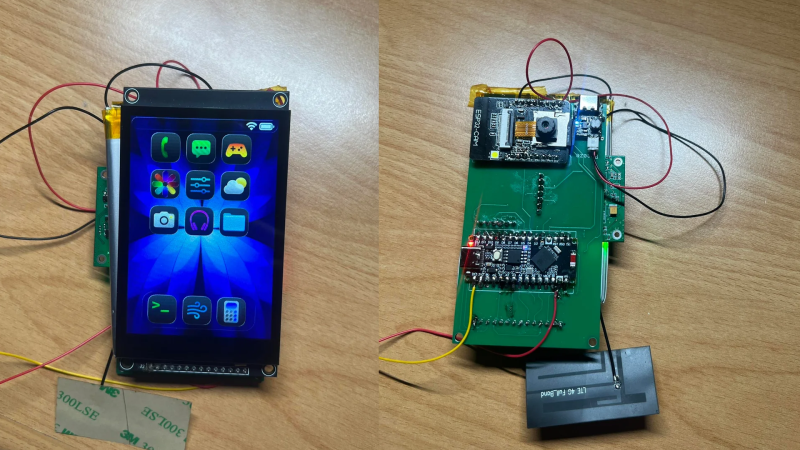
You may or may not be reading this on a smartphone, but odds are that even if you aren’t, you own one. Well, possess one, anyway — it’s debatable if the locked-down, one-way relationships we have with our addiction slabs counts as ownership. [LuckyBor], aka [Breezy], on the other hand — fully owns his 4G smartphone, because he made it himself.
OK, sure, it’s only rocking a 4G modem, not 5G. But with an ESP32-S3 for a brain, that’s probably going to provide plenty of bandwidth. It does what you expect from a phone: thanks to its A7682E simcom modem, it can call and text. The OV2640 Arducam module allows it to take pictures, and yes, it surfs the web. It even has features certain flagship phones lack, like a 3.5 mm audio jack, and with its 3.5″ touchscreen, the ability to fit in your pocket. Well, once it gets a case, anyway.
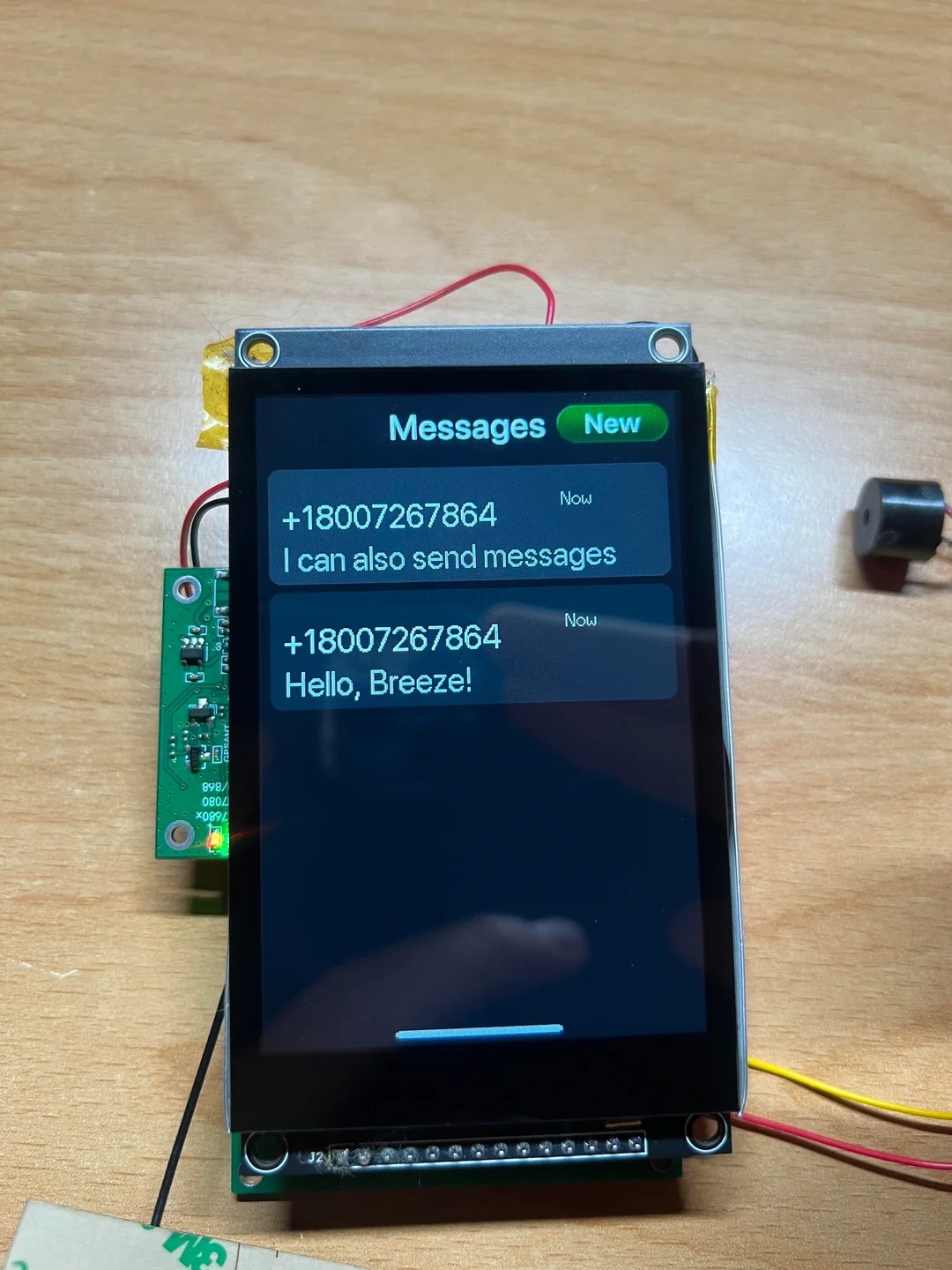
This is just an alpha version, a brick of layered modules. [LuckyBor] plans on fitting everything into a slimmer form factor with a four-layer PCB that will also include an SD-card adapter, and will open-source the design at that time, both hardware and software. Since [LuckyBor] has also promised the world documentation, we don’t mind waiting a few months.
It’s always good to see another open-source option, and this one has us especially chuffed. Sure, we’ve written about Postmarket OS and other Linux options like Nix, and someone even put the rust-based Redox OS on a phone, but those are still on the same potentially-backdoored commercial hardware. That’s why this project is so great, even if its performance is decidedly weak compared to flagship phones that have as more horsepower as some of our laptops.
We very much hope [LuckyBor] carries through with the aforementioned promise to open source the design.












Smartphones are meant to run “apps”. This is like those cargo cult planes designed by aborigines in Australia and New Zeland after WW2.
Yeah it’s a dumbphone, and you can still buy those, and this one would still be running the propriety stuff of the 4G modem module, so there’s always the external control.
Still though, it is probably fun to make something like this yourself, and you can add things to it that you can’t easily add to smartphones or pre-made dumb-phones I guess.
“app” is just the android and iOS term for “program” and before that “binary”. They all mean the same thing. There’s no reason why this platform couldn’t have “apps” written for it. Provided the platform was either open enough to do so. Or the platform provides an sdk
“apps” are what the computer illiterate call computer programs. An ESP32-based system can absolutely run a simple operating system to load various programs. Does this one? Well, it could be all hard-coded as a single program with many functions, or it could be an OS with various executables– “apps,” if you must. [LuckyBor] hasn’t shared enough info to say, so your mudslinging is premature and uncalled for.
Also, the cargo cults arose amongst Melanesians, not the Maori on New Zeland who fought the British with stolen muskets or the Aboriginals of Australia who’d been exposed to the white man’s technology for over a century at that point.
The current apps are just C++ functions that are numbered like runApp1-12 for example, but the final version will have truly portable python apps (since loading elf’s is a pain), so for now its hard coded, but there will be portable apps loaded from an sd card to actually be a full smartphone by definition, right now its a smartphone-like dumbphone which is cool too, but it will be an actual smartphone since custom apps arent a huge priority right now (I need to finish all the preloaded apps first)
To me ‘apps’ are the name for programs on phones, and it annoys me no end that they now try to make people call programs on computers ‘apps’
But seeing MS is turning Windows into a Android-type thing I guess they have a point, once completed (or is it already with W11?) it is no longer decent to call it programs, especially the stuff from that MS ‘app store’.
I already have plans for adding in user installed apps, via micropython for it to have the definition of a smartphone, why micropython? Yes its slow but it’s easy for people to write with, and easy for me to implement, a win win situation here. But yeah for now it only supports static compilable apps, and if you want your custom apps in C++, once its going to be open source, you can just write them and flash them natively.
Thanks for clarifying!
That’s great, and I agree that micropython is a good choice here even if it isn’t the fastest. BASIC wasn’t fast either, but it was everywhere for those same reasons: easy to implement and easy to use.
Why not WebApp this should be the standard. It can run on every OS.
Yes, please!
We don’t constantly need freakin’ apps for everything that spy on platforms that spy & sell our data.
We need such an open platform where we can actually write simple open source programs and be actually sure they do not call home whenever they can.
The goal of the project was mainly this too, create a good, smartphone experience (even if its just an esp32 s3) thats also open and private, also because creating a smartphone is cool I think
So so cool, happy lowtech ! Love that solution. Do we really need” apps” to communicate ? :)
We “need” apps to doomscroll and wait passively for our Overlords to tell us what to think.
I’d been considering a similar project as one of my next so I look forward to seeing some documentation on this to know how steep that mountain really is. Though I was thinking use a small micro or possibly a FPGA to run the HID and basic phone features while having a Pi Compute Module or similar it can wake for the heavy lifting when its needed. Which is where the FPGA might be needed – acting as a fast transparent databroker/switch between the modem, HID, battery management type stuff and the real computing horsepower – that way any Linux install at all can see standard hardware with drivers and just work putting all the complexity of stitching the hardware together into the FPGA ‘chipset’ I guess you could call it..
That’s a really interesting architecture idea, and I hope you run with it. Let us know on the tips line if you do.
Won’t be for a while if I do go with it at all being in the middle of less interesting but necessary projects at home. So if anybody else finds the idea interesting enough to run with I really hope they do too. It is something I’d really like to see exist at least as much if not more than actually doing the project – while I’ve no doubt all the learning and problem solving would be ‘fun’ in that annoying but satisfying when you figure it out way the end result seems like it would be a highly useful and very flexible device.
Cool idea, but since I dont like verilog, I dont use fpga’s, but if you know how to, nice!
Cool idea! I wont be using FPGA’s for this phone since I’m not good at verilog though. And using an FPGA as a custom chipset is very cool too!
How can one not be cynical when one sees a hacked-up phone with wires sticking out of it that has features one wants but cannot get from a “regular” phone, even if they are perfectly reasonable?
– It’s actually portable and fits into a pocket (if I wanted to lug a TV around, I’d buy a TV).
– Replaceable battery (I assume).
– 3.5″ audio jack so that I can attach real headphones. (Ok, I don’t exactly expect the ESP32 to stream high quality audio… or am I wrong?)
– Support for SD cards so that I don’t have to clean up its storage constantly or pay a premium for expanding built-in storage… which, I suppose, is what the manufacturers want from me… all except this one. So –
– An honest manufacturer.
Add to that the coolness factor that you get by carrying around a phone with a brick-shaped 3D printed case.
The battery will be replaceable just by unscrewing the contacts, and the esp32 s3 just streams CD quality audio, nothing super HD since its not needed, and an SD card will be in the final version, and the final 4 layer PCB which is currently in the schematic stage is being worked on to be ultra thin, hopefully it’ll work!
if it can do two-factor authentication, then that’s the entirety of the functionality i need from a phone
I don’t think most people realize just how much of their system resources consumed by what’s euphemistically called “analytics”. Its a perfect storm of competing spyware providers and inefficient scripting. I reckon that normally at least 80% my system resources are being consumed; unfortunately modern policy dictates we can’t use and older browser (for “security” reasons) so we’re stuck in this dumb arms race, adding more and more resources just to run in place.
Also known as ‘enshitification’.
One man esp32 smartphone project ?
Reminds me of paxo
https://github.com/paxo-phone/PaxOS-9
It was only 2g tough
This project and this discussion truly made me smile!
I think A7682E has no VoLTE, so it is using 2G fallback, so not really working for a long future. :S
I made a DIY 2G mobile phone using Arduino Nano + SIM800L.
It supports call dialing, OLED display and keypad control.
Full project (code + circuit) available on GitHub:
https://github.com/electronicsideaa-ai/Arduino-GSM-Phone
are cheapest then t-display P4
?
who remember https://www.wiphone.io/
esp is vunderability ;( and probably have chinese comunist back door.
But I’will buy it if have a meshtastic/meshcore/reticulum module too ;D