
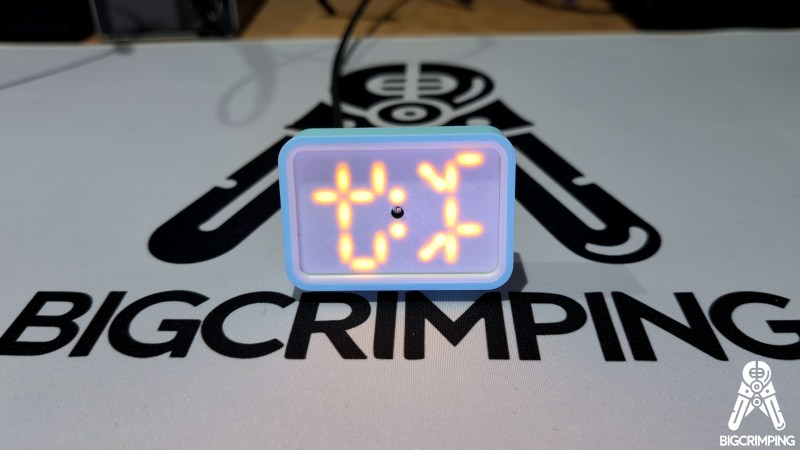
Around the thirteenth century CE, European society was in the midst between transitioning from Roman numerals to the Arabic numerals that we use today. Less remembered are the Cistercian numerals, which [BigCrimping] used for their most recent project in the form of a rather unique clock.
The Cistercian numeral system was developed by the Cistercian monastic order in the 13th century, forming a rather unique counterpoint to the Arabic numeral system. Although Arabic numerals are already significantly more compact than Roman numerals, Cistercian numerals up the ante by being capable of displaying any number between 1 and 9,999 with a single glyph.
Although for a simple 24-hour clock you don’t need to use more than a fraction of the possible glyphs, there is the complication of the Cistercian numerals not having a zero glyph, but that invites an even better take. For the version that [BigCrimping] made there are namely two glyphs that encode date and time, with the left glyph a counter for blocks of two hours and the right for seconds from 1 through 7200.
The clock is based around MAX6969 LED drivers and an ESP32 MCU on a custom PCB, with the design files including the 3D-printed enclosure available in the repository.












If the context is defined, a single vertical line could define zero, then you have a base 10,000 positional numeral system.
I agree, and feel that should have been obvious even to the Cistercians. That said, they must have had something that represented ‘nothing’, perhaps writing out a word similar to ‘null’ or ‘nihil’.
In the code 0 is defined as the 3 vertical lines
They didn’t need a zero because nobody used it prior to the adaption of arabic numerals – that was probably one reason for the switch. Roman numerals and mathematics also didn’t use zero.
Yes to Yimin Rong! They must have known that back in the day.
And it’s kinda cool that you can “add” 1 + 4 = 5, 1 + 6 = 7, 2 + 6 = 8, and 1 + 8 = 9. Maybe there’s a way to make more of such “additions”.
Hmm. Well, first, there are three hz and vt lines, so they represent 3 binary digits. The angles could represent two more binary digits. So there’s a four digit, base-32 number represented by a single, clean glyph. Then it seems like the best thing to do would be to strip the alphabet of 4 letters (finally fixing foolish English spelling – notwithstanding Mark Twain’s “Plan for … English Spelling”) and, score! You’ve got all the numbers and letters a modern human needs.
You talk about simplifying with base-32 numbers and glyphs, but have you considered the implications? Language isn’t just about utility – it’s about cultural expression and the nuances we hate. Who gets to decide which letters are “foolish” and are not “politcally correct”? Everyone has their own take on language and spelling that enriches our communication. In my country we have a saying: “Wenn der Wichse fließt, gebiert die alte Schlampe.” This isn’t progress. it’s linguistic naivism. Compared to the so called “modern audience” pigeons might not be the first understand it, but at least they know how to navigate life without completely dismantling their birdish identity.
Great stuff Süleyman
IMHO, if I remember right, roman numerals were practical in the sense that were based off what can be represented with ten fingers as a number when, say, trading in a loud marketplace. Counting was a bit tricky, since for fractions they used 12-based math.
Arabic numerals are not compact, and since they were mostly used with the 10-base math, they would always be limited to that particular use, BUT forcing everything, fractions, too, to the single 10-base math was making things decidedly simpler.
On the topic of number representations, I found the idea behind the so-called “classical mayan count”, ie, 20-base numbers, more compact, and much simpler to learn and master. Things like additions and subtractions are quite simple to represent visually, though, I am unsure if mayans truly ever dealt with fractions, which would be a bit of a doozie (some speculations have it, they were indications representing things like 1/5 with 1 being a dot above the “main number” 5, a horizontal line – not sure where and in which context, since that would mistake it for number 6, which is the same, a dot above a horizontal line). I think there was a merit in developing THAT kind of math, just haven’t seen any good follow-ups, representing things like primes, etc – in short, continue on with the concrete math, ie, positive real numbers.
Also check out Kaktovik numerals, 20-base math, it is even simpler than mayan : -]
(I found it to be one of the absolute simplest ways of representing numbers that would be self-explaining enough so as to not even needing a teacher)
https://en.wikipedia.org/wiki/Chinese_number_gestures
This tool will preview Cistercian numbers if you want to see what they’re like: https://cistercianjs-mrled.vercel.app/