
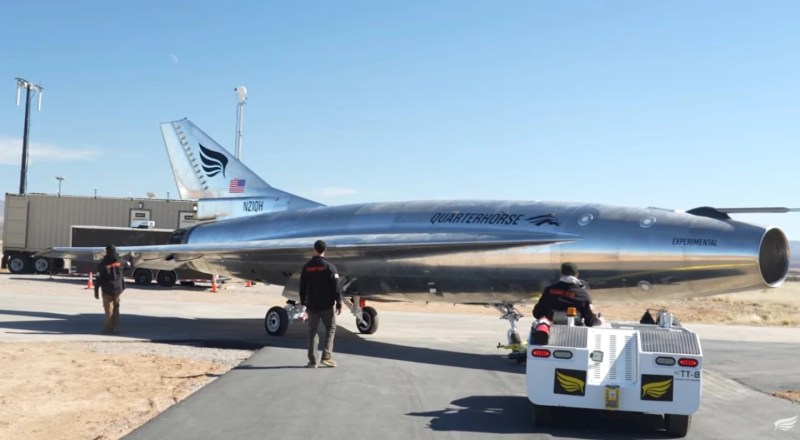
You’ve got to be ambitious to target a legend. If there’s one thing the folks at Hermeus Aerospace are, though, it’s ambitious: not only do they plan on their Quarterhorse unmanned aerial vehicle (UAV) to outfly the SR-71 blackbird, they’re hoping to do it in record time. They took one big step closer to that goal in March 2026, when Quarterhorse 2.1 took off for the first time from Spaceport America.
The F-16-sized prototype is actually the second first flight Hermeus can brag of in the past year– version one first flew in May 2025. They’re iterating fast. Version 2.1 is hoped to prove a key part of the engine design for v2.2, which is the plane Humerus hopes to use to break the SR-71’s air-breathing speed record of Mach 3.3 from 1976. They’re hoping the next prototype can actually hit mach 5, which would be amazing if they pulled it off. Of course when exactly v2.2 will fly will depend largely on how this current model does in its test envelope.
This Quarterhorse hasn’t yet broken the sound barrier, but it certainly will. With the same F100 engine as the F-15 and F-16 fighters, it’s got the thrust, and one look tells you it has the aerodynamics. Of course an F100 can’t fly at Mach 5 — not on its own — but the F100 isn’t purely stock. It’s actually a component in Hermeus’ Chimera engine, which combines the F100 with a pre-chiller to actively cool the incoming supersonic air so the engine doesn’t melt at high speeds, and a ramjet stage that bypasses the engine entirely. That would make the Chimera a turboramjet engine; starting with an old and well-known turbine stage seems like a good move and is arguably a hack.
It would work like this: the engine takes off on turbine, the chiller kicks in when the aircraft goes supersonic, and the turbine is bypassed completely at high mach. This is how they hope to break the SR-71’s record: as well-designed as the J-58 engine was in that plane, it only pushed bleed air into the afterburner, rather than bypassing its turbine stage entirely, so was limited by the need to not melt said turbines. In some ways, the Chimera reminds us of a cheaper, simpler SABER engine. Of course as ambitious as breaking a 50 year old speed record might be, Hermeus’ goals are downright humble compared to the single-stage-to-orbit dreams the SABRE was meant to allow.
It remains to be seen just how fast Quarterhorse 2.1 will be able to go. Notably, at least as it was first unveiled, the aircraft doesn’t have any kind of shock cone on the inlet. It’s unlikely that the pre-chiller makes that unnecessary; it is more likely that either 2.1 is going to be restricted to low mach numbers where such things aren’t necessary, or it will be fitted later. Either way, we look forward to following the test program, at least as much as it is made public. Check out footage from the test flight in the video embedded below.












Getting strong OceanGate vibes here.
Are you an AI? I ask because I think that’s one heck of a hallucination to see any parallels between the two.
OK, now I know it’s AI slop using sockpuppets to reply.
“My project”? Stockton? WTF are you talking about? Hallucinate harder.
Ambitious equals OceanGate? There’s no wannabe-celebretiy CEO, there’s no unique and questionable choice of materials– everything here is conventional and has been talked about for years. Look at the airframe: add a shock cone and paint it black, and it’s pretty close, aerodynamically, to the SR-71’s D-21 drone.
Yes, they’re iterating as they build. That’s a thing in aerospace. I don’t think Skunk Works built a bunch of subsonic, sub-scale prototypes for the SR-71, but it’s very common. For example, the Saab 210 built to prove the Draken’s aerodynamics.
Have we fallen so far as a civilization we must refuse to believe we can even match our former glories?
Yes.
Reading comprehension is hard, right?
At benthic pressures…the best part is every part.
There is more wiggle room in aviation. If the whole plane was a black box…it would never leave the ground….so kudos to re-inventing the Super-Saber.
TSTO approaches compared:
https://phys.org/news/2026-03-europe-starship.html
The paper:
https://link.springer.com/article/10.1007/s12567-025-00625-8
Must be financed by hypersonic weapons seekers…
They can get better ordnance elsewhere.
Now, if you want an OceanGate moment…well, here’s Mount Krakaboca:
https://m.youtube.com/watch?v=Xh-QBWtP444
Can’t fault Bechtel for rock tornadoes.
They are going to have to aim higher than the SR-71. A bold claim considering it’s never been supersonic.
There was the USAF X-51 “Waverider”, a hypersonic scramjet that topped out at around Mach 5.
There was the NASA X-43, another hypersonic scramjet that hit Mach 9.6.
Both used “aspirating” engines, without carrying oxidizer. But they weren’t “dual-mode”; they didn’t have a turbine mode for slower flight. They used rockets to attain operational speed. It’s nice to be able to take off from a runway. Although when the SR-71(or A-12) did it, they immediately had to refuel midair to continue their journey.
The SR-71 was limited by the material science of the time. Any faster and the aircraft would start to melt, like what happened with the contemporary X-15. It could have gone faster otherwise.
Here is how the last of the Blackbird’s fuel was used up:
https://x.com/Habubrats71/status/2029271571165012089
The biggest reason I want SLS to not only live, but evolve into a longer, parallel staging/side payload-mount Energiya clone is so EXPERTS can build orbiter size hypersonic test articles like Waverider boilerplates.
You really need to be able to test hypersonics at large scale. Previous test articles were closer to warheads or ingots…even Stratolaunch’s Roc isn’t enough.
The goal would be for the 747 Orbiter ferry to release test articles for low-speed tests –then side mount them to an Energia-type SLS mod and have that return from space for re-entry tests.
With RS-25s on SLS, any space-plane tested will not have the draggy, Columbia-type aft boat-tail.
Had engines been underneath the old shuttle External Tank the whole while–each orbiter could have been different…a Buran type…a Faget type straight-wing…a slimmer X-34 scaled up for crew only–no payload bay.
Then whichever design handles best can be the basis of a true RLV like God and Kubrick intended.
I think it would be best for RLVs to at least be coated (if not manufactured) in a microgravity environment where new types of metallurgy are possible.
Elon and others want to use Earth side manufacturing for reusable vehicles first–the idea being such vehicles will make spaceflight routine so space industry can follow.
That is the wrong approach.
I think expendable stage-and-a-half designs should become wet workshops, with RLVs made there to fly to Earth and back…in that microgravity production methods can be showcased sooner.
That is superior to a bunch of kids playing with pot-metal atop a dirtpile.
Side payload mount allows for much wider articles than in-line designs can handle—here is but one example:
https://falsesteps.wordpress.com/tag/space-exploration-initiative/
I guess Feynman never heard of the MEM
https://jmnet.one/sfs/forum/index.php?threads/mars-excursion-module-mem.16504/
One thing about SuperHeavy, is that it challenged some folks on CFD:
https://m.youtube.com/watch?v=mu59cR2tc54
https://research.gatech.edu/record-breaking-simulation-boosts-rocket-science-and-supercomputing-new-limit
Now that is good and all—and NewSpace libertarians love to attack my guys at MSFC, but the shuttle External Tank was an amazing feat of engineering.
Empty, it had two mammoth SRBs to either side…and an orbiter hanging off one end.
SuperHeavy is rather limber—not balloon tank limber—but not Sea Dragon either.
Poor Robert Truax….he got no love.
At least Phil Bono lives on at Stoke.
What, precisely, does the use of MEM have to do with the basic laws of physics?
[…and, so, uuuhhhh…VERY implicit in your thinking is that if Richard Feynman did not propose MEM as a solution, then his credibility has just been trashed? Thanks very much for your professional expertise; and…give us all a break !!]
The laws of physics do not include your “…just get a bigger hammer…” solution.
By the way, where did you obtain your doctorate in physics, and do your postdoc work?
Just curious.
That’s an AI slop video. Original sources or get out.
Says right in the description: “AI-generated lecture inspired by Richard Feynman’s teaching style Narration: Synthetic voice (AI-generated) Research & Production: Oxadow”
The problem with AI ramblings is that even when the information is superficially correct, it is often not accurate or relevant to the case, but it will sound authoritative when presented with the voice of a famous physicist.
And Mars Direct was to to utilize ISRU refueling anyway–as Starship is supposed to do.
SSTO is easier for Mars.
Not that lifting off Mars is easy:
https://www.smithsonianmag.com/air-space-magazine/the-one-pound-problem-718812/
…except that it is not Richard Feynman—but a clickbait AI-generated video with 6 7 simulacrum of him, and a voiceover that doesn’t sound like him at all.
That’s not Feynman, and as far as I can tell, it’s not even based on anything he ever said. It’s just some AI slop.
Don’t get me wrong, Musk can do one, but posting a sock-puppet video of a dead physicist saying things that he never said while he was alive, is not the way to prove your point.
The poster was an Elon-hater troll.
I don’t always agree with Musk, but on balance he has been more boon than bane. Feynman would have been wrong even if he himself said all that–as wrong as NYT was about Goddard.
I was more of a fan of Wheeler. Feynman was terribly conventional despite a Bohemian appearance–the opposite of button-down Wheeler, who gave us such concepts as geon holes…”charge without charge,” “mass without mass,” and so on.
Little correction, SR 71 used the J58. The J57 is on the B 52, well at least for awhile.
True. J57 was a shameful typo.
I went through the linked articles and now I am wondering if and SSTO could be made using a rocket-ramjet hybrid.
The thought was that you could switch modes just by switching on or off the oxidizer supply and the rocket mode would let you get up to speed at the start.
No…Elon is correct in saying SSTO only works for Mars.
Stage-and-a-half is best…launch, leave engines and tankage in orbit as wet workshops, then return to Earth in a simpler, more compact orbiter…engines in its payload bay on return–but under the ET upon launch.
That or a pod maybe:
https://www.researchgate.net/figure/The-Ares-launch-vehicle-can-send-47-tonnes-on-direct-trans-Mars-injection-59-tonnes-to_fig1_4702054
https://www.secretprojects.co.uk/threads/mars-direct.10745/
It is less clear cut than you suggest, as on paper the idea can work really well as you need so much less oxidiser on board, which reduces both volume and mass of the launch vehicle. And can gain altitude through that thick draggy air efficiently while launching from way more places (assuming space plane SSTO – which seems more likely than a vertical rocket style launch profiles on a rocket/jet engine system).
Just so far the engineering to do so hasn’t be solved, largely as right now the most plausible looking method ends up being multiple separate engines for different stages of the flight, so that weight saving on oxidiser is rather reduced if not eliminated and the complexity of the control systems goes up. But much like recovering via tail landing or catching boosters as spaceX does was ‘impossible’ or ‘unworkable’ till it wasn’t impossible at all SSTO might well happen, and I’d bet on it being a hybrid rocket engine of some sort.
Separating the rocket parts from the aircraft part makes the most sense…just keep rocket/tankage in orbit to harvest—which reduces re-entry mass.
A side note:
There was an intellectual exercise about sending orbiters to the Moon:
https://ntrs.nasa.gov/api/citations/19910014907/downloads/19910014907.pdf
Now this was called impractical, even though it is the same approach as Lunar Starship…lots of in-orbit propellant transfer.
Big blobs of liquid are to be avoided.
If compact hypergolic depots were launched—then a solar-thermal/electric tug could take it away from LEO where a rupture would not be catastrophic.
Hypergolics can keep for years…as in waiting for a friendlier, pro-space administration.
No boil-off…no threat to LEO. More compact propellant blobs.
In the past, the mantra was separate crew from cargo. Better to keep them together—but separate both from rocket/tankage.
That could come down unmanned like Starship.
Here’s the thing—a Buran like Shuttle-2 with turbo-jets could be made like any other airplane.
Once it comes in from space, it has kerosene tanks. You could fly it sub-orbitally. After re-entry—it can’t get back to space on its own…but it could self ferry.
The Buran analog needed no ferry.
A similar build Shuttle-2 could use ramjets once it goes subsonic.
No fancy scramjet tech, no wonder materials.
The pre-Buran OK-92 concept was even more awesome.
They did not get to Mach 1 but claim they will get to 5?
Ok… This is just a investment pitch them. Got it
sigh SR-71 didn’t get to Mach 1 on it’s first flight either. Or it’s second.
I don’t know why people don’t understand how aircraft development works.
Clearly what they need to do is hire all the experts in the comments section who clearly understand waaaay more about this than the teams of engineers and scientists actually working on it.
Don’t be a homophoneophobe. ;)
I’ll fix it, while grumbling about English not having consistent orthography on account of being three dialects in a trench coat instead of a real language.
While you’re at it, don’t mix SABER and SABRE too.
If you’re going to use the multlingual heritage of English as an excuse, at least make your spelling mistake plausible with something like “airial” (from airplane) rather than what, “arplane”? :P
The big mystery was how they got titanium out of Russia during the Cold War.
That’s book-worthy.
There was a hypersonics guru named Seymour Bogdonoff….I half suspect he may have played a role.
https://www.researchgate.net/publication/267196650_Seymour_M_Bogdonoff_and_the_Princeton_Gasdynamics_Laboratory
https://www.nytimes.com/1955/01/23/archives/tunnel-simulates-11400-mph-speed-princeton-compiling-data-on.html
Instead of kids playing–you need folks capable of writing articles like this:
https://arc.aiaa.org/doi/10.2514/3.26028