
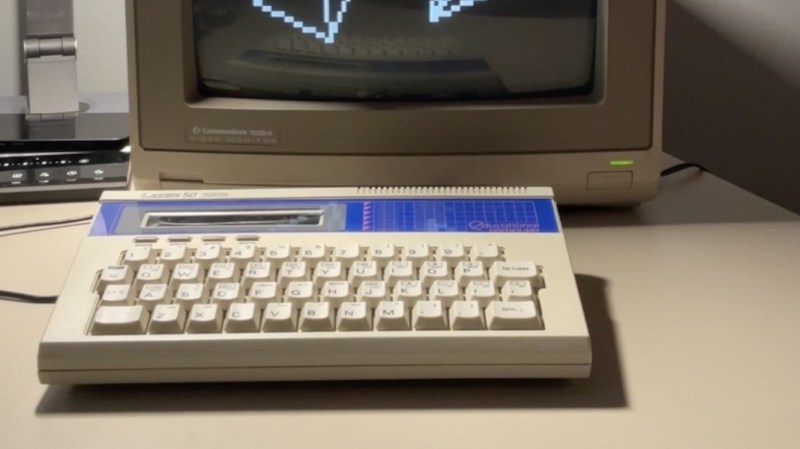
Back in the 80s, buying a home computer could easily mean an inflation-adjusted cost of thousands of dollars (or your equivalent currency unit of choice), and all for an 8-bit machine that might not have a hard drive and almost certainly didn’t connect to a network. Here in the future it’s easy to get spoiled by all the computing power and inexpensive devices practically falling into our laps, but using some modern low-cost microcontrollers can connect us to our early computing roots like [Joe]’s latest Arduino-based computer.
Taking design an engineering cues from computers like the Timex Sinclair 1000, Commodore PET, and TRS-80 MC-10, this computer uses a trio of Arduinos to accomplish what the best computer manufacturers once did with tons of integrated circuits. An Arduino Due handles all of the processing and traditional computing tasks, including a somewhat customized BASIC implementation, while an Uno performs audio processing duties. Taking care of the video processing is the much more capable Arduino Mega, outputting 40×25 monochrome NTSC composite video at 8×8 character resolution. There’s even WiFi courtesy of an ESP32 — certainly an upgrade compared to the source material.
After booting it up, the user gets a Commodore-like experience that replicates the 80s computing era quite well, and is even built inside its own keyboard case just like that era of computers usually were. [Joe] plans to release all three firmware images and the Python script used to get files onto the faux-retro machine, so keep an eye out for that.
In the event that you used rubles instead of dollars to pay for your expensive 8-bit machines back in the 80s, this computer might be more up your alley instead.












This is legitimately really cool and the website is adorable. I love this for so many reasons; thank you for sharing!
That reminded me of the Amethyst: https://github.com/74hc595/Amethyst – which, I suppose, is the Apple (if someone had told Woz about Forth?) to the Daisy-1’s Commodore / Atari.
“Here in the future it’s easy to get spoiled by all the computing power and inexpensive devices practically falling into our laps…”
Man, I wish I had a lap like that.
“lord ive seen what youve done for others…”
Is that a transputer?
The garbage collectors says: “The transputer is a series of microprocessors from the 1980s, intended for parallel computing. To support this, each transputer had its own integrated memory and serial communication links to exchange data with other transputers.”
So, to me, transputer.
i have a couple transputers on ISA cards found in a university dumpster in southern Ohio circa 1994. At least one of them works; i managed to download software for it and test it out back in like 2003. somebody come up wtih a good use for them other than occasionally bringing them out to fondle!
I thought fondling them was a good use.
I’d say closer to a game console. Those sometimes have a coprocessor running sound or graphics, especially in the case of backwards compatibility where this chip can also be the same CPU as the previous system.
That was actually a pretty limited time that they did the “I/O coprocessor that’s really the prior CPU”: basically from around 2000-2010. Before that backwards compatibility wasn’t really a thing outside of the Game Boy (which had two CPUs on the SoC it didn’t have running at the same time) and after that, it didn’t make sense to do it due to both the complexity and the fact that emulating it was more practical.
The Sega Genesis/MegaDrive released around ’88-’94 had a Z80
that both was sound co-processor and the main processor of the earlier Sega Mastersystem.
By using an cartridge adapter, SMS games could be used.
A MegaDrive version of Phantasy Star 1 was using the SMS ROM that triggered SMS mode.
https://retrosix.wiki/wiki/mega-drive-overview-sega-mega-tech
https://segaretro.org/Phantasy_Star#Phantasy_Star_Fukkokuban
Yeah, the Genesis is basically the exception, and the fact that you had to buy an adapter tells you they weren’t sure. Very weird decision by Sega.
The systems that used prior system CPUs as a coprocessor (either on chip or on board) is probably Genesis, PS2, PS3, DS Lite, and 3DS, which, except for the Genesis, is pretty common in time.
Hardware backwards compatibility in general is basically the same timeframe (excepting the Genesis and Atari 7800).
It identifies as a transputer.
A personal computer that’s just three microcontrollers in a trench coat.
It’s a super fun project and represents a quirky specific vision. If I were to do it, though, I would implement all of the functionality on the ESP8266 except for the sound and video, which I would’ve put on a Raspberry Pi Pico. Arduino DUEs and MEGAs yield poor bang-for-the-buck (though the Chinesium versions are pretty cheap).
To be fair, I don’t think the point was to make a cost-effective computer. I think it was to build a computer using relatively primitive 8-bit hardware. The 32-bit CPUs on the Pi and ESP negate that challenge.
Only two out of three are 8-bit; the Arduino Due is based on 32-bit ARM chip. But it doesn’t invalidate your general point, as it’s very much an older/slower/more limited device.
The project also has strong “let’s use all the old stuff I have lying around” vibes, which is surely appropriate for a Hackaday article if anything is.
Yeah the DUE is a pretty nice 32 bit controller from fairly early in Arduino’s evolution, and you don’t hear much about it or the Arduino MEGA, which really does sound like a old stuff, perhaps found in a forgotten box or picked up from the estate sale for someone like me after falling off a roof one time too many. but I will always have more ESP8266s than I know what to do with even if it is still my favorite microcontroller.
i have one in the back of my desk drawer that i never use. i liked the abundant i/o and usb support. but then the atmega32u4 mcus started showing up and my usual go to is knockoff pro micros and leonardos.
most of my projects are junk i have laying around and 3d printed parts.
“Storage is handled by a small Python server (daisyfile.py) running on any networked computer.”
So in addition to the three Arduinos it also requires an entire modern PC :)
Arduino can handle floppies, so that seems like a fun next step
https://hackaday.com/2021/04/30/an-arduino-with-a-floppy-drive/
arduino can handle sd cards just fine.
Neat project! I like it!
For those who weren’t around back then, there really was no ‘might’ about it having a hard drive or not… it wouldn’t have one.
The Supra for Atari 8-bit (for example) cost $700 for an interface and 10MB hard disk and didn’t come out until 1985. I mean, that’s what an Atari 800 cost in 1979, but by the time the 130XE came out in 1985 it was $150. (And the floppy drive was about another $150.). 10 packs of floppies were like $10, so you could actually buy the drive and 10MB worth of floppies and still have many $100s in your pocket compared to buying the hard drive.
The only people I ever heard of buying a hard disk for the 8-bits were running BBSes (so the files they had available for download were on the hard disk.)
Most 8-bit home computers didn’t have hard drives but did have modems so you were more likely to have the ability to connect to a network than you were to have a hard drive.
Maybe in the US, where free local calls were a thing – in the UK, for example, there was no such thing as a free phone call – and in any case modens had to be approved by the BEAB before they could be wired into the phone network (we didn’t even have wall sockets for telephones until the mid-80s! phones were rented from the GPO (later BT), and hardwired to the outgoing line) so very few people had modems at home here.
i hate to say it but the due is a 32 bit microcontroller. idk how you can define the mega as “more capable” (unless there is a better one i dont know about).
Yes! This is so good. I would want to make a tape recorder storage add on! Why i don’t know as they were a pain in the ass.
The great thing about Flash is that you can tippex out MB, write KB on it, and pretend it’s bubble memory. ;-)
Wow! I wish I had the code-I have the parts…I think..Arduino mega x2 Arduino uno x1 ESP32 x2
But it would need MacOs🙃