

Among so many other technological advances, the Cold War saw the advent of the ballistic missile submarine. The concept was simple—pack enough nuclear warheads to destroy a small civilization into a compact metal tube, and then hide it underwater. The oceans would act as a cloak for your fleet of world-enders, and keep your enemies forever on their toes. A terrifying machine that could both start and end a war with the push of a button.
Most nation states are populated by humans with the will to live. Thus, there has been a great incentive to find ways to keep tabs on these sunken doombringers. Great efforts have gone into improving sonar and magnetic detection methods over the decades, which are the bread and butter of sub hunting to this day. However, military researchers have also explored the prospect of whether submarines could be detected via their effect on the gravitational field alone.
Do You Feel It?
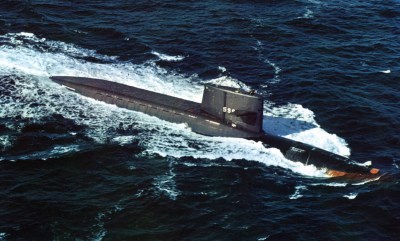
The simple matter is that every object with mass has its own gravitational field. We don’t typically think about it, because gravity is the weakest of the fundamental forces. On anything less than a planetary scale, it’s generally not obvious to us in our daily lives. However, submarines are quite heavy and large, particularly those that are armed with a complement of nuclear-capable ballistic missiles. Thus is raised the prospect of detecting these massive objects via their perturbations to the local gravitational field. This has been a hot-button news item in military commentary circles of late, with much bluster that advanced measurement equipment could potentially render the ocean transparent and reveal the locations of submarines at great distances.
Naturally, it’s difficult to comment accurately on top-secret military capabilities from a civilian viewpoint. Such a technology would be game-changing in a strategic sense, to the point that any nation state with such a capability would have great reason to keep its existence strictly hidden. However, there is some literature on the topic that is in the public domain, which discusses just how hard this feat would be to execute in practice. A great example is a report prepared by the Pacific-Sierra Research Corporation in 1989, under the sponsorship of the Naval Air Development Center.
How It Works
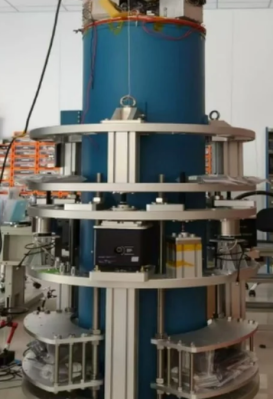
When it comes to detecting the gravitational anomaly of a submarine, you might think it would be easy given the sheer mass of such a craft. However, the way submarines operate frustrates this at a very fundamental level. In normal operation, a submarine is neutrally buoyant, displacing an amount of water roughly equal to its own mass. Thus, the submarine is not really distinguishable from the water around it in terms of its first-order effect on the gravitational field, being roughly as heavy as the water that would otherwise be there.
There is a wrinkle, though, in that a submarine is bottom-heavy for the sake of stability. This does create a variance in the gravitational field versus the otherwise uniform field in open water, and it’s one that could theoretically be detectable with a sensitive enough apparatus.
The device used for measuring gravitational variation is called a gravimeter. They are essentially a special-case variant of accelerometer, specifically designed to very accurately measure the local acceleration due to gravity at a single point. Then there is the gravity gradiometer, which measures the spatial rate of change of gravitational acceleration. By virtue of measuring acceleration gradients, a gradiometer is not sensitive to the acceleration perturbations of a moving platform, making it particularly useful for use in a moving frame of reference such as towing behind a ship or aircraft. Various types of each instrument exist, from portable units to high accuracy laboratory instruments; creating an exhaustive list of all variants is outside the scope of this article. The real question is, based on the gravitational anomaly generated by a large submarine, to what useful range could a gravimeter or gradiometer detect one?
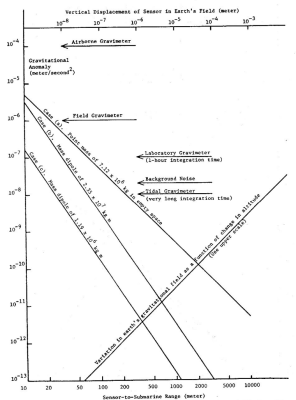
Unfortunately, the maths says that you have to get very, very close. In the 1989 study, calculations suggested the best gravimeters and gradiometers in the world would maybe be able to pick up a large submarine from a distance of tens of meters, at best. The simple problem being that the gravitational anomaly generated by an underwater submarine, and the gradient of that anomaly, are both so small, that even highly sensitive instruments would struggle to pick it up when the submarine is practically in visual range. Even if the problem were simplified, and one were trying to detect a submarine as a heavy point mass in empty space, detection ranges would stretch to somewhere in the range of 100 meters at most. Of course, this would be largely irrelevant due to the neutral buoyancy considerations explained above.
It’s true that technology has moved on since 1989. We have more advanced gravimeters and gradiometers available now, including quantum units with greater sensitivity than ever. And yet, even with these advances, it would be still be a struggle to detect a submarine at useful range. Sensitivities would have to jump by four or five orders of magnitude to enable detection at ranges of 1000 meters. Even still, if this were achieved with some highly classified system, it would still be relatively limited in capability versus more established techniques in magnetic or acoustic detection.
The parameters of the problem, combined with the sheer weakness of gravitational forces, means that gravitational detection is not some silver bullet for tracking enemy submarines at great range. While it would be desirable to have some kind of sensor that could reveal where these nuclear weapon platforms are lurking at all times, that technology seems beyond the reach of even the most capable navies at this time. For now, strategic planners will continue to sweat over the threat these weapons pose, never quite knowing whether they’re lurking just off the coast or half a world away.












I thought that all submarines were now totally trackable globally by satellites.
What is still difficult to detect is a stationary extremely deep submarine with nuclear reactor shutdown and running from batteries.
High resolution “Thermal Infrared” can track nuclear submarines by their cooling water which is constantly discharged.
“Magnetic Anomaly Detection”, quantum magnetometers can detect the miniscule changes to earths magnetic field caused by the massive steel hulls distortion.
“Synthetic Aperture Radar”, as submarines move they generate shifting pressure waves and temperature gradients as they plow through the water, these miniscule ripples and ocean-wave distortions can be detected from space.
High power “LIDAR” can penetrate several meters under water and detect submarines running at periscope depth.
LIDAR in the UV would penetrate well over 100 meters. In some videos of deep diving one can see among the monochrome view that the silicone “rubber” on spearguns and a few small fish species are bright orange or blue from excitation by UV from the Sun.
The first time I saw this I had to look it up and yes, UV passes through water nearly as well as through air. You can sunburn while diving.
I have a friend whose phd thesis was on using satellite measurements of wave height to track submarines, but my impression was that they had to be moving and the positioning was laggy because of the amount of time it took for the pressure waves to move through the water, so you knew where they were a couple minutes/hours earlier, not right now.
“Thermal Infrared” is a no-go. You seems to greatly underestimate the sensitivity needed to a sub a mile under the waves since you know… the sun is heating the waves and the waves are reflecting that heat to space.
Using synthetic-aperture radar would require a fleet of LEO sats and computing power to rival that of the investment in AI.
High power LIDAR is definitely not happening. You basically need a fleet of ships out there trawling the entire ocean.
“Magnetic Anomaly Detection” seems like the best option but it requires constantly updating magnetic maps since the magnetic fields are in constant flux.
It seem like you are unaware of the very real limitations on the capabilities of these technologies.
You don’t need maps for MAD, not sure where that idea comes from.
The SAR thing actually is real; there were issues with instruments on Skylab being sensitive enough to (inadvertently) track US subs. It’s not a silver bullet, but both whales and submarines are somewhat detectable, and are quite differentiable. It’s not good at detecting a submarine during its mission, but submarines generally move quickly to and from mission zones, and the strategic crowd was shocked to discover that this could be tracked.
(there are significant strategic implications even in just this; you can’t just assume that the enemy won’t know, or will easily lose track of, where your subs are, and sub bases are easily watched, not just from orbit)
They can’t even find the stationary MH370 with all the basic knowledge of the area it is supposed to be. Finding a moving submarine is way more harder and people are assuming Earth is tiny and easy to browse because they have experience Google Earth and maps.
Hmm, so if gravitational detection becomes a thing submarines will just lose their keel weight and maintain their attitude by hydrodynamic means, or by periodically quickly moving ballast internally. I think if I were a submarine designer I’d be designing that capability into submarines now just for the additional capability.
A control moment gyro would be the solution here, not shifting ballast around.
you still need to counteract buoyancy. i mean you can do a positive buoyancy submarine and use the downforce of hydrofoils to stay submerged. but this requires the sub to be constantly moving, otherwise you float to the surface (though reverse gliding is possible). this also makes them easy to track acoustically. attitude control really isnt an issue as you have control surfaces like an aircraft.
operational doctrine would require the sub stay as deep as possible thus giving it a lot of room to silently glide around with the engine off. no more lying in wait using subsurface terrain for cover. not sure what your minimum speeds or what kind of glide slope you will have. would certainly explain a lot of the manta form drones that seem to be popping up. doing a manta sub as a manned vessel with a nuclear reactor, do we even have a shipyard that can build that?
gyro and reaction wheels could help
A control moment gyro would be much more effective.
Wouldn’t that just stabilize the inside of the submarine and cause the outside to do whatever?
As someone who hunts submarines, it’s fascinating how poorly understood it is by the general public.
Radar and sonar are really the only two methods that are used for the most part.
No, satellites cannot detect them under the water.
No, LiDAR cannot see them under the water.
Magnetic anomaly detection works well but only at very short ranges, and has fallen out of favour (it is not even part of the sensor suite on new ASW aircraft)
And as far as gravity anomalies, definitely not. Even if you could somehow use future tech to increase the sensitivity a million times it’s still worse than MAD.
Sonar and Radar, that’s really it.
Nice try, FBI…
In all seriousness though if you’re crew on an ASW aircraft, ship or helicopter, would you have a “need to know” on the effectiveness of systems like satellite-based infrared electro-optical sensors that might be able to detect the presence of a nuclear submarine?
A satellite based infrared camera may see a streak of 1 degree warmer water from a nuclear submarines cooling systems due to mixing that is hundreds of meters wide and kilometers long that an aircraft would struggle to detect simply due to its low thermal difference and massive size. If this was the case then your vessel/aircraft would simply be told “search for submarines here”, you wouldn’t be told why you are being assigned that area…
You’re not detecting anything thermal from cooling water, not when it’s at depth.
We know why we’re sent where we’re sent, and that’s all I’m going to say about that.
It’s nowhere near that warm. For a quick estimate, the S9G reactor that pushes an Ohio-class boat around at an official speed of 20 knots is rated for 220 MW of thermal output. For nice round numbers, let’s say that cruising at 10 m/s takes 200 MW. It takes about 4 MJ to raise the temperature of a cubic meter of water by one kelvin, so each second the reactor can heat about 50 cubic meters of water by one kelvin. So a one-degree temperature signal only happens if the heat is concentrated in a trail of water no more than 5 square meters in cross section.
Since, as you suggest, the warmed plume would likely be hundreds of meters wide and maybe tens of meters tall by the time it reaches the surface, you’d be looking for temperature signals of single digit millikelvins. And the watts-per-knot figure drops at lower speeds, so creeping around slower makes that even smaller.
Polar caps?
Exactly. Using the 4 MJ example at 20 knots, 4 MJ applied perfectly (good luck) would melt about a dozen kilos of ice. But its not spread perfectly and its zipping along at 20 knots. It would be like trying to melt the snow off a driveway by making one pass with a car relying on car exhaust, its not going to be visible.
In theory there is pattern analysis, if every time a sub passes under the ice a hundredth of an inch of ice melts, maybe with overly precise guidance it would be possible to melt a visible channel in the ice over a decade or so. Like if there’s a narrow underwater channel and they always go within a few feet of the precise center of the channel for decades.
Its not a realistic problem.
“Most nation states are populated by humans with the will to live”, shame so many are ruled by humans with an active will to kill other nations humans and at best indifference to the survival of most of their own population.
What we really need is a working detector to weed these nut jobs out before they reach positions of power.
Homo Sapiens is not equipped to ‘naturally’ care for others external to their tribe. You would have to weed out at least a two-sigma spread of the population (>95%) to find such individuals. At two sigma, such outliers would most likely be genetically deficient in other ways.
One may be inclined to say that overcoming tribalism is simply a matter of upbringing and education. To some limited extent, anti-social behaviors can be mitigated through upbringing and education. But most humans are too stupid to accept ‘higher’ education and control their primal drives, regardless of our supposedly abnormally large prefrontal cortex.
The clever tech introduced by the the 97th percentile has enabled the vast majority to be destructive jerks, with the lightspeed resultant. We’re screwed; enjoy tech, and the illusion of civilization while you can.
There is a difference in favoring “your tribe” and actively trying to harm everyone not in “your tribe” and unfortunately those in the second group seem to have the drive to get in power.
The difference is determined by environmental constraints. Think about the difference between the beginning and end of a battle royale game, for example. Shrinking resources favor an all-or-nothing mentality, and guess what we have now on Earth?
too bad the people who tend to start wars are not the people that fight in them, otherwise we could have this selected out in a few generations. i dont expect to see any frontline leaders in the near future. we would be better off sticking the ruling class in war machines, like the clans in battletech.
i also have little faith in the intelligentsia to not fall into the very traps they wish to eradicate from the world. they always claim to know the solutions but never seem to finish the job, even when given dictatorial levels of power. had they been more successful i might be less harsh in my judgement.
religion did a better job even though its utter bs. even in spite of wars started on religious grounds. still managed to keep people from behaving like animals most of the time. humans are hard wired to resist anti human behaviors. religion is organically grown and therefore is more compatible. eradicating tribalism just doesn’t work so well. best you can do is make the tribes bigger. national darwinism will solve that in time, provided we dont blow ourselves up first. mutually assured destruction has a great track record though, making life impossible is also against our nature.
Dont know about you, but to me, stoning someone to death is the archetype of behaving like a beast.
Your comment seems in bad faith…..
Couldn’t help it you provided the perfect setup for that pun, and I had to take it.
“What we really need is a working detector to weed these nut jobs out before they reach positions of power.”
Due diligence, old-fashion and labor intensive. Want set and forget? Get AI involved.
Want to get it all wrong? Get AI involved. :)
this is why we need to put polar bear cages in congress. they can be opened with a 51% online referendum, polled at multiple random times each day.
Now, there’s a plan.
Interior and all meeting rooms of the House and Senate in stainless steel.
Lean, mean, hungry polar bears in cages in obvious positions in those rooms.
Doors that lock before the cages are opened.
No windows or other ways to escape.
Fire hydrants and fire hoses strategically placed to hose down the mess.
Big drains in the floors.
Remains of last Congress members left in place until the new ones are sworn in.
Swearing in takes place right there where the polar bears ate the last Congresscritters.
After the swearing in, the new Congresscritters’ first job is to hose down the rooms to wash out the blood and guts of the previous Congresscritters.
Daily online poll. At some specific disapproval rating, release the polar bears.
I’m afraid that would be very inhumane to the polar bears, though. Given the (lack) of quality in current politicians, the poor bears would be over stuffed and over weight in very short order.
It’d be easier (and more humane to the polar bears) to require them all to wear a dog training shock collar. Daily polls. When the approval rating drops, all the Congresscritters get a tingling. Elected to Congress->shock collar installed and only removed when voted out of office.
We do weed them out, unfortunately after they have power. Those are called world wars.
“A terrifying machine that could both start and end a war with the push of a button.”
The subs are not there to start anything. They make sure the other side looses no matter what.
https://en.wikipedia.org/wiki/Ballistic_missile_submarine
… thus making them a survivable deterrent in the event of a first strike.
Watch your word choice there. You don’t want the other side to “loose” anything. Ideally, you remove their capability to do so before they do.
Well, looks like I’m wrong. I guess they did make some for first strike.
I was so sure the boomers where for final strike, nobody left to recall them, they finish everything 3 weeks later, with some cobalt fallout.
mutually assured destruction works. even the most insane politician doesn’t want to live in a post apocalyptic world.
though i think id amend that with a page from the great convention in dune. anyone who launches a nuke gets glassed by everyone else regardless of allegiance. the forms must be obeyed!
No, there are some that would gladly make the trade.
Having a fun discussion about the future of ASW, from sensing (mostly passive, but some active, and sensor fusion), to adaptive camouflage. And even drones in the mix.
In 1970 I first saw Robert Forward’s invention, the rotating Gravity Gradiometer, which could fly on a small inertial platform in a C141 to map local gravity. This was something that previously required a team of people on the ground with Lacoste- Romberg gravity meters painstakingly griding a region, compensation for elevation. ATVs and mules and grad students were essential. The rotating gradiometer is incredibly sensitive and is one of the two physical instruments described in “Gravitation” by MTW.
But I can not see how this will work at any reasonably distance from a submarine, particularly considering the sub has the same density as the water it displaces!
Dr. Robert L. Forward was a physicist working on gravitational wave detectors (with the infamous Joseph Weber), later lunar mass concentration detectors, as well as space elevators (Tethers Unlimited), solar sails and laser propulsion. Also author of Rocheworld and Dragon’s Egg.
He came up with the very clever “rotating cruciform gravity gradiometer” aka “Forward Mass Detector” that was fantastically sensitive at detecting nonuniformities in density, exactly what is called for here.
Sadly, he passed too early in 2002.
Here’ the thing, unmanned underwater drones are now capable of quietly trailing such things for weeks, if not months, at a time. This makes things infinitely simpler, since there could be dozens of them quietly parked at some kind of known rendezvous points.
(there aren’t that many of large submarines around, btw, and ALL are now traceable – from time to time they HAVE to berth for maintenance … where they will be seen from a satellite, if not directly, then indirectly, by the wake they make when arriving at the port of call, or leaving).
Hunt for the Red October was a good movie, btw, but already outdated whilst the script was still being written. Smaller things exited ever since, and I’ll stop at that. (as usual, internet is your friend).
@Sammie Gee
Submarines, including nuclear ones, constantly get stuck or accidentally hit things.
The super advanced technology featured on popular tech sites is not quite in accordance with real life it seems.
It is likely the same for all those underwater drones and all that jazz.
Moray, either on seabed, or attached to sub. Different implications.
Small UUVs cannot keep up with larger submarines, and anything that small going that fast is very easy to detect.
There are plenty of large submarines around, more nations than ever operate them and they keep building more. While you can definitely see them coming in or out of port, once they submerge they’re quite a bit more difficult to track, and no one’s doing that with satellites.
There’s nothing outdated about the submarine tracking depicted in The Hunt for Red October. You need to be close to them to track them, full stop.
I spent a couple of decades working as a marine geophysicist. The topography and geology of the seabed varies significantly, especially as you approach the coastline. I think that this variation of mass distribution would mask any gravity anomaly from a submarine. Gravity measurement requires the most sensitive of all instruments compared with other geophysical data sets that are acquired. I’d posit that acoustic data might be of more use in locating a submarine, perhaps from drones or seabed nodes which are now relatively cheap to produce.
But the same cheap and easy tech also would allow faking acoustic signals surely.
i think subs already use undersea terrain as cover, at least in areas where the ocean floor is above crush depth. accoustic, magnetic, gravetic, you name it. shipwrecks can also be used to mask your signature.
Load project 2025 into missiles and launch. Wait a couple years for results. Proving the most powerful weapon is a bad idea packaged properly.
“Project 2025”
Nuf said….
I thought car detection systems at traffic lights use the distortion of the earth magnetic field.
There is a paper on it from 2014.
https://www.researchgate.net/publication/287944531_Vehicle_detection_system_using_magnetic_sensors
But I thought I knew about that before 2010 already. Mostly passive and low power way to detect cars on driveways, open garage doors. Tiny smart car managed to trigger that sensor as well.
Almost every stoplight here uses magnetic loops to detects cars but also bicycles on bicycle paths.
Although I wonder if those fancy modern aluminium bikes have some stuff to compensate. I know there are people that hacked some magnets on bicycles to achieve a more assured detection in the past, but I don’t know if manufacturers do the same.
Anyway if a loop works and is easy why use the earth’s magnetic field?
passive detection. pretty sure anti-submarine warfare makes heavy use of both active and passive magnetic sensing. modern subs generally dont surface to take out sub hunting planes. revealing your position is the thing you are trying to avoid. if you are in an attack sub and not an aircraft you definitely want to run passive.
Use electron neutrino detector.
Yes, in theory that can work, but you may need many of them to image anything in a useful way.
Single warhead AI controlled nuclear subs that can convert to cruise missiles are tiny and can loiter for extremely long periods of time before being recalled to the mother sub for replenishment.
I wonder how good a home made gravimeter could be.
A weight on a spring, measure it with an interferometer, count the cars driving past outside perhaps.
Its worth pointing out that a sub that’s as thermally efficient as a whale would be hard to distinguish thermally from a whale. Subs are like “tens of megawatts” whereas whales are like “tens of kilowatts” so there’s plenty of technical room for efficient whale sized underwater drones.
The other problem not being discussed is single point instant contact confirmation vs long term statistical analysis. Whales don’t travel in a straight line at constant speed from a sub base to a patrol box, even if the vehicle has a precise match to the thermal and acoustic signature of a whale.
Also no one is talking about neutrons which more or less drip out of reactors along with neutrinos. Probably a lot easier to pinpoint neutrino sources than pinpoint graviton sources.
Gravity detection? Am I missing something? No matter how heavy a submarine is, since it is neutrally buoyant, wouldn’t it have the exact same average density (and hence gravity) as the water it displaces?
I would have thought it would be cheaper and easier to bribe someone with access to the command and control system.