

If you were around tech in the bad old days, magnets could be really bad news. They were fine on the fridge, no problem at all. Put one near a floppy disk, or a hard drive, or even a computer monitor, though, and you were in for some pain. You’d lose data, possibly permanently destroy a disk or drive, or you’d get ugly smeary rainbow effects all over your screen.
The solid state revolution has eliminated a lot of these problems. We all use SSDs, flash drives, and LCD monitors now, all of which care a lot less about flirting with magnets. However, the same can’t be said about all our modern hardware, for a magnet could cause your smartphone some major grief indeed.
Magnetic Fields

As you might expect, the magnetic susceptibility of certain modern smartphones once again comes down to non-solid state parts. Now, there aren’t exactly a lot of phones out there that are packing hard drives or floppy drives or any sort of magnetic storage. Instead, it all comes down to cameras.
Take the modern iPhone line, for example. Apple is quite careful to warn against carelessly using magnetic accessories with the smartphone, because it can interfere with the cameras. Specifically, it’s because of the optical image stabilization (OIS) and closed-loop autofocus systems that are built into the cameras themselves. These devices use magnetic position sensors to determine lens position to compensate for focus, vibration, and movement, and use magnetic voice coil actuators to move optical elements, in order to take the best possible photos and videos at all times. If there’s a strong magnetic field in the vicinity of the lenses, it can interfere with this operation.
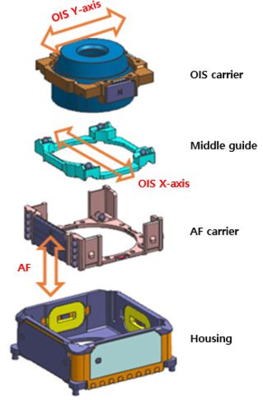
Few of us are sticking fridge magnets on our iPhones, to be sure. However, there are a lot of magnetic cases and mounts and other accessories that give people a great reason to stick magnets on their phone. In the cases of some third-party accessories that are poorly designed, it’s possible for these to cause problems with the camera if the magnets are too strong or too close to the key hardware. It’s worth noting that in typical use, something like a magnetic case or other small magnet won’t cause a lot of permanent harm. It will generally just degrade the operation of the camera until the magnet is removed.
This isn’t solely an iPhone problem, either. It can affect any phone that has any sort of magnetic sensing or actuation involved in the camera mechanism. Indeed, Samsung has even filed a patent on ways to mitigate this problem through carefully orientating the magnets used in folding phone mechanisms, and the appropriate use of shielding. Ultimately, similar camera technology is used in a great many phones, all of which are susceptible to this problem.
It’s true that in day to day use, you’re probably not going to run into a lot of problems waving around a magnet near your smartphone. Nor did floppy disks fail en masse in the 90’s, unless one of your colleagues was feeling vindictive and wiped them all with a fridge magnet on their lunch break. Still, like the oddball helium problem that because apparent with smartphones a few years ago, it’s funny to think that magnets could be causing trouble with computer hardware today. The fact is that a modern smartphone contains multitudes, and thus can surprise you with its edge case frailties.












MRAM is becoming more popular in embedded devices, and it can be affected by strong magnetic fields.
Rule one: stay away from MRI machines.
Back when I worked in the Memory Products Division at Microchip we got some MRAM samples specifically to identify weaknesses we could market against. We found that by waving a MASSIVE neodymium magnet directly in contact with the IC for a while we could sometimes get a bit or two to corrupt.
We touted this as proof MRAM was vulnerable, but in all practical sense it was bull.
I always wished Microchip would make a PIC32MX/MZ with built-in MRAM the same way TI added FRAM to their MSP430. I’m sad it was only a threat to you and not a sales opportunity. You would have sold millions of them.
Any electronic circuit could, in theory, be affected by a sufficiently strong magnetic field, particularly if there is any fluctuation in field strength or a the magnet involved is moving in a particular path with respect to the circuit
I.e. the movement of charged particles creates an electromagnetic field (wires with electricity flowing through them have a magnetic fiels) and changing magnetic fields can induce current into a conductor (think a wire coil with a bar magnet passing through it from bottom to top and back again.
Fortunately the strength of a magnetic field produced by a magnetic dipole (like a bar magnet) decreases with distance according to the inverse cube law. So just casually waving an ordinary magnet near your smartphone will have minimal effect.
On the other hand, if you stuck it inside the operating zone of an MRI machine …
Edge case, or case edge? I see what you did there.
Has anyone here ever actually seen a magnet erase a hard drive?
I used to work at a radio station. We had a great big electromagnet for erasing reel to reel tapes. We would use that on those, carts, casettes and even floppies. It worked great for that.
We tried it on hard drives, the old metal-shelled mechanical PATA drives and even some old MFMs. It did nothing. I don’t know why, could the metal enclosures provide shielding maybe? It never erased even a single bit when we tried it.
The metal enclosure does provide shielding, and the magnetic domains need a strong flux concentration to flip a bit.
The coercivity of the hard drive surface is something like 0.3 Tesla while audio tape is around 0.04 T to 0.151 T so you need around 2-10 times stronger magnetic fields to erase it. Since you can’t actually get close to the platter like you can with tape, you’re unlikely to generate such fields just holding a magnet to a hard drive case. The field strength diminishes in the cube of distance, so just the fact that the case separates the magnet from the platter by 1 cm means it probably can’t erase anything.
To make the comparison, a big alnico magnet might do 0.15 Teslas right on the surface, so it’s just strong enough to erase the most stubborn audio tape when dragged right along the surface.
A Neodymium magnet can do up to 1.5 Teslas at the surface, so they might actually be dangerous to hard drives as well, if it weren’t for the steel shell that shields it.
I don’t know any numbers to quantify how much magnetism the reel to reel eraser put out. It used enough power that you had to be careful what else was running on the same circuit at the same time. It was enough that anything metal placed on it shook violently. I was actually a bit surprised it didn’t damage the heads even if it didn’t erase the data.
It was meant to do a whole spool of reel to reel tape at one time, this wasn’t just a little cassette tape eraser.
Hard drive cases are mu-metal (and have been for decades), which is specifically designed to shield against magnetic fields. Very hard to damage them from the outside.
Do you have reference to the actual cases are mu-metal? that sounds exorbitantly expensive.
Are you sure it wasn’t just some tiny part in the read head, or part of the actuator assembly?
The way you phrase it makes it sound like consumers have ready access to significant sheets of mu-metal through old HDD’s, and that it has been the case for decades.
I think the only bit of mu metal in a drive is over the spindle motor. I used to think the voice coil magnets were stuck onto mu metal but after doing a spark test one day they turned out to be low carbon steel. (No carbon in mu metal.)
The body is aluminium and the cover plate is stainless steel. Platters and spindle are aluminium as well. Occasionally you find glass platters in small laptop drives.
They’ve been made this way forever, they were never made of mu metal. I’ve no idea why Dan thinks that.
But could you make the head crash, that seems a bigger risk when I think about it.
I wonder how much field strength you would need to affect the head coil or head itself. And crashing is extreme but what if you can throw it out of alignment? Can’t be good.
Of course now with the new technologies with the shingled stuff or the heated domains and what not the whole equations chances I suppose.
I tried to erase a betacam sp tape once with such a bulk eraser. Did nothing. Not even a dropout. And that after rubbing the tape to the eraser for almost 3 minutes. Metal tape…
At least in 1998 there have been some newspaper articles in Germany.
https://www.heisegroup.de/presse/Datenkiller-InterRegio-1610087.html
does this count:
https://www.youtube.com/watch?v=OHeVJQcBgio go to 21:00 to see a magnet stuck onto the storage part and watch the drama unfold. Though I might suspect it to be slightly exaggerated.
Definitely exagerated. Plus… that’s reel to reel tape. That’s exactly what the device that didn’t erase the hard drives was meant to erase. Although… not by sticking it on the top of the player/recorder, you were supposed to take the reel off of that and set it directly on the top surface of the eraser.
Also, there are fairly strong magnets right there, inside hard disk drives; that’s how the read/write head is actuated.
I think there lies the real danger for data loss, that an external magnet can interfere with the precise movements of the head. But of course that would only be the case while the drive is in operation.
Former customers of mine had a special device to permanently erase hard drives. When a drive failed we would send them a new one. They would put the old drive in their special device. We understood it functioned like a chipper/furnace combi oven. When complete they would send us a “certificate of destruction”.
A lot of the time when people use magnets, they don’t care about where the magnetic flux is going and they don’t make closed paths for it – which diminishes the effectiveness of the magnet. When it fails to work as intended, they put in a stronger magnet.
Then you get problems like random screwdrivers getting stuck to your stuff, or your stuff getting stuck onto random objects like chairs or table legs made out of metal tubes. Looking at you Fluke, with your fancy carry case strap with an insanely strong magnet…
@Dude; I love my Fluke hangy strap. Scared to death of getting it near my quartz watch. Had a problem the other day while troubleshooting a duct heater that was mounted in a stainless enclosure though. Doesn’t matter how strong the magnet is if the stainless is not magnetic.
No mention of the other piece of tech still found everywhere that was responsible for so much of the damage? the humble speaker. Putting Hi-Fi speakers next to an old CRT was a surefire way of warping the shadow mask and causing all the funky colours, and leaving a tape or disk on them was a similar death sentence.
It wouldn’t surprise me at all if getting your phone close to a loud speaker particularly at a gig or concert would do far more damage to these camera systems than any case magnet.
A speaker in an enclosure won’t warp the shadow mask. You need a strong magnet really close to the screen to do that. If the speaker is not shielded it will definitely mess with the picture and the monitor may need degaussing though.
I feel like they might be mixing up the shadow mask warping with shadow mask being magnetized which causes funky colours but is reversible and some displays have built in degaussing coils to help with that.
Getting your phone close to a loudspeaker at a concert is probably going to damage it from the sound pressure before the magnetic field.
And You may think it’s broken the speaker, but actually it’s your hearing that’s damaged.
I set a magnetic GPS antenna on a laptop over the HDD and insta-crash. Laptop would not reboot until the HDD was replaced. Not sure what the actual root cause was.
Maybe you damaged the voice coil actuator that moves the read/write heads.
Same here, put my tablet with the smart cover on the laptop palm-rest…
Insta crash, dead hdd.
Same…Macbook air 2024 lost😞
the oddball helium problem that because apparent with smartphones a few years ago?
Unless you’re wondering about typos here are links:
https://hackaday.com/2018/10/31/helium-can-stop-your-iphone-maybe-other-mems-too/
https://hackaday.com/2018/11/20/ben-krasnow-gasses-mems-chips-for-science/
~1971 Pomona College’s IBM System/360 was having problems with random “Machine Check” errors (very bad). 3 IBM techs in white shirts and skinny ties spent a week on-site without solving it until one noticed a wall calendar held to the side of the main console with a magnet. He swore mightily and threw it across the room and the machine was fixed.
Reminds me of a story about Motorola MX300 portable two-way radios (walkie-talkies.)
A fellow I used to work with was a troubleshooter for Motorola. When (large) customers had problems, he would be sent to find the cause(s.)
The MX300 had a relay to switch the antenna between the receiver and the transmitter. One customer awas having trouble with radio failures. Oddly enough, it was always the relay that failed.
The fellow I knew was sent to investigate. He paired up with one of the security guards at the plant. The guards had the most trouble with the radios.
He followed this fellow on his rounds for a day or two.
At one point, the guard went into this one room and took off his watch and put all the metal stuff in his pockets in a locker. The troubleshooter did the same.
The proceed to the next room, which was a large hall with enormous cables and large chemical baths.
The customer was an aluminum refinery. That large hall was where they plated the aluminum out of the solution to get metallic aluminum ingots. The voltage was relatively low, but the current through the plating system was on the order of hundreds (if not thousands) of amperes.
That amount of current is enough to generate a strong magnetic even around a straight wire.
Did I mention that the security guard kept his MX300 in its holster when he went in the refinery?
The magnetic fields there are strong enough to wreck a mechanical watch or tug on your pocket knife.
They were also strong enough to kill the electromagnetic relay used in the MX300.
Mystery solved. Do not take the radio with you in the refinery.
Later models (unrelated to the MX300) used solid state antenna switches, usually a PIN diode or a purpose made IC.
For as long as the aluminum producer was using the MX300 radios, they had to make the guards leave the radios in the lockers along with the watches when inspecting the refinery area.
There have been refinery explosions caused by radio device use in areas they aren’t supposed to be. I know a oil refinery safety admin who caused a large burnout that way. Ironic right?
Same reason radio transmitters are not permitted near blasting operations.
Same reason radio transmitters should not be permitted near gasoline refueling stations.
“Ironic right?”
Positively ferric!
Back in the late 80’s, I placed some 5.25″ floppies on a 9″ speaker magnet, waved them back and forth, and just left them there for a few days.
None of them were affected in any noticeable way, even the files were still intact.
I doubt most of the claims of magnets casually erasing data or damaging equipment.
The flux density in the magnet itself (strontium ferrite probably) is around 0.4T. Pole pieces condense this to a sizable level (1-1.5T?) at the coil, but that’s not exposed on an assembled speaker (but, that does explain why it’s so damned hard to get nails, metal shavings, rust, etc. out of the gap). Only the leakage from the back side is exposed; but that’s instantly much less than the 0.4T in the magnet; probably in the mid/upper 10s mT?
Prying the pole pieces off the magnet will greatly increase the external field! But also reduce its density. The density at the face of a naked magnet (no pole pieces) is ballpark half its magnetization (give or take aspect ratio).
Or magnetron magnets; same material, a bit easier to pry out.
Doubt all you like. It happened.
Leaving the floppy in contact with the speaker wouldn’t change much. It is motion in a magnetic field that mangles the data worst. Alternatively, a changing magnetic field such as generate by a transformer will do.
My father started having trouble with bad floppies on our Tandy 1000 computer. This was back in about 1985, 1986.
I used the same computer, but never had trouble.
The difference was that he always turned on the low voltage halogen desk lamp that sat on the computer and I never used the lamp. The computer was placed on a shelf above the monitor, with the long necked halogen lamp sitting on the computer – with its transformer right above the 5 1/4 inch floppy drive.
I move the lamp to a difference shelf and the problem went away.
I got kicked out of high school because of this very thing. We had apple 2e computers in computer lab. There was also a large floppy storage container that had aproximately 300 disks in it. Some were entertainment, most were teaching disks for the three r’s. I told another student that a magnet would erase all of the disks if it were waved around the container. Students started bringing non-working disks to the teacher within minutes of the event. I got blamed and got a two week suspension and had to pay about USD300.00 for the disks to be recopied. Fun times and YES they are eraseable.
That’s silly.
I was in training at my first job, and for some reason there were tons of copies of King’s Quest on 3.5″ floppies on a table off to the side of the meeting room. I grabbed a set, put them in my briefcase, and took them home.
But upon trying to install them, I found they were mostly corrupted. So I got another set the next day. Same thing.
I got suspicious and examined my briefcase. Sure enough, one of the flaps on an internal pocket was secured by a magnet. Talk about a dumb thing to have in a briefcase in the ’90s.
Strong magnets can affect inductors by saturating the core. Not sure somee switch mode power supplies would like having the inductor becoming a simple resistor.
So that’s why they are contemplating to abandon magsafe.
Maybe they should use a less powerful MagSafe
Supposedly, the metal that HDD mags are mounted on is special. It won’t let magnetic lines pass through. Have confirmed this many times. Put a piece of metal on the other side and BEHOLD! It won’t stick.
I was using my laptop to troubleshoot the network cable to a cash register in a department store. I didn’t yet own a cable certifier, but used an app called Broadcom Advanced Control Suite (BACS), which exposes the NIC’s diagnostic capabilities to tell you the length of each pair, whether the pairs are split, the link speed and duplex, etc. I set the laptop on the cashwrap and went to the network switch location. When I returned, the laptop had bluescreened. Turns out that I had set it atop the Real Strong Magnet that removes the antitheft tags from clothing, and wiped it while it was operating. The laptop was unusable until I replaced the drive; it could not be formatted.
I used to volunteer for a nonprofit that takes in retired computers, refurbishes those that have usable life, and recycles the rest. Hard drives that were not big enough to reuse, or whose former owners required it, went through the degausser to be destroyed. The degausser made a loud clunk when it operated; I think that it uses heavy current from the discharge of a capacitor, to make a strong magnetic pulse. Out of curiosity, one time I dismantled a drive that had been degaussed. The magnets from its head positioner mechanism would not stick to a refrigerator, whereas undegaussed magnets are hard to pry off the fridge.
Is it possible there are Lilliputian coil magnets (like maybe the read-write head) which may be damaged by current induced into them by a magnetic field?