
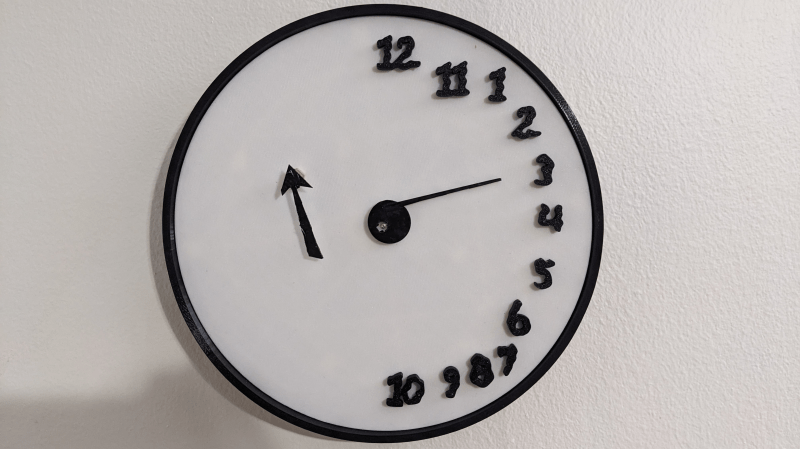
One simple screening tool for cognitive impairment is the clock-drawing test (CDT): the patient is provided with a printed circle and asked to draw a clock face with the hands pointing to a certain time. Depending on how the clock is drawn, this could indicate a variety of different disorders, particularly dementia, with a particular deformity in the drawing sometimes pointing to a specific issue. These failed tests inspired [John Silvia] to create a clock with a unique, disordered face.
The numerals in this clock face are placed exclusively along the right half of the clock (in the test, this can be a sign of damage to the right parietal lobe, or of executive dysfunction caused by dementia), and out of order. The hour hand is controlled by a servo motor, and the minute hand is mounted on a separate, commercially-purchased clock mechanism on the left-hand side of the face.
The frame for the clock and the face are 3D-printed, and the servo motor is controlled by an ESP32-C3 with an RTC module. To minimize power draw, a MOSFET disconnects the servo motor from power except for the once-per-hour position update. Once per month, the ESP32 connects to Wi-Fi to synchronize to NTP time, otherwise remaining in a low-power state – even its indicator LEDs are disconnected to save power. These efforts paid off: when the servo isn’t active, it draws only about 160 µA, and a set of three AA NiMH cells lasts about a year.
Since the servo motor draws most of the power budget, it wouldn’t make much difference, but the ESP32’s co-processor can also be used for ultra-low-power projects. For a happier take on a drawing-related clock, check out one of these projects.












What if person under test comes from a different culture where mechanical clocks (as done in Western Europe) were not used? They will fail immediately without being at fault. This is yet another example of white ethnocentrism.
You’re allowed to give a different test to a different person.
You can’t do that. It’s discrimination!
/s
You think only white people use clocks? You’re a racist.
Where do you think the term “big black clock” comes from? 😏
I honestly can’t tell if this comment is tongue in cheek or not. I reeeally hope it is.
Easy. We ask them to draw a bicycle.
As the Polish dictionary once defined horse: “everyone knows what a horse is”
We also used to know what a spit roast dog was. We used them for over 400 years and they were as common as horses. Now we know almost nothing about them. The horse quote was used in a short documentary about these dogs. We know nothing about them because at the time Everyone knew what a spit roast dog was so no need to explain it.
we saw the same YouTube short i see
Do you mean turnspit dog? I ask because i want to see that short and I didn’t see anything about “spit roast dogs” but I do get a lot of hits for “turnspit dogs.”
Well, if they come from a culture without a quantified measure of time, they probably won’t make it to the appointment anyway, so it kind of solves itself.
The concept of the clock is so ubiquitous that if it hasn’t penetrated their “culture” by this point, they for sure won’t be attempting to diagnose cognitive disorders, either. More likely they would be trepanning to get the demons out of the skull.
Sssshhhhhh!! Don’t let RFK Jr hear you say that; he’s got enough wacky ideas.
good point
Spot on!
We do have isolated populations where psych tests based on what we think are obvious and shared experience, go utterly wrong.
Women from Greenland will be evaluated using European standards.
One woman was given an inkblot test and said she saw a wokan gutting a seal. This was a very normal part of her life because that’s the equivalent of her going to the deli counter for lunch meat.
She has to process it herself to feed her babies.
The psych tester took her children.
https://www.bbc.com/news/articles/c1wlw2qj113o
“who 3d printed my clock app icon?”
Though different culture may mean just being young:
https://news.ycombinator.com/item?id=46395757 – NYC phone ban reveals some students can’t read clocks
https://www.bbc.com/news/education-43882847 – Young can ‘only read digital clocks’
I had a thought like that percolating in the back of my alleged mind.
Not “phone ban reveals students not being taught to read clocks”?
I would have to sign in for full article so I will just quote ycombinator comment.
ribosometronome wrote:
I feel like most of these comments have ignored the article. They were taught how to read clocks, in first and second grade. Then they had no need of the skill for most of a decade and it atrophied.
My son and daughter both had been learned this skill very early ate school. We have big dial clock on the wall and there are dial clocks in school. Yet two years later my son (to my surprise) struggles a bit to read dial clock as he never really use it – he sees it but don’t really use. Yes – I will fix that.
Analog clocks are part of 1st and second grade curriculum in the US and have been for decades.
But just like EVERY OTHER thing you learn but don’t use you forget.
A high schooler who hasn’t read an analog clock in 10+ years would easily forget how.
It is a medical test. They are not about failing/passing. Also they might not be universal, you might need different tests in different situations. So if at all there will be a very subtle ethnocentrism in here, because maybe in western white dominated countries doctors might be trained in a way which might not work equally well for people from a different culture. So although this may be very hard to eliminate entirely and it is certainly not an argument against such test (because cognitive tests have to refer to culture in one way or the other), you may have a point here.
I will make the point that in general, if you’re going to come to a place with a different culture to live, it’s incumbent on you to learn to adapt…and that doesn’t mean just “coming to western white dominated countries”. Looking at my laptop and my Android phone, both clock icons are clearly derived from analog clocks. I am interested in hearing–not necessarily specifically from you–of any countries with a recent-ish (say, last couple hundred years, but possibly before the widespread advent of digital clocks) experience in timekeeping that don’t use western-style analog clocks (I would posit that any clocks using the post-French Revolution decimal time probably don’t meaningfully count as different.)
Also, remember the original point of the story was cognitive/stroke tests, not actually telling time. Anyone with an Android (or I presume Apple) phone that’s ever used the clock should at least have an idea of what an analog clock should look like.
There are a few cultures that split the day and night, then divide those into 12 hours each.
They have all realized how insane/impossible that is.
Regardless of how Mohammed kept time.
There is at least one other that did similar, don’t recall it.
It would make for nice exploits.
Only give employees long hours.
‘You’ve all got nigh shift until spring. Same as last year.’
Union painters would do he opposite, of course.
‘We only paint at night in summer, too hot.’
Also final boss in mechanical Horology.
Set your latitude or your watch will be wrong.
Martians fail 100% of the time
I come from a cuture where there are no lions, rhinos, or camels, so it’s completely unfair for someone to give me a test where someone points at a lion and asks me to name it.
‘K. Plenty of other people pointed out that different tests can be used in different situations. But… let’s go a little more interesting than that.
What test would you recommend that would work the same for all people of all cultures, races, sexes, genders, etc…. Please lend us your wisdom. Hey, if you really come up something it might even qualify as a hack. Good luck!
Draw a person’s face.
Well then, I’m due to be stuck in the Alzheimer’s ward at the old folk’s home.
I know where all the pieces of a face go, but I can’t draw for shit. They’ll take one look at the drawing and say “Yeah. This MF has had at least one stroke and Alzheimer’s on top of it.”
Draw a smiley. I cant draw for crap and I can do that. BUT I cannot draw a clock very well!
There are several measures on the Weschler general intelligence tests that are not culture bound, like copying symbols to measure processing speed, block design patterns and figure weights for non-verbal reasoning.
Perhaps they can draw a picture of a fish, to catch the obvious bait you attempt to dangle in front of us.
This is the most idiotic comment I’ve ever read. This individual likely doesn’t know what a clock is, let alone how to read one.
That is the stupidest thing I’ve ever heard. Clocks are used all over the world, and across different cultures…not just “white cultures”. Clocks aren’t time pieces meant only for white people. I swear, so many of you people just try so hard to make every little thing into a race issue. Its pathetic.
Can you give a specific cultural example and references please?
Sorry that our christian culture gave us stability, freedom to think critical and ways to exchange ideas over distance, so that we where able to get out of stone age and develop mechanical clocks.
Saying that it it has something to do with our skin color is racist.
But you got a point that this test mostly works for old people that grew up with mechanical clocks, aren’t used to digital clocks and is no longer up to date!
But still a interesting observation that shows how the brain gets confused.
The MoCA isn’t a single question pass/fail test that is only administered once. It’s designed to measure a trend over time (pun unintended). Language/cultural barriers are irrelevant since all of that information is factored in by the primary healthcare providers.
There’s also a certain world leader who has been taking them regularly, and it’s interesting to observe commentary of it play out in real time.
It’s not about the clock, it’s about the executive function,spatial perception and motor coordination needed to reasonably draw a common household object. Different tests will always be used for different populations.
“I really love this watch. It’s beautiful. I just really wish it would tell the time!”
~Mehdi Sadaghdar
My blind ex-girlfriend had one the literally would; it spoke the time to her.
A redditor made one of these several years ago, and it’s accurate without servos or an Arduino
https://www.reddit.com/r/neurology/comments/28m0xs/i_built_a_working_accurate_5handed_hemispatial/
Lore says that anybody born in this millennium will fail the clock drawing test anyway, since none can read an analog clock. Not even if you write out the instructions in longhand.
Just need to put the instructions in a Tiktok dance.
It’s disturbing how true it is. It really isn’t difficult but you now have people old enough to vote who cannot read an analogue clock. It does make you wonder if it is just clocks they cannot read or if it is any analogue style dial. Can they even read the speedometers in cars if it doesn’t have the speed displayed digitally? Could they read weighing scales with analogue dials?
Take yourself back a bit and people were probably saying they can’t believe these people are voting, but can’t even ride a horse.
Or anything that was once common place but now isn’t.
They’re perfectly capable of learning to read analog things; they just haven’t really needed to, since there’s almost always been a digital version available.
Why is that disturbing?
Think about it. Once upon a time the analog clock as we know it hadn’t even been invented yet. It was just one of probably an infinite set of things that then future people might have come up with to help coordinate time with one another. Countless other possible inventions within that set never came to be.
If the last analog clock disappeared forever then analog clocks would just return to that infinite set of things that do not exist just like all the others that we don’t even know about.
Maybe in some alternate timeline an alternate you would find it equally disturbing that people here will never know how to use whatever they used.
Now if you want a technology to be disturbed about the disappearance of.. may I present to you the AM radio? It’s simplicity made it a great starting point for kits and electronic projects that started kids on the path to engineering. It could be received and demodulated by simple circuits that worked without a source of electricity making it great for broadcasting instructions in times of emergencies. It’s parts requirements were so simple that soldiers in foxholes made receivers out of junk they had on hand such as rusty razor blades.
What’s so special about the analog clock? Moving parts to wear out so that people buy more future landfill?
It’s not a great leap to make an FM detector instead. All you need is a tuned filter. Sometimes an AM radio tuned slightly off channel will hear the signal, because the FM signal goes in and out of tune, which causes amplitude modulation.
That’s a slope detector.
https://wiki.analog.com/university/courses/electronics/electronics_lab_fm_detectors
Despite all the mentions of just how horrible it is, you will often find it used in vacuum tube radios.
I learned that about tube radios while fixing one up. I noticed that the FM section connected to the AM demodulator rather than delivering the audio signal itself.
That, naturally, led me down a rabbit hole about FM receivers.
I second that RE: AM radio.
On the topics of clocks there are very good and kinda short books describing various attempts at time keeping. “A Brief History of Timekeeping” one that I found quite well written (others recommended by Amazon seem to be mostly personal stories, IMHO). I’d say the earliest stable solutions were clock towers, and not only in Europe, btw.
Common wisdom days otherwise, when you look at the number if analog watches on the market, and anyone who wants to can look at a watch and figure it out. I had it explained to me once when I eas 4 or so, and 75 years later I’ve never forgotten. So simple that even I got it on the first take. THAT’S why it’s used as a cognitive test.
I still see analog clocks all over the place.
Freaking churches right?
I think they should make digital clocks that have some classical style though, and it’s not that hard I would say, you just make the digit more fancy instead of straight lines, not so fancy that you can’t read them anymore though, subtle does it.
But nobody doing big projects (like clock towers) or commercial offerings (like watches and alarmclocks) is doing it AFAIK. Odd that.
Make each number shaped by Jesus on the cross.
When people want to appear fancy they go for roman numerals.
Amateurs! 𒐖 | 𒎙𒐘 | 𒑂
Smart watches have the option to install analog styled faces. So, an already incredibly popular commercial product is widely available, and if all we’re worried about is someone’s clock (chrono?) literacy, I imagine this would suffice.
Only freaks use smartwatches (IMO).
And maybe people with existing medical conditions that also gave up caring.
My children could all tell time on an analog clock before they even started school. Saying that “no one can read an analog clock” is factually incorrect.
Or… teach your kids and reinforce it.
Mine can read a clock.
Mine know how many feet are in a mile (and meters in km) and also have a good idea how far that distance is, which almost no adults actually do.
They also know how to dial a rotary phone, despite that being a literally useless thing.
And how to make a bow-drill to start fire.
It’s all about what you teach them.
Less complain.
More teach.
Of course someone on this site would probably draw something like this and get themselves committed.
/| /
/ |/
|__
__|
https://hackaday.com/2026/03/08/building-a-super-compact-cistercian-numerals-clock/
https://hackaday.com/2021/06/19/tell-time-the-cistercian-way/
https://hackaday.com/2021/03/29/oh-brother-would-you-look-at-this-cistercian-clock/
There’s am app on google play tha has every type of clock you can imagine, including binary.
is this loss
Is this loss?
Today kids don’t even know this type of clock dial, only knows digital face.
Give the kids more credit; if you really believe that, they’re smarter than you are.
They failed the credit review and are not eligible.
That’s been repeated since the first mechanical flip thingy ‘digital’ alarm clocks.
It has always been true, but only for the dumbest of the dumb.
Lost causes.
I guess it’s “art”, but the inspiration for this feels rooted in mockery & not utility. Myself, as someone who’s aided dementia family members, can EASILY imagine so many more worthwhile, useful, or simply novel designs would’ve actually HELPED someone afflicted. How about:
• a clock that minimizes all other face numbers when the hour hand isn’t near them, or
• a clock face that expands to include all daylight hours, or
• a clock face that’s metric like Swatch, or
• a clock face that rotates according to the hour with a separate face behind for minutes, so that the hour & minute appear through a fixed window with text like “o’clock” or “the time is” to ease digital-only kids to see time revolving on an analog device.
So much potential, but so little empathy nor understanding of seeing a problem, and reiteratively conceiving how to help sufferers instead of pointing a finger at their disordered suffering. Perhaps the creator’s next achievement could be a self-kicking machine using a servo motor & an LED … for “art”.
Cringe comment
Now that’s an interesting idea.
Attach a magnifying glass to the hour hand.
I agree, but doesn’t that reduce to a digital clock? Or is it position plus numbers that is helpful?
There’s no evidence at all that it’s rooted in any kind of “mockery”. I think you just look for things to be outraged about and take offense to. And you just found one. Get over yourself kid.
Pro tip, to not have people dismiss you as an hollow idiot stop saying things like ‘Get over yourself kid’ whenever you disagree with them.
Or in fact any variation into which you insert ‘kid’ as an attempt to appear superior.
Not mockery, but probably black humor. I spent my career helping to innovate life-saving medical advances; and it is common for people in this field to feel so much empathy and even anger that more isn’t done, that humor is used as a release and recognized as such. If it is mockery, be reassured that l’m only a few years or one accident away from self-mockery.
So if I upset you I’m sorry, I did spend many hours considering whether releasing this was net good or bad. I didn’t consider it “art” but since you extend me that encomium, It appears to be pretty successful art based on your comments and the traffic it seems to have generated.
I can relate to this clock and love it, and kudos to the creative hacker who made it.
It’s only half the day. I guess, half the day on half a clock.
What it needs is a second row outside the existing, for the afternoon hours 13 to 21 with 22-23 up the top. But I think it would throw the artistic balance off.
Maybe a retractable set of numbers that change over at 11h59!!
It didn’t say in the article but does the hour hand actually point to the hour number on the clock face? Would be a missed opportunity if it just went round and round like in a normal clock.
“The hour hand is controlled by a servo motor, and the minute hand is mounted on a separate, commercially-purchased clock mechanism on the left-hand side of the face.”
Assumingly it’s operated by a servo motor because it only goes up and down the right side to point at the hour digits.
https://clocks.brianmoore.com/
AI would fail the test
I consider myself as ready-to-be-approved on a cognitive tests, but I still can’t figure out how the reading of the minute pointer is done. Could anyone help me?
Do you mean specifically on this clock? Judging by the article, the minute hand works like it does on a traditional clock. The hour hand is the only one that presumably moves up and down the right side by using a servo motor. The minute hand is on a separate, commercially purchased clock mechanism, implying it goes around the entire face. You just have to imagine the numbers that are meant to be there. :)
Best guess, as I didn’t see any mention of how it is supposed to work from a quick review of the linked article, is that, since the minute hand uses a regular clock mechanism, the minute hand traces a circle once an hour, so you’d estimate the minutes by the angle. It also looks like the pointer of the minute hand is where it’s actually attached, so the “back” end tells you what minute it is. That is, the picture at the top probably reads around 2:25.
Salvador Dali himself would probably fail the test.
Question: If someone with damage to their left parietal lobe would they be able to read this clock?