
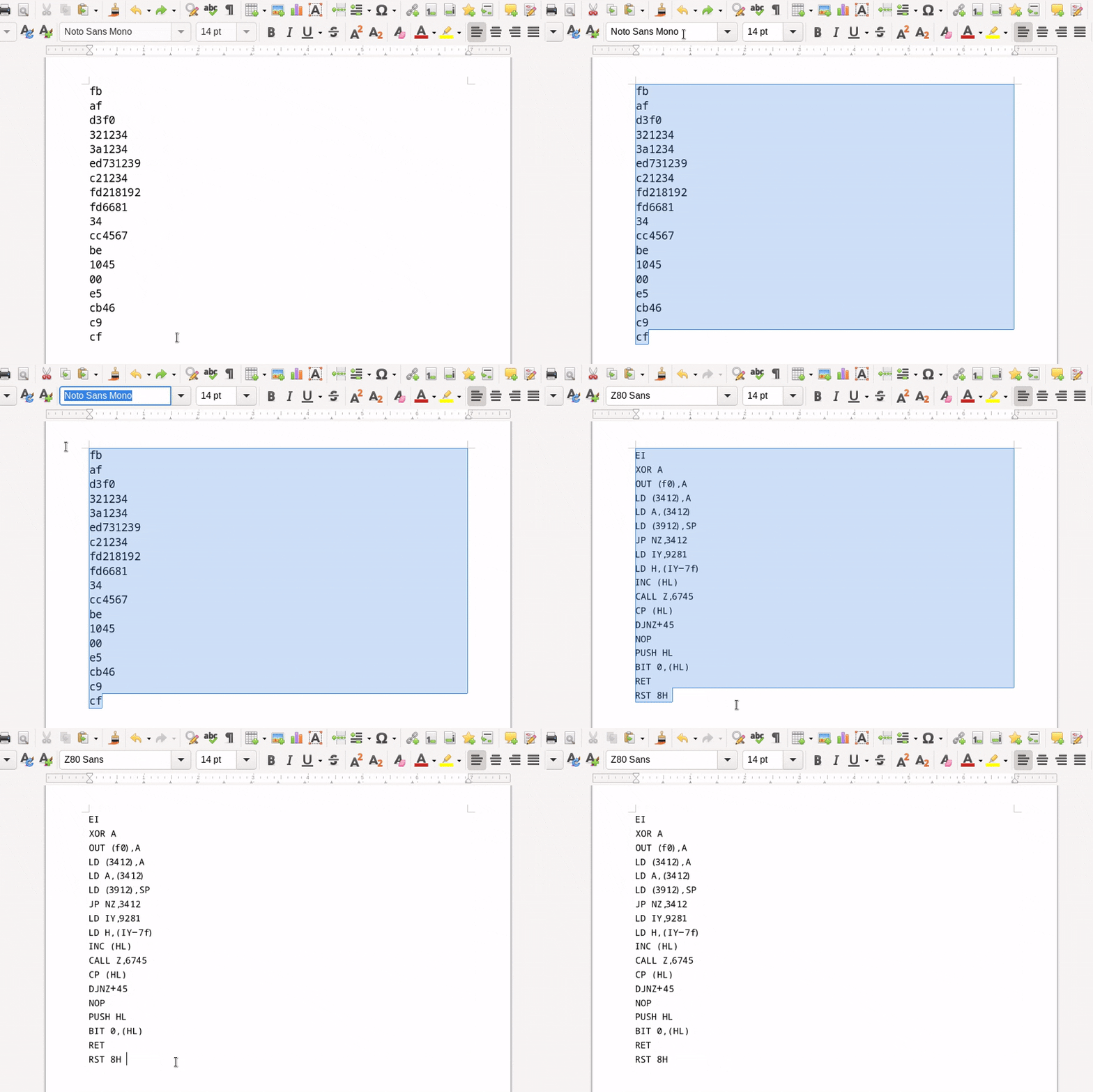
Those who stay into the forbidden realm of font rendering quickly learn how convoluted and arcane it can be – LaTeX is a fully Turing-complete programming language, Unicode has over eighty invisible characters, and there are libraries that let you execute WebAssembly in a font. A great example of a font’s hidden capabilities is Z80 Sans, a font that disassembles Z80 opcodes to assembly mnemonics.
If one pastes Z80 opcodes into a word processor and changes their font to Z80 Sans, the codes are rendered as their assembly mnemonics. The font manages this by abusing the Glyph Substitution Table and Glyph Positioning Table, two components of the OpenType standard. Fonts define relations between characters (internal representations used by the computer, such as ASCII and Unicode) and glyphs (the graphics actually displayed).
In some cases, though, the way a character is displayed depends on where it appears in a word, or what appears around it (Arabic characters are a common example, but an example from English is the ligature “æ”). Z80 Sans defines all the possible glyphs for each nibble of the opcodes, then used a recursive descent parser to generate substitution rules which display the correct glyphs in context.
For a deeper dive into the pitfalls of text graphics, check out this font rendering engine written for a hobby OS. You can also use fonts to play games or talk to an LLM.












You can use the ae char to spell out a popular IDM duos band name.
Probably best suited to RISC opcodes with fixed length (e.g. ARM and MIPS)? In which case you don’t have to figure out each line length, it would work without splitting lines at all, and if you do want to split lines for visibility (probably a good idea) a dumb script can do it automatically.
HarfBuzz has gone too far. If you can’t render fonts without being Turing complete then you have fundamentally failed at writing a font renderer.
Input a string and it renders a playable version of doom.
bookmarking this comment for 6 months from now when there’s a HaD article on this
I challenge someone to make one of these for x86 or x64 including MMX, SSE, AVX etc. Could it even be done?