
Some FDM filaments are pretty brittle even if properly dried and stored, especially those which contain carbon fiber (CF) or similar additives like glass fiber (GF). This poses a problem in that these filaments can snap even within the PTFE tube as they’re being guided towards the extruder. Here a community theory is that having an actively heated chamber can help prevent this scenario, but is it actually true? [Dr. Igor Gaspar] of the My Tech Fun YouTube channel gave this myth a try to either confirm or bust it.
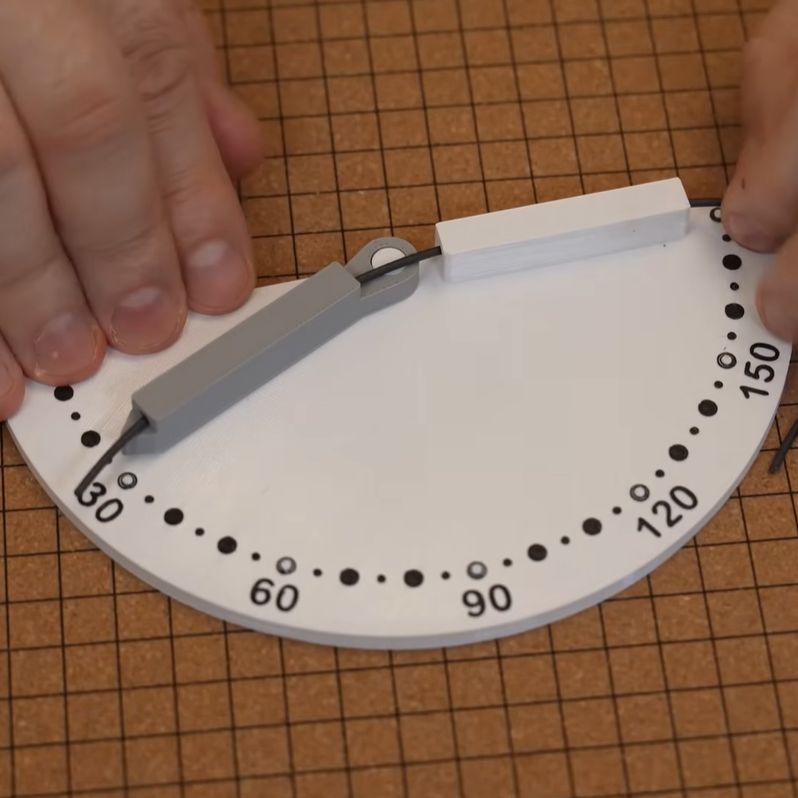
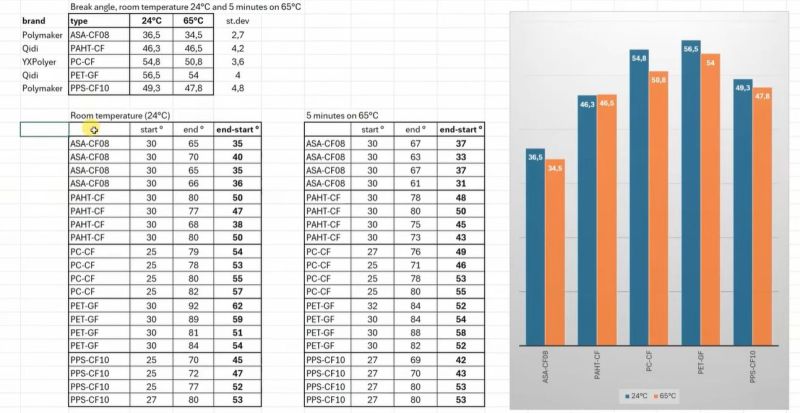
The comments suggested that heating the chamber to 65°C will help, but there’s little information online to support this theorem. To test the claim, a heated chamber was used along with a bending rig to see at which angle the filament would snap. In total five different filaments from three manufacturers (Polymaker, Qidi and YXPolyer) were tested, including Qidi’s PET-GF and PAHT-GF as the sole non-CF filaments.
A big question is how long exactly the filament will spend inside the heated chamber after making its way from the spool, which would be about 2.5 minutes with a 500 mm tube. For the test 5 minutes was used for the best possible result. Despite this, the results show that even with the standard deviation kept in mind, the heating actually seems to make the filaments even more brittle.
Considering that in general CF seems to simply weaken the polymer matrix after printing, this finding adds to the question of whether these CF and GF-infused filaments make any sense at all.











For anyone who’s read the article and is about to watch the video don’t be fooled by the nice picture of the bending rig here. Prepare to spend the next few minutes screaming “move your fingers out the way!”
I have some really brittle Flashforge Burnt Titanium ASA. It started out OK, but I think I over dried it and it was very brittle even when printed and left a terrible surface finish, I almost threw it out. On a whim one day, I stuck it in my dryer one day with a large container of very wet desiccant and left it until the humidity was back down to 9. Crazily enough it printed a little better and I could slightly bend the filament without it snapping. I did this process one more time and it’s even better.
“Considering that in general CF seems to simply weaken the polymer matrix after printing, this finding adds to the question of whether these CF and GF-infused filaments make any sense at all.”
This statement is not universal and it misses the whole point of fiber reinforced FDM – drastically reduced warping. The additional stiffness is (sometimes) useful too when constrained on weight or space. Additionaly there is little doubt nylons tend to benifit signifcantly in strength and is not the only material thaf does, plus it makes the wet/dry properties more consistent (though still quite variable).
I dont disagree that it gets used more often than it should and users need to fully consider the downsides (health concerns, low impact strength) but there are real use cases for it as well.
Additionally, while im not sure if pla-cf makes much sense for most applications (though near zero warp pla isnt useless), I have concerns about the SEM photographs showing poor fiber adhesion/contact. I would like to see a control sample of traditional CF-epoxy composite as well as several injection molded cf and gf reinforced polymers because i have a theory that its just about impossible to make a cut without de-bonding those very strong and hard fibers from the realtivly weak plastic.
There’s usage cases where CF PLA works better than plain PLA. When we need the print to be stiff, it works well. It’s not CF in resin and we don’t expect it to have those properties.
There’s a contingency that, for some reason, seems to want it abolished and can’t stop going on about it every chance they get. To them, I suggest getting together and making T-shirts.
Various types of Nylon definitely benefits from fiber reinforcement ( or rather, filler) in most cases, same with ABS/ASA.
PLA is definitely one where I’m scratching my head about it, because the nature of it means it doesn’t lend itself well to reinforcing filler.
IMO it seems like there’s kind of a connection between filaments that can in some scenarios have almost destructive unintentional bed adhesion capabilities, and benefitting from fiber filler reinforcement.
One of the basics of material science is the concept of strength vs. toughness and modifying a material to increase one typically decreases the other.
As I read these articles I frequently see comments much like yours.
This keeps being pointed out and yet the articles keep neglecting to mention this.
From that closing statement in particular it’s pretty clear HACKADAY is biased against filled filaments.
I had some filament I over-dried and and it became very brittle. I was still able to use it by pre-warming in the dryer. Note that the dryer sits just above the printer and the filament has a relatively short path down into the top of the extruder, with no tube.