
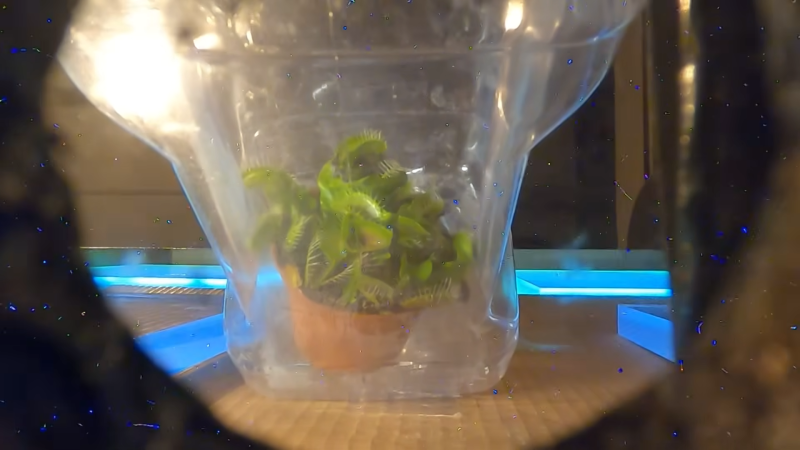
In the blue corner, we have the VENUS FLYTRAP! In the red corner, we have the underdog of the century, AN ENTIRE PARTICLE ACCELERATOR. Yes, you read that right. When you have a particle accelerator, it’s only second nature to throw anything you can into it. That’s why [Electron Impressions] put a poor fly-eating trap into their accelerator.
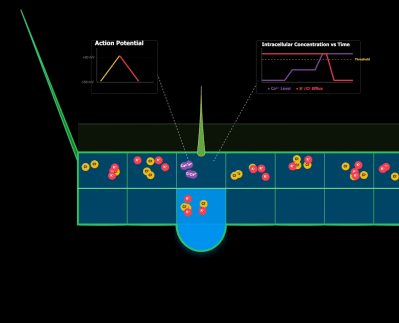
The match-up isn’t quite as arbitrary as it might seem at first. The flytrap’s main mechanism of trapping and digesting insects relies heavily on intracellular ion movement. Many cells along the inside of the trap have hair-activated calcium channels that respond to a fly landing on its surface. This ion movement then creates an action potential, which propagates along the entire surface, triggering closing. As the potential moves across different cells, other ions leave and create osmotic pressure. This pressure is what creates the mechanical movement.
Of course, this makes it no surprise when the plant finds itself under the ionizing radiation that every single head closes at once. While this is a cool demonstration, there is a slight side effect of killing every single cell by ripping apart the trap’s DNA.
Well, who would have guessed that the underdog accelerator would have won… Anyways, the DNA being ripped apart is far from ideal for repeatability. If you want to learn more about genetic features that SHOULD be repeated, then make sure to check out the development of open-source insulin!












Somehow, I really feel sorry for the Venus flytrap.
Zombies
He could put cockroaches in it next. Or the guys of that incogni firm he advertises.
This is how you get Little Shop of Horrors.
My thoughts exactly
WKRP will never be the same.
Ohhh the humanity!!!
In terms of radiation
https://techxplore.com/news/2026-03-radiationhardened-wifi-chip-survives-kgy.html
If the plant uses ion processes itself then could it be possible to keep the plant DNA alive with ion shielding to stop the it breaking up during the experience in particle accelerator.
Plants alter enzymes to protect themselves:
https://phys.org/news/2026-03-survive-stress-scientist-persistence-reveals.html
https://www.pnas.org/doi/10.1073/pnas.2529243123
Perhaps plants could be spliced with DNA from this:
https://en.wikipedia.org/wiki/Radiotrophic_fungus
An accelerator might still be a bit much, but if it works, you might have life that could survive harsh environments in space…near flare stars, in Van Allen Belts, etc.
This is how you create that “feed-me-Seymour, feeeed meeee!!” plant in the Little-Shop-of-Horrors’
Her name is Audrey II.
It’s also the name of my sourdough mother. Because it’s always saying “feed me”.
Plants need DNA to reproduce, granted. Do they need it to live?
Fungus use giant virus DNA to toughen up.
https://phys.org/news/2026-03-giant-virus-dna-polar-algae.html
Maybe redundant coding can be introduced, same way the space shuttle used three computers
I know everyone likes to bring up Little Shop of Horrors, bud did anyone ever see that old 50’s Sci-Fi flick “Day of the Tiffids?”. I always think of that one when super science gets to messing with plants.
I laughed. This is the best science research in a while. 😜
Well, that’s a better result than creating a man eating plant monster. Still cool though.
You want Little Shop of Horrors? THIS is how you get Little Shop of Horrors
Would static electricity do the same without the damage?