

If you’ve ever bought a suspiciously cheap Ethernet cable from an online listing, there’s a decent chance you’ve encountered Copper Clad Aluminum. Better known as CCA, it’s exactly what it sounds like—an aluminium conductor with a thin skin of copper deposited on the outside. Externally, cables made with this material look largely like any other, with perhaps the only obvious tell being that they feel somewhat lighter in the hand.
CCA is cheaper than proper copper cabling, and it conducts signals well enough to function in an Ethernet cable. And yet, it’s a prime example of corner-cutting that keeps standards bodies and professional installers up at night. But just how dangerous is this silent scourge, found lurking in so many network cabinets around the world?
Not Up To Scratch
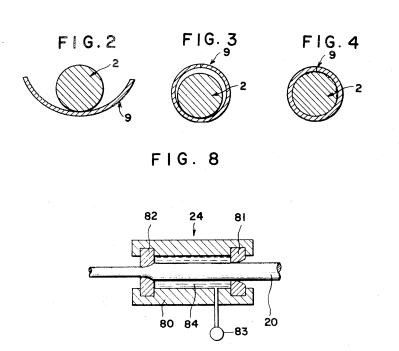
Everything you need to know about CCA is in the name—it refers to an aluminium wire with a thin copper cladding, typically applied through a die extrusion process. The reasoning behind this exploits a real physical phenomenon called the skin effect, wherein higher-frequency AC signals tend to travel along the outer surface of a conductor. The idea goes that since most of the current moves through the outer copper skin layer anyway, the less-conductive aluminium core doesn’t unduly impact the wire’s performance. Using copper-clad aluminium wiring is, in theory, desirable because aluminium is much cheaper than copper, which can really add up over long cable runs. Imagine you’re wiring a building with with hundreds of miles of Ethernet cabling, all with eight conductors each—the savings add up pretty quickly.
There’s a problem with CCA cabling in these contexts, though. Due to prevailing cabling standards, any cable made with CCA is technically not even a real Ethernet cable at all. The relevant documents are unambiguous.
ANSI/TIA-568.2-D requires conductors in Category-rated cable to be solid or stranded copper. No other materials are acceptable, and thus CCA is explicitly excluded from use in Category cable applications. A cable with CCA conductors cannot legitimately carry a Cat5e, Cat6, or any related designation under any circumstances. Similarly, ISO/IEC 11801 has the same requirement. The U.S. National Electrical Code also states that conductors in communications cables, other than coaxial cable, shall be copper. This isn’t a suggestion or a best practice; it’s the letter of the code. Anything lesser is simply not allowed.
CCA cabling can be hard to detect, particularly where a manufacturer has intentionally hidden the fact that the inferior wiring is used. One way to be sure is to strip a wire and scrape away at the copper to see if there’s aluminium lurking inside.
The simple fact is that regulators demand a certain level of quality for communications cable, and CCA just isn’t it. In the specific case of Ethernet cabling, it is worth noting that the skin effect that makes CCA construction useful in other applications doesn’t really apply. That’s because the skin effect is frequency-dependent, and so it doesn’t apply to DC power as used in Power over Ethernet. In fact, the DC resistance of a CCA conductor of the same gauge is roughly 55% higher than copper of the same gauge. CCA cables also tend to be less flexible and more brittle than the proper all-copper equivalent. These are fundamental physical ways in which CCA doesn’t measure up to scratch. These differences aren’t enough to stop the cables working for their intended purpose in many cases, but it’s part of the reason that standards organizations mandate pure copper and nothing less.
The problem that stems from this is that installing CCA communications cable in a building can make the installation non-compliant and potentially even illegal in jurisdictions that adopt these relevant standards. Much of the concern comes down to fire ratings and insurance concerns. For example, the UL 444 standard lays out the requirements for cables to meet the CM, CMR, CMG, and CMP fire ratings you see printed on legitimate cable jackets. These rules require copper conductors. Thus, CCA cable cannot carry a valid UL listing and any install using it will not be compliant with fire safety regulations. A building with such cable installed would be potentially liable to have any insurance invalidated for not meeting basic code requirements. Any contractor installing such cable could be liable in turn.
Grabbing a cigarette lighter can also help determine if given cabling is pure copper or copper clad aluminium.
The question is, though—are CCA cables actually a real-world fire risk? That is harder to answer. The common concern is that a tightly-wrapped bundle of CCA Ethernet cables running Power over Ethernet could get hotter than intended due to increased resistance, eventually overheating, melting, or catching alight. With that said, we are yet to see any grand examples of buildings catching fire and burning to the ground because of CCA cabling. Such cables might not be to spec, and they might not do as well when used for Power over Ethernet due to their higher resistance, particularly over longer runs. However, issues are likely to be more related to insufficient power delivery rather than severe overheating. Where there’s no smoke, there usually isn’t fire. There would be plenty of photos online of melted CCA cables being pulled out of smoking rubble if this was occurring on the regular.
Ultimately, if you’ve got a CCA cable or two running around your house, you probably don’t have a lot to worry about. They might not survive as well as a proper copper cable, and they might be a little dodgy on long runs with PoE equipment, but they aren’t just going to burst into flames at the drop of a hat. With that said, they are technically uncompliant with all relevant standards, and if you’re trying to meet code, you should absolutely steer clear of CCA in all cases. This warning, and so many that have come before, won’t do much to stem the flow of CCA cables into the market, but it might at least stop you making a mistake the next time you’re speccing a new cable project. Stay safe out there.












I noticed this after trying to solder some cat6 cable for prototype circuits. The copper on this cable was merely a suggestion because it would barely tin. Now it makes sense why the price was so good.
It is worse than “it would barely tin.”
If you use lead-free solder, the solder “eats” the copper plating off of the wire. You cannot solder it with lead free solder.
If you have old fashioned tin/lead solder, you can solder copper clad aluminum (CCA) about as well as you can solder regular copper wire.
I went through this a while back. CCA is also used in cheap jumper wires with the “Dupont” connectors on them. You can crimp such wire well enough to make the jumper wires, but you can’t solder it with lead-free solder.
https://josepheoff.github.io/posts/howtosolder-flux
That blog post goes into some detail on the problem of soldering CCA. It also mentions flux, and makes sense of the modern tendency to flood everything in flux – the no-clean flux in most lead-free solder just straight up sucks, so everyone floods everything with extra flux. Much of the flux in flux pens or liquid flux is activated rosin, so it works much better. If you’d just buy lead-free solder with an activated rosin flux core, you wouldn’t need to flood everything with flux.
Yes, the CCA jumper wires are BAD. Even with leaded solder, it takes very little heat to remove the very thin copper layer and it’s done. It can be done in a pinch, but it is super annoying as you have to be fast. The best is to remove the crimped pin from it’s housing, cut it and solder to that if really needed. The better solution is just to avoid soldering CCA wires.
I’ve seen cheap “Dupont” jumpers that had ferrous wire. They’d stick to a magnet (yes, the wire, not just the crimp terminal) and rust, and of course their resistance is high enough to create problems even in relatively low-power circuits. Before that I hadn’t even realized that anyone on Earth made insulated, stranded iron wire.
Why are you making your life difficult with high temp pain in the ass lead free solder? Yes, it is good for companies producing millions of tons of landfill fodder a day to use lead free, especially when they can absorb the cost of fancy reflow and wave solder machines. But hand soldering lead free…..are you a masochist or something? “But the lead smoke!” Where did you get an iron that can hit the vaporization point of lead?!? Thats vaporizing flux, not lead. “But lead residue” Did your momma not teach you to wash your hands before eating? Because it aint gonna soak in through your skin, plus they make tubes to hold the solder, that you can reload from your spool using a drill and a tape cassette respooler …er, I mean pencil. “But but but [another opinion that falls apart at the first glance at factual reality]”…Bruh, stop. Look, if you hate yourself just say you hate yourself and its a form of self punishment. Because that is pretty much the only way hand soldering lead free on personal projects makes sense. Use the good stuff, nice jUiCy LeAd TiN everybody panic national superfund cleanup site in the making a your desk, far too many people assume, solder. Its fine. No seriously, its fine. Stop torturing yourself. You deserve better.
I don’t know where you got all that, or the rest of your rant.
I use lead-free because that’s what is conmonly available. Tin/lead alloy is getting harder to find.
If you have any skill at all at soldering, lead-free isn’t a problem – just make sure to use solder with a good flux, and don’t try to solder CCA with it ‘causr it won’t work.
I grew up using tin/lead. I used tin/lead daily for 12 years as a technician.
I still use it today, just not as often because I try to keep it for those cases where lead-free doesn’t work.
“Tin/lead alloy is getting harder to find”
I don’t get it.
Use what you want to use, I’m not commenting because I have any interest in changing what anyone uses at all.
But I feel like I am always hearing this or that is hard to find these days. On other forums I hear that variable capacitors are hard to find or varicap diodes… or some other component. More than once I have bought a box of junk at a hamfest because it contained components that I remembered reading were “hard to get today” only to check after the fact and find they were not hard to get at all.
I tried Google, plenty of listings for leaded solder.
Most people are skipping that and going to Amazon now right? I checked.. lots of leaded solder. Maybe some still prefer a brick and mortar store where they can see what they are buying and take it home the same day. Microcenter has it covered.
So I am at a loss. It’s a lot easier today to get pretty much anything than how it was a few decades ago. What makes people think things are rare?
Agreed. Also it is a matter of the right soldering iron.
For a while i tried to use a standard weller magnastat with a extra hot number 8 tip. Brand new. Got eaten away by the solder very quickly, apparently not lead compatible, but it also didn’t quite solder nicely. My unregulated Velleman iron didn’t get eaten away, but didn’t feel quite as smooth as the Weller with lead based solder and a normal 7 tip.
I then bought a Pinecil, and with the Fuji patent SnCuNiGe lead free solder that was recommended to me, hand soldering through hole stuff is literally as easy as it used to be with Sn/Pb and my old Weller.
For newly built stuff i now only use the lead free stuff. But there will always be spools of lead based solder in my stash for working in pre-RoHS electronics, or working with vintage components.
I live in Germany. Most places don’t sell solder with lead.
Conrad.de is a large supplier here in Germany. A search for lead-free solder turns up 237 options on the Conrad site. A similar search for solder with lead on the Conrad site turns up 22 options, half of which are actually lead-free. Most of the results with lead are from off-brand crap I wouldn’t buy. Surprisingly, there’s also an offer from German made Stannol brand for 60/40 tin/lead. It costs about 1/3 more per roll than the similar lead-free offering, and it is only sold to business customers – you can’t buy it as a normal person.
So, yeah, solder with lead is getting harder to buy and more expensive.
Make your own?
TME has a standard 100g spool of 1.5 mm 60/40 solder made by Cynel (a reputable brand) for $9. Currently 197 in stock with next-day delivery to InPost Paczkomat. They don’t really care if you’re ordering it for business, DIY or autoerotic lead poisoning.
https://www.tme.eu/pl/details/lc60-1.50_0.1/druty-lutownicze-olowiowe/cynel/sn60pb40-sw26-2-5-o-1-50-100-g/
Lead free gave.me problems hand soldering. I switched back. No problem finding it. Also discovered that flux is fun.
That said, I have a fume extractor fan with.activated charcoal to keep lead, etc. vapors out of my lungs. Wash hands afterwards.
Safety problems handled.
It’s not just safety. It’s also about what happens when you rinse the little sponge you wipe your tip on. Do you collect the rinse water, or do you let the lead contaminated water get into the drain?
Or the little bits of crusty oxides that flake off, or balls of of solder that sometimes fall of your iron. when you re-tin it. Do you put those in the trash can, or into the household chemical waste to bring them to recycling later?
Or those used prototyping boards that have no-value components left on them, and solder sticking to them. Are you gonna put those in the recycle bin, or simply throw those in the trash?
I know i didn’t always take that issue too seriously. I clean the workbench, tiny flakes of solder stick to the wet wipe, i throw the now lead contaminated wet wipe in the trash. Or i empty the solder sucker in the trash. Or i throw the used solder wick in the trash. Stuff i never thought about until fairly recently. And i think quite a lot of people do the same.
I know hobbyists are only small fry, but it is still wrong to just chuck everything in the bin when it is lead contaminated. When it’s lead free, the environmental impact is already a lot lower.
Because lead oxide fumes are neurotoxic; they literally make you dumb.
The main purpose of the copper cladding (other than deception) is so you have a copper layer to connect to. Aluminum oxide is not conductive and aluminum oxidizes easily.
I bought a CCA patch cable from Amazon that was advertised as copper. Sent it right back for a refund.
How did you know it was CCA?
It said so on the package, but not the Amazon listing.
… Apparently, people forgot about the aluminum wiring debacle in residential construction from the mid 60’s and 70’s, which literally resulted in house fires. I will grant that it wasn’t copper clad aluminum, which only sort of gets around that issue.
We’re also not talking about mains AC loads here. Even PoE is a relatively low-power DC load that isn’t likely to roast anything. As the article said, the most likely consequence is just equipment malfunction from insufficient power.
with 48V PoE power you could definitely get close to ignition at the point of a corroded connection, which is a real long-term risk given how copper and aluminum react. Handling buildings with mixed aluminum and copper properly is a real headache, and requires special techniques (often goops that will seal out oxygen from the joint).
I mean, similar just because of the aluminum, but really completely different. The aluminum wiring caused many fires, death, major changes in the construction and insurance industries. It really was insane. As an electrician I still run into homes with aluminum wiring. I always recommend full replacement. They never do it. A home I had recommended replacement burned down 2 years later…
For house installations, trouble is not in aluminium (which is a decent conductor) but in the connections. Typically, screwed or weak spring aluminium connections get loose over time which causes heat, extreme heat, and later that good-ol’-arc light and hence fire. Rigid aluminium wiring serves well if maintained properly (which noone does and THAT is the trouble).
Going even further, aluminium has a higher conductivity to weight ratio than copper. Lower cost to conductivity ratio too. Makes steel cored aluminium the go to for power transmission lines.
It’s cheaper, it weights half as much for the same losses, which mean the steel core can be thinner as well and can span longer distances between poles.
Conductivty to weight is the most useless stat possible because wire sizing is related to cross section not weight. Also everyone can stop quoting aluminum conductivty specs because you are most likely dealing with aluminum oxides unless every connection is gas tight perfect crimps or welds made is an inert gas environment after meticulous cleaning. I also am sceptical of how the cables perform in terms of flex cycles. I can certainly understand the desire for lower costs and there are good record for aluminum service entrances but of ethernet and low voltage application I don’t like it very much.
The only one of these that seems to have actually used Al wiring. ( Plus the reply from Chris).
Some quick points: probably in a bad order but a mental vomit on how … lacking info this post is
-the only thing this article actually says is it may be against a code. ..note: the code only consider cables that are a part of a building or a permanent installation. Patch cables are not under that accept for specific applications. So most of these meet “Code”
– per this comment the connection matter, given CAT cable connectors just use a fork to dig into the cable this is truly a seemingly bad use of CCA however….
– less then59V per NEC is considered very low risk of a fire, if you are NOT using it for POE it’s probably fantastic. IEC has similar but I’m not as familiar.
– on high enough frequency I expect that the signal would blast through the aluminum oxide layer but might add latency.
-Aluminum is typically 1/3 the cost. On MV+ cable where the connection is native crippled by a hydraulic press you would have to have a reason to use copper… Connection matters
Finally point, this does point out that since WWII we have not seen CCA cable. ( Yes that’s when it came out) Being aware of what you are buying and it’s limitations is a great call. ( Most connectors are not rated for CCA) You will also see CCA cable pretty often on awg 10, 12 and 14. ( Seen on Romex and Metal Clad cable) If you are looking at power CCA I would not use this on plug-n-play connector or wire nuts as both dig into the wire ( accept if they are rated for aluminum), I might use them on wagos as they lay on top the wire. Also lug connections should be fine. All things are cost vs risk use judgement.
There are building codes other than NEC that cover low voltage installations.
Codes do not just include permanent items, there are fire codes and insurance regs in play as well and they cover everything contained in a building. Good luck on a claim when your Cat 6 wiring burns down and they find out your patch cords are not Cat 6 compliant. They have armies of inspectors amd lawyers whose purpose in life is to find reasons to deny claims.
Every RFP for low voltage installs that I have ever read specified a Cat number for an ethernet installation. If any piece in the path is not cat compliant including the patch cords, the installation is not compliant.
I have no idea why NEC would say under 59v is not a fire hazard. Ever heard of a wiring fire in a vehicle? Happens all the time. Current creates heat and 48VDC over thin conductors pushes the limits more than most 120vAC connections. AT&T has experienced complete destruction central office fires triggered by 48VDC wiring.
Crimped connectors are some of the best connections possible as documented in Bell System and NASA specifications. If properly done they are gas tight at the point of contact.
Have a look at your homeowner’s insurance. There’s a good chance it requires you to only use electrical devices certified by a nationally-recognized testing laboratory. If you don’t, and there’s a house fire, the policy won’t pay out. In which case, using CCA communications wire—which can never get a UL or ETL listing—means that all that money you spent on homeowner’s insurance may be an utter waste, because you voided the policy to save a few bucks on wire.
Well, if the problem is screwed or spring connections, what is the suggested fix for that? What other options exist for connecting switches or plugs. No one is ever going to go around a residential site and retorque devices. I believe that the idea of aluminum service wire was acceptable was related to two factors. 1. Bigger lugs with so much torque that even slight loosening has no major effect and 2. Most service entrance cables are in reality grossly oversized proportional to the load so they never heat much.
I understood that the aluminum wire problem was due to different thermal expansion rates between the fixtures and the wire, hence the loosening of connections as power was cycled. I wonder how CCA deals with this? Are the alloys matched or does the thinner copper just “deal with it”
lets go with copper clad sodium wiring lol, best conductor per weight and as cheap as it can get
hardware.slashdot.org/story/19/06/08/1827250/the-lost-history-of-sodium-wiring
I bought CCA network cable from a local budget store, I know it’s CCA because it says so on the cable every so many centimeters (and it was dirt cheap).
And I would not use it as a main network cable but for some quick low speed stuff and experiments it’s OK.
I mean I can update a raspi with it no issue.
The not being able to solder the stuff is annoying though, but with molded connectors you don’t encounter it.
Incidentally I noticed that in the US they often use aluminium wire for connecting lightning rods, seems odd to me because it would melt immediately before the energy was dissipated I figure, but is seems the standard in the US, and they use pretty thick stuff of course.
OH btw most network interfaces can now report the length of a cable connected, so if it is CCA would that number not be way off? Maybe that’s a way to test it?
The only thing the TDR cares about is the coefficient of propagation(percent c in a vacuum of the medium) – which does indeed derive from the medium the signal travels through. For example, coax usually comes in at around .6-.8… fiber around .8-.95-ish(depending on frequency)
Are you saying that fiberoptic gets measured or reported as 80–95% of c? I must be misunderstanding you, I think.
c is the speed of light in a vacuum. Light traveling through glass fiber travels slower. Same as light traveling through air, or water. That’s how you get rainbows, because different wavelengths get slowed at different rates, separating the colors into the familiar ROY G BIV spectrum.
Yes light in comm fiber is usually 70-80 percent of light in a vacuum and electron flow is copper is actually a bit faster than that. Nonintuive but true.
The speed of light in fiber is dependent on its glass (or plastic) composition, which also determines the wavelengths (frequencies) it works best at.
But as a general rule, the velocity factor in fiber is around 0.60-0.70, typically close to 0.67.
Some exotic fibers use very high index glass (or liquid) for a high acceptance angle, yielding even slower light (but better etendue: more light throughput)
But to answer Aknup’s question: You need to tell your TDR the velocity factor of the line you are measuring.
The velocity factor is determined by the geometry (conductor shape, size and spacing), and the interposed material’s dielectric constant.
The wire conductivity or material does not matter.
I still think somebody should test it.
And the non specialized NIC does not ask for data, they just assume a standard LAN cable and then guestimates the length.
I’m sure there is dedicated stuff that does it more precise, but we are talking about a way to find it out for normal users I think right?
And aluminium does some odd things as we know, you get eddies and what not.
Actually It would be funny if we found CCA has some properties nobody ever thought to check for. Inventions were made before from oddities like that, common stuff in configurations and suddenly you have high temperature superconductivity or polarization from sugar and such things. Sometimes it’s done with forethought like doped glassfiber and semiconductors, but sometimes we discover things unexpectedly.
If it takes a direct hit, it won’t matter if it is copper or aluminum. Its gonna vaporize and while vaporizing it is doing it jobs long enough to be effective.
Many would be surprised to know that almost all the big coax of the trunk lines on the RF side of cable systems has copper-clad aluminum center-conductors and aluminum sheaths. The Skin Effect in practical action.
CCA coax cable can be problematic in TV dish setups with power hungry LNBs (depending on cable length to farthest receiver, number of “adapters/spliters/injectors” inside).
Especially with Unicable/DCSS/JESS LNBs where several outlets can be chained in series – adding resistance and dampening with every outlet.
Oh damn limroh, they make CCA coax too now? :o
True, but:
1. The copper cladding is significantly thick
2. The connection between coax and connector is mechanical, not soldered
3. If water gets into the connection, game over.
The latter two are indeed true, however on the cable I worked with, we had to be careful not to scratch the cladding on the center conductor – even rubbing it hard could remove it. It was very, very thin. This was made more difficult due to the tools we were provided to prep the cable for a connector not removing all of the dielectric material from the center conductor. I -believe- they were Amphenol, although I recall another vendor coming in at one point. It was 20 years ago.
I once unknowingly used CCA wires in an outdoor LED installation. After a year, the wire had completely “rotted” and gone open circuit. It had no tensile strength and easily snapped and crumbled into black dust when you touched it, probably aluminum oxide. Never again!
It’s funny that HaD now is talking about CCA when in the meantime we are currently living under the next phase, the scourge of copper clad iron.
And they did actually use it deliberately in the long past because it has a higher strength and for some applications that was wanted I once read, but now that we see it in data and audio cable of all kinds.. it’s worse than CCA isn’t it?
The one advantage is that a magnet will immediately give it away, and if you are at a physical store you can even test before you buy.
I once got some CCI (or is it CCF from ‘ferro’?) and the resistance I measured was insane, you could use it as heating wire I bet.
I received a copper clad steel IEC power cable with something I bought once. Luckily I noticed that the cable got very hot with just a couple amps running through it. I took it outside and ran 10 amps though the cable, which is what it was rated for. It didn’t take long for the insulation to melt.
I check every power cable I get with a magnet now.
Copper clad steel does have its uses. It’s great for permanently installed wire antennas since it’s very strong. Because of the skin effect, RF current only flows on the outside of the wire. As long as the copper is thicker than the skin depth, it doesn’t matter what’s in the center. The copper cladding on good quality antenna wire is fairly thick, so it lasts a long time out in the weather.
CCS is also generally fine for coax as long as the copper is thicker than the skin depth, but it can cause trouble with satellite LNBs because they run power over the coax.
Hmmm…. you’d think the easiest way to identify such a cable would be to measure the resistance, we all have a meter, right? Would not want to destroy a cable to find out.
But the article and linked article has no hard data on it, just gives percentages. Makes the whole thing feel biased toward standard holder. Perhaps they lack the resources to certify what it’ll take to make CCA Ethernet cables that work? Feels like someone trying to turn back the clock. I think I have not seen a pure copper cable in a decade or more. I suspect my latest crappy earbud cables are CCA….
CCA, the horrible stuff, does have a very interesting property: It can be entirely non-magnetic, with the correct proportions of copper on aluminum. The paramagnetism of aluminum cancels the diamagnetism of copper. This is a useful property when building RF coils that need to exist in a uniform magnetic field like a NMR machine or MR imaging system: The resulting coil does not distort the magnetic field.
CCA, for a given weight, also has lower resistivity than copper.
But it’s still horrible.
Thing I’m seeing, is iron core cables with copper outer layer.
I’ve ended up having a magnet in the tool box to check
Copper clad steel is very common when you need the tensile strength. Common for pole-mount telephone wires. Also used in some coaxial cables.
Aluminum-wrapped steel is also common. Pretty much every high voltage power line is built that way.
Even plain steel wire is used in some good quality headset cables for strength.
Aluminium cable is bad for many reasons – many already mentioned above. It creeps in connections, it fractures with flexing, it forms a poorly conductive oxide layer, and it just doesn’t behave as copper does in numerous ways that can cause problems.
While it may not be “dangerous” in ethernet wiring like it was in house wiring it will almost inevitably be less reliable especially as there’s millions of crimp connectors and IDC terminals out there that were designed to work with a very specific copper wire. Modern PoE powers are creeping up too, so it’s not impossible to imagine it setting something on fire eventually.
In the UK we’re still living with the legacy of a load of aluminium telephone cables that were installed for a short period decades ago, and those aren’t carrying high speed data or significant power.
I purchased 500ft Ethernet cat5e cca cables to for my security poe cameras without knowing what cca was. Amazon sellers lie about their product. You really have to do research on what your buying on amazon. I learned from that mistake.
With that said though, its been 8 years since that purchase and I’ve only had to replace the rj45 connector on one of the cameras. some of the wires in the connector was burnt (even though the connector was not exposed to the weather, and it was hidden from sun exposure).
I thought about replacing all the wires and searched for 500ft pure copper Ethernet cables and quickly understand why the cca was so damn cheap lol.
I think for home use, you can get by with cca especially if you already have it. You can use it for short runs, patch cables, and connecting switches and computers.
I’ve had a short ethernet patch cable that stopped providing gigabit, only connected at 100m. It was like 10 years old but it was clean and rarely relocated or disturbed so I couldn’t believe how it could just fail like that. Well when I looked at the ends I noticed the cut ends of the wires were silver colored! It was actually aluminum wire! At that moment I realized that aluminum wires are a ticking time bomb. Aluminum oxide is non-conductive, so what happens is the wires that are shoved into the terminals, oxidize over time and form an insulating layer, breaking the electrical connection. That explains all those times I found a perfectly good looking cable that just didn’t work. Now I know to check for this if I need a reliable cable; just because it’s new doesn’t mean it’s good. That cable came with a Linksys router, smh.
I’ve done several jobs where another contractor had roughed-in cabling, our task was to terminate it and install the equipment. The cable the other guys ran was unbranded, and labeled Cat6. It would not even pass Cat5a certification. It turned out to be CCA, but was not labeled as such. We got paid to rip it out and replace it with copper-conductor cable. (The CCA cable was usable as a pull string, at least!)
CCA is crap.
I have many different experiences with CCA, and not a single one of them good.
Even with leaded solder, soldering them is very difficult and requires many do-overs.
Crimp connections are high resistance, unreliable, and can break the wire. Wire nuts and lever connectors don’t work well either.
And if you install it within 5 miles of the beach, it corrodes into aluminum oxide ‘dust’ within months, despite the insulation, heat shrink (marine grade, with adhesive), liquid electrical tape, and completely sealed junction boxes.
Ask me how I know…… (I have learned all this the hard way, at great expense.)