
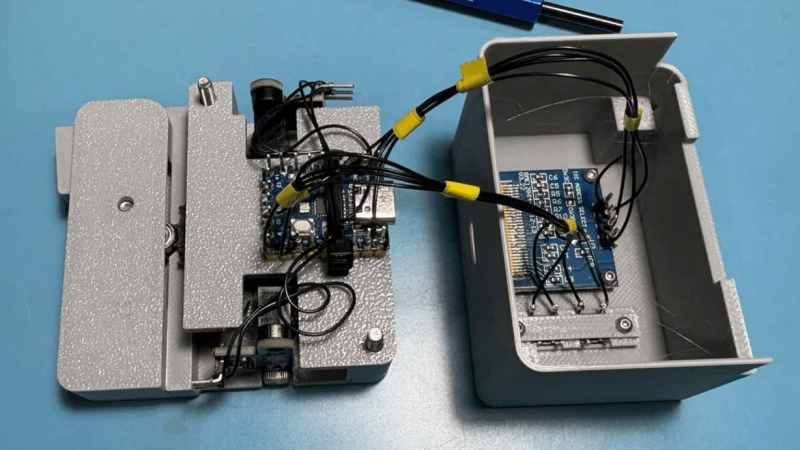
One of the great things about building electronics today is how affordable SMT components have become — sometimes just fractions of a cent each. That low price often means ordering far more than you need so you’ll have spares on hand the next time a project calls for them. Keeping track of exactly how many of each part you actually have, though, is rarely easy. To solve that problem, [John] built the Dotterboard, an open-source SMT tape counter.
While working on some of his other projects, [John] found himself managing thousands of tiny SMT parts and decided it was time to automate the counting. The Dotterboard takes inspiration from the BeanCounter — a compact, portable SMT tape counter — but expands the design to handle larger components beyond the 8 mm tapes the BeanCounter targets.
The Dotterboard is mostly 3D-printed and uses just a few common hardware parts such as springs and ball bearings. An OLED displays the current count, which comes from an encoder tracking movement and multiplying by the number of components per hole. At the heart sits an RP2040 Zero that needs nothing more than a single USB-C cable for power, unlike the bulky industrial SMT counters that demand AC outlets and desk space.
Be sure to check out all the details of the build on [John]’s website, and grab the files from his GitHub if you want to make your own. Let us know what are some projects you’ve done to save you the headache of doing the same task by hand for hours on end.












On the topic of parts inventory management, what are you all using to keep track of your components?
I’m not going to count passives and jellybean components to any further accuracy than “have a pile/running low/out of stock”, the overhead isn’t worth it. I like to keep things I use up, stocked on hand. But I would like to know if my vast collection of 0805 resistors includes a particular value or tolerance, which mcus I have on hand, or if my op-amp collection includes something with bias current below 15nA.
Devil’s always in the upkeep on systems like this, and I’ve yet to find something that isn’t a full time job to just keep updated.
I use this one, hosted locally on my home server.
https://github.com/Part-DB/Part-DB-server
I use inventree! Great project, with support for label printers, a phone app on iPhone and Android, and tons of features that I have gradually started using as my parts stash expands.
“an RP2040 Zero ” New board I don’t know about? I am aware of the Pico boards :) .
you can google it – it’s a 3rd party board. there’s lots of details but from my perspective it’s a pico board with a smaller footprint and usb-c instead of microusb. and a slightly higher price.
Thanks. A waveshare product. Another RP2040 board that I didn’t know existed. I use the Adafruit QT Py RP2040 for the small form factor. Or the Pimoroni Tiny 2350 … Lots of little boards out there!
After about 2 minutes he started explaining the workings of the box. Then I started skipping, but all that is shown in the video is talking hands.
https://johnmcnelly.com/dotterboard-a-better-smt-tape-counter/
Measure twice BEFORE you cut