
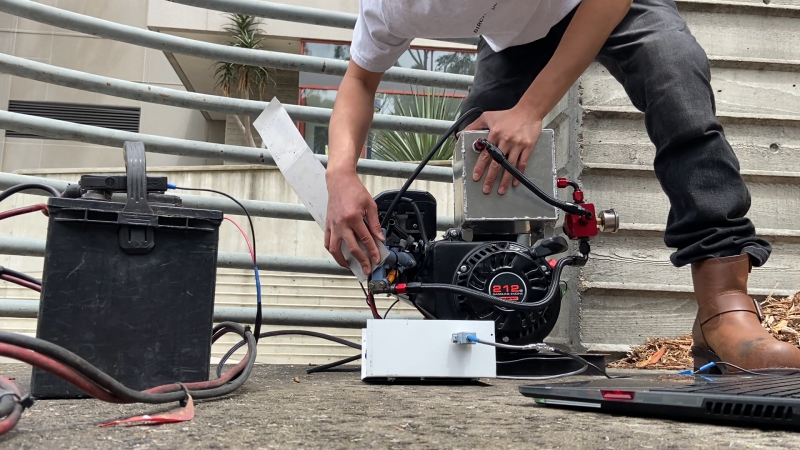
Small internal combustion engines usually keep things simple, relying on carburetors to handle metering the correct amount of fuel and air. Recently, [Carlos Takeshita] decided his small engine could use an upgrade in the form of electronic fuel injection (EFI).
The build began with a Predator 212, a popular gasoline engine from Harbor Freight. [Carlos] set about kitting it out with a missing tooth trigger wheel to measure the crankshaft position with a hall effect sensor. The engine also scored a custom-built aluminium fuel cell, complete with a high-pressure fuel pump and regulator suitable for driving the solitary fuel injector installed in the custom intake manifold. A Teensy 4.0 is charged with monitoring a manifold air pressure (MAP) sensor and the crank position, and choosing when and how long to fire the injector to dose the engine with the correct amount of fuel. Files are on GitHub for those eager to dive deeper.
It can be quite a job to convert an engine to run with electronic fuel injection, but you’re certain to learn a lot during the install and tuning process. We’ve featured similar builds many times over the years.












An aluminium fuel cell or a fuel tank?
In motorsports, often “fuel tank” is called a “fuel cell” – unsure why and/or what the difference is, other than “cells” usually are boxier in shape.
OK, to me (not in(to) motorsports) a fuel cell is a device that oxidises fuel to output electricity.
Thanks!
It’s got something to do with regulatory compliance in racing, where you need to have leak-proof designs and internal bladders, vents and fittings, etc. Sometimes there’s a foam sponge inside to prevent sloshing.
Usually a fuel cell isn’t where the stock tank was, it’s a metal box, and it has a rubberized bladder inside it so that if the metal containment is damaged in a crash, the internal bladder has at least a chance of maintaining integrity against fuel leaks.
But overall I think it has a lot to do with fuel cell sounding cooler: it is a tank.
As they had designed a race vehicle the author may have a bladder in there. Seems like they were re-using a lot of the recent experience.
https://help.summitracing.com/knowledgebase/article/SR-05241/en-us
For reference
Am I the only one that glanced at the title and thought this engine was getting new EFI firmware?
Nope, my first thought too!
Same, and that white computery looking box with the DIN looking cable coming out of it was what I thought might be getting that new firmware. =D
The fuel cell talk had me thinking hydrogen power for the little motor. This is the perfect storm of ambiguous English making things near impossible to understand without a lot more context.
Nice… Now where’s an engine/small generator with a cam profile for Atkinson-cycle operation?
Can you convert a Otto-Cycle engine in a Atkinson Cycle just back changing the cam?
I thought they used variable cyclinder displacement.
The intake valve stays open longer so some of the air gets pushed back out. It effectively makes the power strike longer than the compression stroke
A.k.a. “modified Atkinson cycle” which gives the same effect as the original Atkinson cycle without the complex mechanical linkages.
Great Project.. But no Closed Loop Control.
What do you mean? It clearly has a feedback with the air flow?
I think they mean using an O2 sensor in the exhaust for closed loop control, as opposed to just using a MAP sensor monitoring input. (not even a MAF sensor)
FI without an O2 sensor works about as well as a carb w lots of extra complexity.
The last generation of carbs used O2 sensors to make smog standards.
They sucked, especially the quadrajunk, not so much the Japanese single barrels.
Well, different complexity. Last gen carbs were really intricate too, like the bendix pressure carburetors and their licensed derivatives on american cars. Even the standard carb I have on my old car had an interlink to the speedometer so it would cut fuel flow when you were coasting at high speed to improve fuel economy, and turbo carbs were so difficult. FI abstracts a lot of that. Mercedes/Bosch mechanical injection used throughout the 60’s was fairly simple, even if it wasn’t particularly efficient or clean compared to modern electronic FI. It was still better from both power and efficiency standpoints than carbs of the time.
Some late carbs were insane.
Even the non computer controlled quadrajet was Rube Goldberg.
All the awful English cars with more carbs then cylinders.
Also six pack MOPARs.
But some were dirt simple w a simple solenoid controlling mixture.
Honda IIRC was KISS.
Carbs on small engines are still as simple as they can be.
The Bosch CIS system worked really well without an O2 sensor. The sensor was added for emissions reasons.
I myself have gone as far as installing a CDI (capacitave discharge ignition) instead of the stock megneto ignition on a 212, and the delivery of spark at TDC (offset a touch, of course) was night and day. When you’re only getting to 3600 RPM (governed), it doesn’t make too much a difference, but keeping that spark at the proper time between 1500 and 5000 is night and day over the stock magneto, where your cylinder runs away from the spark… I’d love to have the CDI and EFI; that’s a dream I aim to achieve one day. Closed loop preferred.
I’m working on this myself. I have an Arduino Nano RP2040 Connect, with the Arduino Nano Motor Carrier for TB. I found out after purchase of the $80 board that it may not be compatible with the RP2040 without a driver rewrite.
I’m planning an IAT + MAP (MAP for stroke detection), 58 tooth wheel, a GM LS coil-near-plug, plus a knock sensor and EGT.
Going to change my generator to natural gas, so I want to run way more timing to prevent high EGTs and power loss. I’ve got several starts on code with AI, but the idea is that my core0 will handle the timing-critical items and the core1 will do reporting to MQTT and WiFi.
Impressive kit. Should add some bolts to hold it down next. Is there a butterfly valve in the intake or was the demo to show that it could run choked because of the control loop?
This project, the engine never sees any LOAD.
I’ve designed EFI for V-twin engines and it’s surprising how the cranshaft speed varies – slower on compression stroke and speeds up on power stroke. Pulsating air flow as well, make it very difficult to incorporate a MAF sensor. Speed-Density system is used as with many motorcycle engines, with O2 for cal.
For a 212 with a fuel injection system that addresses some of the issues mentioned in these comments, check out the Robot Cantina YouTube channel. He’s done multiple videos from stupid-simple, to more sophisticated designs. His solution to the MAP sensor responding to pulsing intake pressure works well, and he tests the engine under load.
Jimbo of the Youtube channel Robot Cantina did some videos on fuel injecting the HF Predator engine.
Can anybody point me toward a project like this that runs in a closed loop? I’m going to use a hopped up 212 to power my ultralight and would prefer something that would richen the mixture automatically with altitude rather than having to monitor cylinder head temp/exhaust temp/listening for warning signs of detonation.
Not that I plan on taking it that high any time soon. But as inexperienced as I am as a pilot the less things I have to closely monitor the better.