
While Artemis II was primarily a demonstration flight of the architecture NASA plans to use for future lunar missions, it was also an excellent excuse for the crew to snap some photos of the Moon and Earth with the benefit of modern camera technology. If you’ve been looking forward to seeing more of the crew’s images, you’re in luck, as thousands of new images have recently been released.
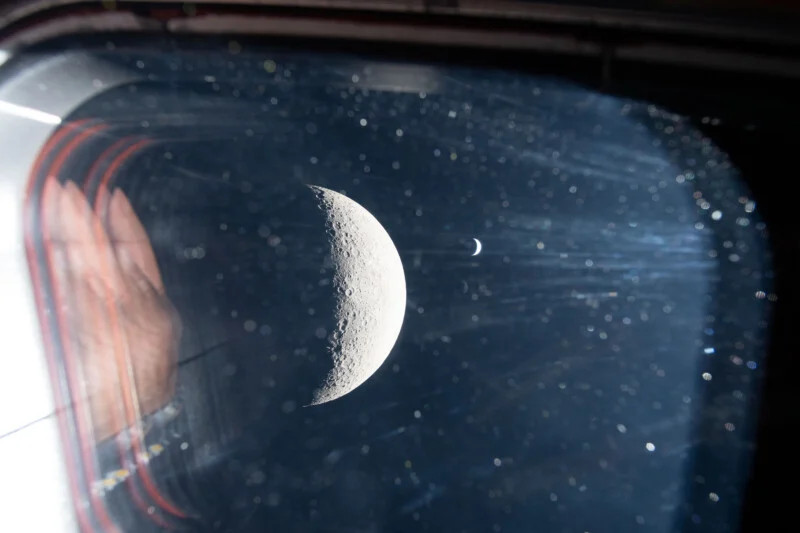 Now we don’t mean to beat up on the folks at NASA, but browsing through these images, we couldn’t help but be reminded of an article we saw on PetaPixel that discussed the space agency’s haphazard approach to sharing images online.
It’s really more like an unsorted file dump than anything, made worse by the fact that you have to access it through a government website that looks and performs like it was designed in the early 2000s. There’s even a prominent button that attempts to load a gallery feature that relies on the long-deprecated Adobe Flash. It would be nice to see the situation improved by the time astronauts actually touch down on the lunar surface, but we wouldn’t count on it.
Speaking of old tech, we’ve been following the resurgence of keyboard-equipped smartphones with great interest, as we imagine many of you have been. A recent CNBC article addresses the trend, although it didn’t quite take the nerd contingent into account. We want physical keys so we can work in the terminal and write code without fighting an on-screen keyboard, but of course, that’s not exactly what your average consumer is looking for.
It’s quite the opposite, in fact. A 20-something user referenced in the article explained how the younger generations see the physical keyboard as a way to be less connected to their phones, describing it as “an extra barrier of inconvenience that adds more steps into the thinking process.” If you need us, we’ll be collecting dust in the corner.
As regular readers may know, we’ve also taken an interest in plug-in solar panels recently. So-called “solar balconies” have become quite popular in Europe, but regulatory friction in the United States has prevented them from achieving similar success here. An article in the MIT Technology Review talks about the process of bringing solar balconies to the US, and we’re not overly thrilled with some of the developments it highlights.
As the key hurdle appears to be safety, UL Solutions recommends that balcony solar panels be plugged into a specialized outlet. If putting a regular AC plug on the end of a solar panel can lead to potentially dangerous situations, they believe the solution is to require a different plug that no one could mistake for anything else, with built-in safety features to reduce the risk of electric shock.
 That might not seem unreasonable at first, but it actually represents a pretty serious hurdle for many users. Consider that the whole advantage of these panels is the convenience: you can simply open the box, plug them in, and start collecting energy. But if you need to install a special outlet, potentially requiring an electrician, the whole concept falls apart. Expect to hear more from us on this particular subject as it develops.
Finally, Spirit Airline customers weren’t the only ones running into issues this week — a Southwest flight in California was delayed due to complications with a robotic passenger. The bot actually had a ticket, but the flight crew said it still violated the airline’s rules for large carry-on luggage and had to be moved to a different seat. Then somebody realized the robot’s relatively large lithium-ion battery was also in violation of carry-on limits, and it had to be removed and confiscated by authorities. Important details to keep in mind if you happen to be a robot planning your summer vacation.
See something interesting that you think would be a good fit for our weekly Links column? Drop us a line, we’d love to hear about it.












I’m pretty sure the grid tie inverters wont generate any power until they’ve read the incoming phase first. The same reason they wont make power and back-feed when the power is out.
Yeah, that part is solved.
AFAIK the real issue is that if you have large loads on the same circuit, you could be overloading outlets and their wiring without it being visible to the circuit breaker at the panel.
Solved, but! There have been a number of large recalls in Germany where the inverters were found to be not up to standards. AFAIK, they were all shutting off within a cycle, but the standards are tough.
“But if you need to install a special outlet, potentially requiring an electrician, the whole concept falls apart. ”
I would think that, like GFC outlets, you would be able to get one that you can plug into a regular outlet. Assuming the “safety” part of the special outlet is all in the outlet, and doesn’t involve the wiring of the outlet to the rest of the building.
(No idea if the GFC-on-the-end-of-an-extension-cord units are as effective as a GFC outlet in a wall box.)
A special outlet will be needed for the solar systems?
Cue adapter cables to convert to a standard outlet being sold on Aliexpress in 3… 2… 1…
(And the accompanying flyer saying “No we will not help you make this cable” at Home Depo etc.)
Plug sockets are NOT designed to have power pushed IN to the wall… Why not instead put a wall-style socket on the end of the solar panel’s extension cord, that way you can power one device (or an extension cord for multiple devices if sum of currents demanded is low enough) from the panel. Or better, build a specific separate device which takes two power inputs, by plugging two male plugs in to A ) an actual wall socket and B ) a “wall socket” on the panel, and then gives one output from a wall-style socket. The separate device could select between them, choosing the panel when possible and sucking power from the actual wall otherwise. You could use this to power something like a fridge or a small server, something which is constantly on and where peak power is within what the panel can supply in ideal conditions. A bit like a UPS, but without the battery.
You can buy very large rubber ‘sun hood’ things on aliexpress (that look a bit like a drain plunger) that allow you to press a camera lens against a window completely removing light reflections.
Those are handy for tech journalist to image things in glass cases, but also are perhaps a better way than rotating the entire spacecraft and desperately trying to get it dark to take picture though a spacecraft window.
Perhaps somebody should tell Apple who can then re-sell them to NASA eh..
Yeah I assume you can buy them at expensive camera stores too, no need to tell me, tell NASA.
Admittedly the windows are double pane, so you’d likely still get some reflections from the side when it hits the farther window when it’s bright inside the craft.
I like the data dump format for the artemis II photos. It’s pretty easy to browse in for me in firefox. I like that you can view a whole page of like 30 photos at a time. Let social media users can sort through it and glamorize/memify it.
Actually the more I browse these images the more I love it. I love how raw it is. It’s like looking through you’re own camera roll. This is like the diametric opposite of modern slop media. I’m seriously tearing up looking at these, it’s so awesome.
As for NRTLs in general, and Underwriters Labs in particular, they all seek regulatory capture per the certification and test industries, which often has nothing to do with the efficacy or efficiency of the technology, or the safety of the implementation.
NRTLs tend to trail industry in technology adaptation, such that their assesment engineers frequently do not understand the product that they are evaluating.
Regarding the blackberry clone: I can see how they would slow down even one of us. The great thing about the originals was, that they usually had a little nub on D/5. And I believe it was after the Pearl, that they introduced the “bulges” in the keys that would lead you to center row. From what I can tell, the clone has none of those features. So anyone who still got to type on the Bold/Q10/… would also be slowed down (when not constantly looking at the screen as is necessary with touch screens). Have schools gotten a little quieter with kids no longer having T9 or Blackberries to type without looking?
Before m$lop bought swype and renamed to SwiftKey, then I assume started feeding the user data to AI, after some practice it was deterministic enough to blind type one handed.
Its been getting really bad recently though, earlier today it autocorrected my typed “or” into ornithology, something I’ve never input before, but now will probably consistently show up since i just typed it! Doh