
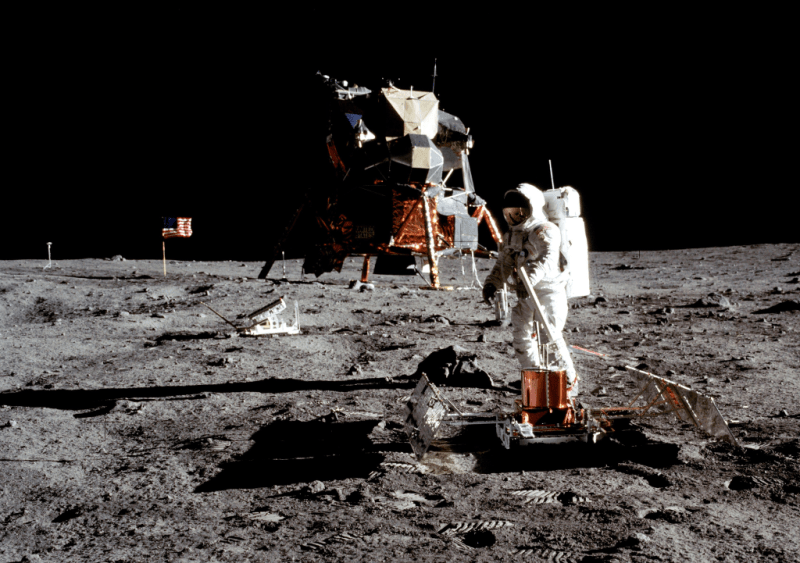
As I write this, four astronauts are on their way around the moon for the first time in 50 years. A lot us have asked ourselves just exactly why you’d send people out that far when the environment is so hostile and we have increasingly competent robots that could do the jobs in their place. If anything, that’s even more true now than it was back in the day of the Apollo program, when the remote operations capability was a lot more constrained. But having people, potentially in the near future, on the lunar surface remains qualitatively different.
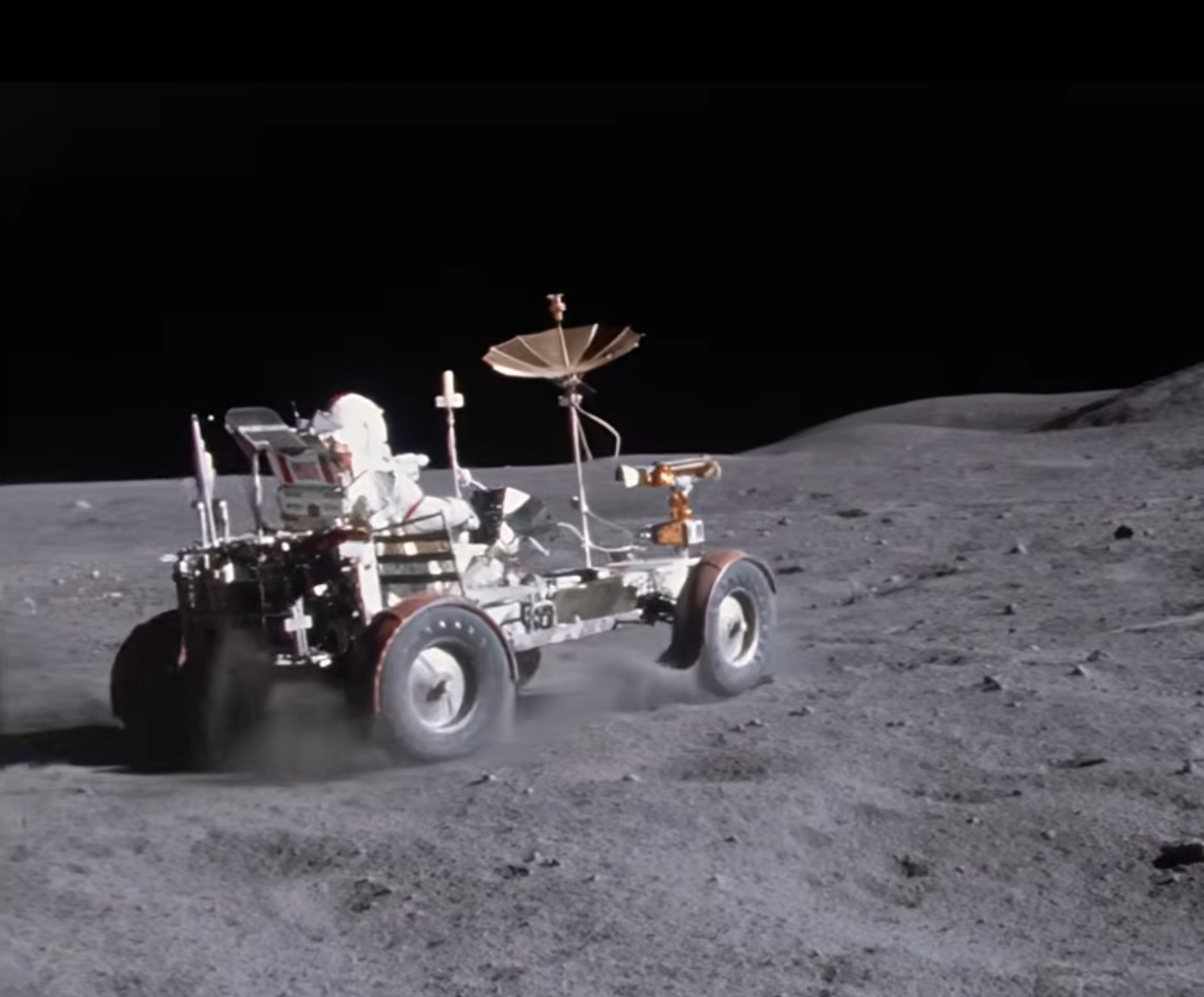 I was recently re-watching some of the footage from Apollo 16 when the astronauts were driving around in the Lunar Roving Vehicle, and the discussions that they’re having about the lunar geology that they can see for the first time with their own eyes is very convincing. Having people in situ tightens the loop of “hey, that’s interesting”, “let’s take a closer look”, and “I wonder what that means” in a way that minutes or hours of transmission time, and sterile observation of photos on a computer monitor just break. In comparison, our Mars rovers move excruciatingly slowly, the data comes back through a very thin pipe, and it takes months or years to analyze.
Of course, there is danger to human life; it’s a lot more expensive to get people safely to, and importantly back from, the moon than it would be with a disposable robot. Comparison with the Mars rovers is also unfair because travel to Mars is another scale entirely. Even if it does make sense to send humans for exploration on the moon, it may not make sense to do the same on the red planet, in the near future or ever. Given all that, I’m stoked that we can see through the robots eyes, but if all else were equal, I’m sure that we’d learn more from human explorers.
While in a lot of ways the Artemis I and now the Artemis II missions are underwhelming in comparison to the many “firsts” of Apollo, I absolutely appreciate them for what they are: a shakedown trial of a set of technologies and practices that we used to grasp, but which have atrophied over the last five decades. If a new generation of scientists is to put feet onto regolith, we need to learn to walk before they can run, or rover. In that spirit, I’ll be crossing my fingers for the future of manned spaceflight over the next week and a half.












This is where we should have been in 1975.
All politics and money problems aside, we should have been courageous enough as a country to continue to explore the Moon. The ASTP (Apollo-Soyuz) should NEVER have been the final Apollo mission.
This!
the case for humans on the moon is that you can deploy telepresence systems with zero lag with the operator sitting in a shirt sleeve environment rather than crammed into a space suit. and if that robot ever breaks down you either walk it to an airlock, or have another robot walk it to the airlock if it cant walk, and then be able to affect maintenance. sure beats a bunch of people in mission control debating the best way to avoid a rock and then waiting several seconds to see if it worked. if you want to build permanent lunar infrastructure at a useful pace, thats how you do it.
It’s not a race.
Until you realise we are one disaster away from a great filter.
Win the race or lose it, entropy wins in the end. No big deal.
If you have to invent completely new existential threats to rationalize your actions, it’s a hint that maybe you what you are doing is not that reasonable.
So far the competition of the race has been the only thing that has managed to motivate the masses to fund a space program. To stop racing is to regress. And we have been regressing for a lifetime now.
Well, that should give you an idea how stupid the whole thing is, no? If the only way you can justify it to the general population is through gamification, then maybe, just maybe, it’s not really such a smart thing to do. YouTube is full of similarly stupid “challenges”, which proves that by you can get people to do arbitrarily idiotic things if you just frame it as a contest.
What about reusing some of the hardware left on the moon by the “old” missions in the future moon base missions ?
E.g. may be the rovers, fitting them with new batteries, cameras and comm hardware ?
Not thinking in terms of cost but of cargo space and weight in the future missions.
Best regards,
Daniel F. Larrosa
Montevideo – Uruguay
Cosmic rays do amazing in circuit modifications to electronics and you cant really harden them to prevent that mod. Stuff on the moon is probably trash sad to say. But what can i know, i just built sattelites in LEO
Was going to say pretty much similar. Though I would be curious to know what condition the rubber-and-piano-wire tires look like these days, as well as the fenders (especially the one John Young had to field repair after an accident with a survey hammer).
Hi! Radio tubes and relays aren’t much vulnerable to radiation.
Neither are incandescent lamps and mechanical devices.
Stuff meant to be left on moon simply has to be built using the right type of technology, I think.
It doesn’t have to be transistor/diode based technology all day long.
The reasonable place to build a moon base is near the poles, where sun doesn’t set. All the Apollo hardware is near the equator.
Um no. Others already explained that it is probably in no condition to be useful. Besides that though… compared to what we will need to actually maintain a presence on the moon the hardware which is already there is negligible. It has far more value as historical artifacts than you could ever recover by reusing it. Either bring that stuff back and stick it in museums or leave it be until some future time when there are museums on the moon.
Moon dust is like asbestos. It sticks to EVERYTHING due to it being electrostatically charged by the solar wind AND it’s radioactive because of neutron activation. All those visions of astronauts going outside to “build bases” or “do science” is pure copium.
I don’t really understand what’s the point of sending people there just so that they can sit locked in a tin can for months. They already do it on ISS and what are the measurable scientific gains from that?
Why do people climb a mountain? Because it’s there.
There is a lot of what you say that I agree with. I’d also add that actively killing the one undeniably habitable planet we know of in our solar system while going out to explore one that is absolutely uninhabitable is a very strange expression of intelligence.
I also have to laugh at one of NASA’s justifications for Artemis ll. I quote;
Human eyes and brains are highly sensitive to subtle changes in color, texture, and other surface characteristics.
To the human eye the moon is black, white and grey. There are no colors visible from orbit.
They are really desperate to try and justify this mission scientifically. It just isn’t a scientific mission. It’s just an amazing engineering exercise.
The point never was to replace Earth as our home planet.
It was about growing up as a species and society and leaving the cradle.
Going to the Moon made us look back, made us admire Earth even more.
By understanding to solve colonization of other planets, moons and things we might discover a cure a long the way to our own ecological problems down here on Earth.
Things like better water and air filtering, recycling methods, new types of food or other new things related to environmental protection.
It will also give new insights about how low gravity affects human body.
And the Moon simply is the next baby step after Earth orbit.
Going straight to Mars without visiting the Moon first isn’t reasonable in my eyes, it’s just another form of actionism.
We must learn how to walk before we can run.
Joshua,
We know how to fix our ecological problems. We just collectively refuse to do this.
It’s the whole weird misapplied intellegence thing. I see the human race as creatures with the emotional intelligence of a bunch of chimps that wield the power of gods.
And I don’t exclude myself from this judgement. I may just be a little more aware of it in myself than the average Jane or Joe.
As far as discovering solutions to our ecological problems by traveling to the moon I see that as wish full thinking. As I said above, why hope for unknown solutions when known solutions exist?
Artemis will add zero new information to how microgravity effects the human body. The ISS is doing that job. The whole “how does lack of gravity effect the human body” is a funny circular engagement ie we need to send humans into space to see how space effects human beings. We have been doing this since manned spaceflight first happened and the answer is, human bodies don’t do well in space.
Cheers.
“Artemis will add zero new information to how microgravity effects the human body.”
On Earth we experience 1G. Aboard the ISS they experience basically 0G. On the moon (an actual landing mission) they would experience roughly ⅙G.
Yes, we know very well what it is to live in Earth’s gravity and a decent idea what it is to live without it. And we continue to learn how to handle 0G. Astronauts that spend extended periods aboard the ISS today are of course damaged by the stay but not as much so as ones who stayed earlier. And it’s not like they have stopped working on this or that there is nothing more to learn.
What will be learned at ⅙G. Anything you extrapolate from 1 and 0 is just a guess until it is tested. Bone loss, muscle loss, vision imparement, etc… Are you just assuming this happens linearly as gravity is lowered? Or maybe you assume it is binary.. anything less than earth.. you die… It would be nice to have a datapoint somewhere between 0 and 1 to look at.
And yes, the current mission involves no landing so ⅙G does not apply. But the point of this mission is to lead to ones which do, it is not the end goal.
Dear Alan,
This is a sort of misanthropic view, I think.
And it doesn’t do justice to the many fine people who work in, say, hospitals, retirement homes or animal shelters.
Alas, people with such a misanthropic view always tend to complain about how bad humanity is instead of actually being a positive example themself.
.. because it’s easy and comfy. Destruction is easier than building something up.
I have an relative who’se exactly like that. A pessimist that thinks (s)he’s a realist and that positive people are plain stupid or naive.
That person always complains about something,
but never attempts to fix a problem or to provide helpful criticism.
(In the end, the naive optimists end up fixing things for that person.)
It’s always a big lamenting about how something can’t ever be fixed,
rather than channeling all the negative energy to provide solutions.
Which is ironic, because many issues would eventually go away naturally with a positive mindset, with a positive basic attitude.
If more people would think that humanity is good and people are “worth it”,
then many conflicts would go away on their own.
Many people would then become good people because of their positive view on humanity.
They would identify as good people and act accordingly.
From a psychological point of view, it would be a self-fulfilling prophecy.
Unfortunately, many “realists” don’t think that far.
They think in an “us vs them” or “me vs them” kind of concept. The “us” is neglected.
That would explain the negative comments on the internet, I think.
Some people feel disillussioned and have given up and then they drag down others in order to not live a miserable life all alone.
But it doesn’t have to be that way, if we were willing to make a change.
Instead of criticising people they (we) could also try our best to validate other people and motivate them through positive comments.
Even if they (we ourselves) don’t always feel that way.
Criticism when due is always important, too, but it would be good if it was respectful and constructive, at least.
Or point out why certain things don’t work and what the alternatives are that might work.
_
That’s exactly why space projects are important, not just Artemis, I think.
It makes people think and focus on bigger things than just our trivial conflicts down on this blue marble.
It makes people see the bigger picture and how we’re all one big family, really. And not just nations.
Space exploration always had a positive mindset, please let’s keep that in mind.
Best regards,
Hi, in my country there used to be something called “basic research”.
It was performed at universities and founded by public money, for example, even if the commercial aspects were unknown.
The idea was that research helps us to understand the world we’re living in.
https://en.wikipedia.org/wiki/Basic_research
Wrong again—it is a draw. The SLS core came about due to human spaceflight—and it can place probes in orbit of Ice Giants.
Falcon is too weak.
“actively killing the one undeniably habitable planet we know of in our solar system while going out to explore one that is absolutely uninhabitable”
8 Billion people can’t multitask? I vote to fund green energy AND space exploration at the same time. And who knows… maybe lunar H3 will save us… not that I am counting on that.
Are you really making an argument against going somewhere based on it’s color or lack of? What a strange tangent.
“It just isn’t a scientific mission.”
Even if I were to grant you that….
“It’s just an amazing engineering exercise.”
engineering exercises are valuable.
If they were bold enough they could, you know, do it anyways. I’d take a short life of moon exploration over a long life at an office job any day.
On the surface, but how deep does it go?
I do imagine the moon has craters that could be used as hideouts for underground moon bases, maybe.
In your opinion. You forgot to add that bit of detail.
There might scientists/researchers more experienced than us, maybe, that beg to differ.
People who spent years or decades making it a reality.
“They already do it on ISS and what are the measurable scientific gains from that?”
Are you kidding? Have you tried googling it? Try this: “spinoffs and research from the iss”
Fourth attempt at a comment.
“A lot us have asked ourselves just exactly why you’d send people out”.
50 years ago they were going to and from the moon with nonchalance, with elegance, singing and jumping and doing autocross, today’s problems arising from the immeasurable technological difference require much more audacity.
much like certain people have been said to be a “poor person’s idea of what a rich person is” — sending humans to the moon is a pseudoscientist’s idea of what science is
I would rather do, than gripe at people for not doing. In that spirit this is the first step towards a moon base for American, European and Chinese people, and I applaud it in its shonky, over-expensive glory.
Rule #1.
Never kill a Moon-rocket that actually performs in favor of a tiled monstrosity that’s supposed to be cheaper-this and re-usable that.
We made that mistake once America.
Let’s not repeat that mistake.
Not that Starship can’t be useful…hauling toilet contents back from Orion capsules, say.
But the rocket didn’t have the same use as the shuttle?
The main reasons the shuttle wasn’t cheaper in the long run was the US military, look it up.
The Shuttle was SUPPOSED to be much cheaper. With it’s inexpensive re-use we were supposed to start building up a presence in orbit far beyond just a few astronauts at a time in one space station.
Orbit was going to be our gateway to the rest of the solar system with habitats and even larger ships to take us beyond orbit constructed in space.
But the dream was way bigger than the budget. So NASA turned to the military as was natural since the space program was born with the military in the first place.
The military wanted something big and bulky enough that it could drop a ton of bombs on Moscow from orbit. So that became the new spec and space travel became more expensive than it was even during the Apollo days.
A few years back I heard that NASA has several tons of moon rock that nobody ever looked at.
So perhaps we can send a probe to NASA storage facilities? How much would that cost?
No.
They only ever collected 842 pounds (382 kilograms) of the stuff they most certainly are not storing “several tons”.
It is true that not all of it has been studied. That’s not the wasteful thing you might think it is.
It has been 53 years since anyone went. 53 years! Think about how technology has advanced since then. If some of that rock were taken out of storage now (and periodically some is) it could be studied in ways that were impossible back in 1972. What will we be able to do 53 years from now?
With no guarantees if and when we would return it made a lot of sense to set some aside and bring a little out at a time as technology progresses. Does that mean that with the return it will be time to bring it all out? Probably not. First, don’t count your rocks before they actually land. Second… the moon is a whole world. It’s a smaller world than Earth but it’s still a big place. No doubt they will try to land in different spots from where they have already been with different geological history so as to learn as much new information as possible. Even with a fully realized and fully successful Artemis program it could be a long time before anyone samples those same geological areas that were sampled in the 70s. So it’s probably best to just keep bringing that material out a little at a time as advancements are made or new questions are asked.
I don’t mean to disagree, I share that view in principle.
It’s just that for some applications, our current technology is too over-developed again, too fragile.
It’s sun shine technology that merely works on a day with good weather.
Decades earlier, the computing power of a C64 flew the Apollo crews to the moon, basically.*
The technological level of 1977 to 1985 was ideal for space programs, I think.
Assembler language and robust chip strictures in the Micron range (mikro meter) were still common at the time.
Anyway, just saying. For studying rocks on ground, modern technology is fine, of course.
I don’t meant to question that. I just meant that in the context of space program in general.
That being said, by early 80s, I think, graphic workstations started to be available which then helped with CAD/CAM or displaying of molecules.
That’s when our modern scientific environment came to by.
By 1990, Unix workstions or Macs/PCs were very common in research.
That’s technology from about 35 years ago, which was basically no different to what we have now.
(*To be fair, rocket stages contained a lot of computers, too.
The equivalent of a couple of mainframes, basically.
The AGC was much less computationally strong, but did fit in a shoe box and had other qualities.)