
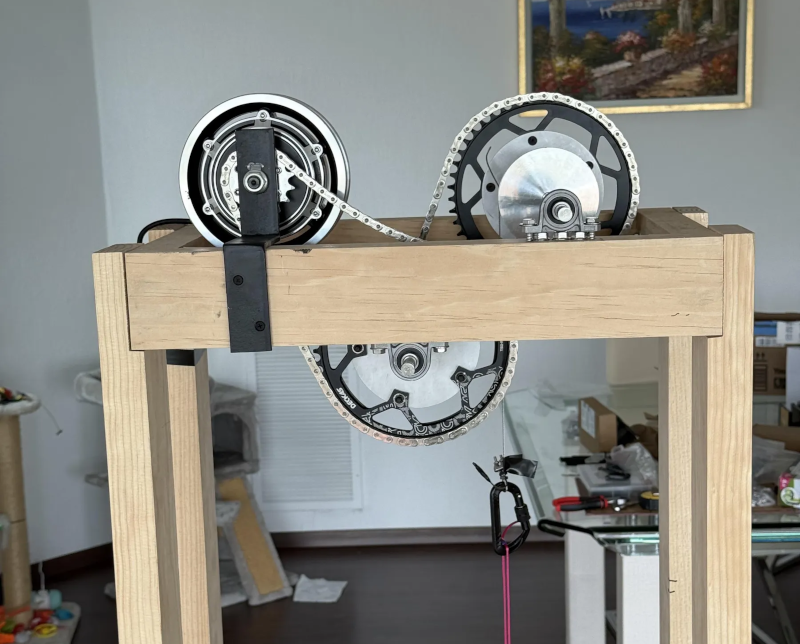
Gravity batteries aren’t exactly a new idea. You can store energy by lifting something heavy, converting kinetic energy into potential energy. To get it back, you let the mass fall and convert that motion to electricity. [Valeriamayara22] shows how to build a working demonstration model of such a system.
This isn’t free energy. Something has to lift the weight. In this case, the height is 1.8 meters, and the mass is 15.65 kg. Even so, the model achieves 13 W peak output and 58% efficiency, according to the post. Reportedly, it takes 394 drops of the weight to fully charge an iPhone 16, so this isn’t a practical project, but it does show how a gravity battery works. One nice thing is that the system stores as much energy on its 1,000,000 th charge as it does on the first one, especially if you keep the chain lubricated. Try that with a chemical battery.
The mechanical part uses a bicycle chain and some sprockets. There is a battery to even things out since, like wind power, when you make energy with a mechanical battery, you either use it now or lose it.
The cost of the build is about $400, and there’s a GitHub repo with all the files if you want to take your own shot at it. The energy efficiency number references the potential energy stored versus the energy produced. Obviously, if you are using some other energy source to lift the weight, that’s another calculation.
As you might expect, a practical system like this can be very large.












Use tide. It’s free. (Not free Tide at Walmart)
Dams are a thing.
Are dams gravity powered
– gravity pulls the water downstream turning the turbine)
or solar powered
– sun heats water in the ocean or elsewhere downstream causing it to rise as steam, eventually condensing and refilling the reservoir
I think it’s the latter with gravity only being part of the mechanism to retrieve the energy. Unless water is being pumped into the reservoir by some other means than sun power. But then… it’s still probably not gravity.
You are correct: gravity does not power anything, it only allows you to recover energy stored in the gravitational field.
A tidal dam that catches the high tide and runs it through a turbine on low tide would be powered by gravity: of the moon.
Dams are the most common example of gravity batteries. Water is pumped up when there is a surplus of electricity production, e.g. from PV during the day.
There are over 60,000 “large dams” worldwide, only about 25% of them are used to generate hydroelectric power. Out of those there are only approximately 150 to 170 operational pumped storage hydropower (PSH) dams globally, nearly 1/3 of which are in the US. Its a rare and very slowly growing scheme that requires very specific geography to make work, and even then is wrought with issues and inefficiencies. It certainly will NEVER be widely adopted.
Gravity towers, which use cranes to lift massive composite blocks are far more practical as they can be constructed almost anywhere. Additionally, Solid gravity towers have a higher round-trip efficiency (80% to 90%) compared to pumped water storage (70% to 80%).losing less energy to friction and turbulence than the hydraulic and pipeline losses experienced when pumping water
Yeah, one of the funny things about pumped hydro storage: It doesn’t provide much power and only modest energy stores.
It takes many thousands of acre-feet of lake to buffer just a few hours of a single power plant output, and the peak power (in or out) of the facility is limited by the turbines/pumps/motor-generators: typically maxing out at just a few hundred MW, similar to a power plant.
Which is all fine, when the site and the grid needs favors it.
The Niagara Beck pumped storage plant (and its brother on the other side of the border), for example, literally turn off Niagara Falls overnight, and pump that water a short distance uphill, recovering a measly 170 MW (for Beck, somewhat more in the US) when the water is let back out during the next day, but this is in addition to (literally on top of) the much larger generators that take the direct (not stored) river flow plus the output from the 170 MW generators.
However, if you want power to buffer something like solar and wind with high power in and out on the hour-or-so timescale, pumped hydro is not favored. Instead, batteries are smaller, more easily sited, cheaper, and have much higher power density, but they aren’t so good for many-hour or days of storage.
In a single year, the electricity supplier in Ontario (site of the Niagara Beck facility) quintupled their stored power capacity from ~230 MW to 1200 MW, just by buying a bunch of battery storage systems. This was far easier and faster than expropriating land and developing a pumped storage facility.
Meanwhile, a 1000 MW pumped storage facility being built a few hundred km north of Niagara is ten years along in site development, and has not put a drop of water in the reservoir yet.
In a few decades we will discover that harvesting energy from tides or wind causes undesired changes in the local climate, causing the entire climate to change.
Mark my words, this energy will appear to come with a price.
It slows the moon down a bit, but they, you can watch the full moon a tad bit longer then.
i think it speeds the moon up?? the tides are caused by the mismatch between earth rotation (24 hours) and moon orbital period (28 days). so the earth is slowing and the moon is speeding up and the tides will disappear when they match (“tide-locked”)
Orbital mechanics doesn’t work that way.
If you add energy to the moon in orbit, it raises the orbit, increasing its potential energy and paradoxically decreases its velocity (kinetic energy).
Frankly, I’m eager for when fusion, fission or solar pop off to the point where the concern for global warming is because we are literally generating that much heat directly.
At that point electricity will be basically free and we’ll likely be advanced enough to actively cool the planet.
The home worlds of the Pierson’s Puppeteers in Niven’s ringworld series were so heavily industrialized they didn’t need sunlight to warm their planets, so they pushed it out to the edge of their solar system.
If we get to the point we can move the planet I would hope we find a better way to do things than shoving electrons down copper wires.
Same with solar. Covering acres of land with solar cells will lead to long-term changes in local ecosystems, and when covering very large areas, can possibly modify regional wind/weather patterns.
Covering acres of land with solar cells is about power companies making money. I suspect in the next decade or two we will start to see laws mandating new construction, especially commercial development, to include sufficient roof mounted solar for the structures anticipated needs.
Put solar panels on all roofs, except you don’t see any benefit from it… the power that your roof makes isn’t seen by you, the owner of the house.
Woohoo… that new office building put 6 solar panels on it’s roof, which offsets about 1/16th of their electricity usage.
And, with our wonderful AI rush, all the solar panels and even the 300-foot-tall wind turbine you installed in your wife’s garden goes to keep “Clod” running.
Microclimates for better crops, and decommissioning is easier.
I will try to remember, Thikjzer the soothsayer.
Although everything comes at a price and there are of course negatives associated with renewable energy e.g. massives solar farms are already shown to locally affect climate. Thing is, they’re a lot less worse in comparison to burning fossil fuels. Unless your powers of divination can suggest better ideas?
Don’t we slow the rotation of the Moon when we use the tides as energy? Because the rotation of the Moon drives the tides and the energy has to come from the Moon? I mean I know there’s an incredible amount of energy there but still
From instructables:
“This project explores whether that principle can be turned into usable electricity at small scale. The answer: yes, at 58% efficiency.”
Little correction:
the answer is “No”. This contraption can store around 1% of the energy of an 18650 cell and does it for around 100x the cost. That is an difference of 4 orders of magnitude. And that is still ignoring other factors such as the size difference.
The answer is still “Yes”, as the goal of this project was never to compete with chemical batteries. This seems pretty obvious to most people.
you could use a lead acid battery as a weight and store the energy in that. ( sorry, couldnt resist…)
but yeah. a waste of resources and time.
This is actually brilliant!
i think you read too much into the word ‘usable’. the word ‘useful’, for example, implies an opportunity cost calculation
Why not tankers that are filled with gravity fed water.at the top of a hill and drained at the bottom. As the tanker goes down the hill power is produce and less power required to return to the top of the hill under its own power.
You invented hydro-electricity but with extra steps and more moving parts…
In particular, pumped hydro, which is already in use as an energy buffering technology in some places. I believe there is a pumped hydro plant near Niagara Falls, for example. As always the question is one of efficiency of both the pumps and generators, but if you have excess power at some times of day it may make sense to store it for use at other times, even if you lose some.
that’s a water wheel :) the buckets come up the back side empty
Here’s an idea from an old gray-haired person who doesn’t claim to be smart….
You have a weight right? As it falls, it engages a DC motor which charges a battery.
What if you were to split that DC motor output? Half to the battery, the other half to a capacitor?
That capacitor when it’s fully charged, runs a motor that lifts your weight back up.
Like I said, I’m not the sharpest chisel in the toolbox…..
Conservation of energy says: Nope.
If you stored 100% of the energy released by dropping the weight, it would be exactly the amount of energy needed to raise the weight back to its start position. There’s no extra to use for charging the battery.
Since no mechanical or electrical system is perfect, you will not even get back all of the energy you put into lifting the weight. That’s the 58% mentioned in the article.
A system as you describe it would be a perpetual motion machine, generating energy for free. Ain’t gonna happen.
That’s where that efficiency number comes in. Motors and generators (they’re basically the same thing, but in reverse) have various losses, mostly through friction, where some of the potential energy is lost to heat instead of usable electric energy.
Overgeneralizing a bit, 50% efficiency means you get 50% of the work you put into a system back as usable energy.
In your example, even if we spent all of the output to lift the weight back up again, we’d only lift it to about half the original height – the efficiency is 50%ish.
To be able to do what you’re describing, we’d need a system with more than 100% efficiency, which famously doesn’t exist. Solar, wind, hydro, tidal, and many other renewables get around this problem by harnessing “free” sources of energy where the sun, climate, etc, are doing the work.
Before LED bike lights became ubiquitous on our push-bikes, we had a friction coupled dynamo driven by the wheel. Going downhill, you had potential energy converted into kinetic energy by gravity — and from there into electrical energy to power the light. We were way ahead of our time ;)
I remember being surprised at the sudden extra work needed to pedal when I engaged that thing back when I was a kid.
They always ended up making more friction than electricity, and the moment you needed them it was usually wet and the dynamo shorted out and gave no light.
True, but now my car generates electricity going downhill, even if it’s wet; progress!
You could add this to a gym setup. When heavy lifting sometimes is ok to drop the bar and with max weight you need to rest between reps, so it is ok if the weight takes a couple of minutes to reach its resting position.
With >100Kg you get at least 6 times the energy output. Not amazing, but usable.
Maybe just rig up generators to all the excercise machines in the gym you can (rowing machines, bikes, step machines, etc etc) so people are generating power with their workouts. Might net a kw or two average output from a gym, enough to keep the lights on!
https://time.com/archive/6907370/in-the-gym-clean-energy-from-muscle-power/
You just described “Fifteen Million Merits” from Black Mirror
Like the bikes in Black Mirror’s “Fifteen Million Merits.”
The complaint is that it takes 400 drops to charge an iPhone. Meanwhile, a grandfather clock happily runs for a week on a single “gravity charge”. I think the lesson here isn’t that gravity batteries suck, it’s that our devices (and by extension we ourselves) are ridiculously powerhungry.
Ahh, but given that my phone replaced a 400W TV from my youth, and that neither my grandfather clock nor my spring-wound clock can produce moving images or allow me to communicate with others over long distances, the power usage seems a fair trade off.
The issue here is simply one of scale. A cubic yard of concrete ($150) is almost 1800kg and 2 ton, 20′ chain fall hoists ($250) exist. If you can find a barn with a loft to hold it, and gear down the system to keep from destroying the transfer and generator, you can power your phone all day with a single lift. Not that it makes it any more practical for home use, of course. ;-)
For energy storage, that lofted concrete can be replaced by a pair of 18650 cells, which are significantly more portable.
Gravity: By far the weakest of the fundamental forces.
Good call. But you can’t read the article or the comments on a grandfather clock.
I second that.
I have Developer Mode turned on on my cell phone so I can force off the apps that sap the charge the fastest. The thing is, somehow they keep re-starting themselves all feking time no matter what I do, so I have to keep forcing them off. With properly running phone (no parasites) one charge can last me almost two weeks; with parasites – merely 5 days the most. I know who the parasites are, so I perhaps should look into some kind of third-party app that would keep shutting them down the second they are automagically launched.
Case in point – most of the times my phone is feking OFFLINE, ie phone only. I don’t need things like Google Play Store or Weather or anything/everything under the sun that needs/uses live internet connection. Nada. Those can turn themselves back on when/if I am connecting for things I need, and HAVE to shut down, but they usually decide to stick/lurk around.
Ah, Google is permanently disabled, too. I know they read my email, since I was forced to sign up for google email account (throwaway one, btw – I am not using it for anything critical), but beyond that good luck mining my phone for profit : ] I am not using google search (for reading topics of interest I use wiki), don’t read news feeds, etc etc. I need PHONE FIRST and everything else second, period.
Doesn’t smell right.
58% efficiency out of that concatenation of conversion steps? Including a deliberate energy-dissipating magnetic brake.
Incredible.
Calculating input energy and measuring peak output watts, and including a storage element leaves considerable wiggle room to misinterpret (or fudge) numbers.
Literally, not credible.
Gravity batteries are nothing new and usually achieve 75-90% efficiency. So 58% for this setup is very realistic.
Not when you first adjust the brake to slow the descent to the desired speed (like the instructions clearly state)! Most of that energy is going into heating the brake.
The power storage potential could be increased. A gravity battery in one design are weights that are lifted using a renewable source. Instead of dead weight like concrete blocks why not rechargeable batteries ? Imagine an elevator lifting a block of rechargeable batteries while the batteries are being recharged. Or part of the dead mass being batteries. A slightly large renewable source would be needed. While the elevator descends energy would be generated by the descending mass as well as recovered from the batteries. While there are some losses the dual storage of potential and chemical would offset some of it.
I know you’re being facetious there, but it’s amusing to see how high a battery can lift its own mass.
One proposal is to use a battery-powered carriage for a space elevator: Use the battery energy to climb the ribbon to space, then jettison the battery to re-enter and glide back to recharge. Continue on with a smaller second stage battery, etc. The exponential rocket equation very much applies here. (spoiler: you can’t do it with batteries).
So how far can a battery lift itself? About 100 km. If it’s carrying along three times its own mass in cargo and motor and chassis, then it’s only 25 km (~80,000 ft for the metric-challenged). Think about that next time you want to climb a mountain in an EV, and thank the maker for regenerative braking.
A few years back, there was a setup using this principle, to provide lighting in areas without electricity.
Falling weight, powering a basic LED. Called a “Gravity Light”, a single weight drop provided light for several hours.
From memory, it fell out of favour because people preferred something that could recharge a mobile phone.
And there’s a reason that design landed in The Museum of Hoaxes
Though it can work: a 10 kg weight lifted head-high can sustain a 1-lumen LED for several minutes. Not sufficient to actually read by, or do useful things like cooking or sewing. But it’s a fun party trick that can get you several hundred kilobucks on a kickstarter.
this is impractical because it takes up so much room indoors. but if you have access to a cliff and could build it with a winch hanging over the side of it (probably with some way to stabilize it against wind, ANOTHER SOURCE OF POWER) and a very large mass, it might actually be useful. DIY pumped storage might also be useful in a case like that. i’ve thought about all these things a lot because i have an off-grid cabin with 5 kw of solar panels and a finite chemical battery that, once full, means i can store no more. obviously i have worked out that heating water is best done at that point.
Love my hydro, we can thank gravity AND the evap/Solar cycle. At Niagara Falls water falling 300+ feet to spin turbines; no downside there, water going to Lake Erie regardless. (thank you N. Tesla) Proposals to drop turbines in Gulf Stream to spin off that 3 kts current properly rejected; that’s a weather-changer, albeit way down the road. Let’s be responsible and we’ll have better chance.
Remember the “gravity lights” that were supposed to be the One Laptop Per Child of electricity in the early-late aughts? Did anyone ever get one (there was a “buy one, give one” option like a OLPC)? It was the same idea, but supposedly rugged and commercial. I always wondered how there was enough load introduced to keep the weight from just straight dropping.
I’m guessing they were a scam/flop/both. This is the only link I found on it, and the links to learn more/buy are all dead.
https://beautifulnow.is/discover/impact/innovative-lights-based-on-gravity-and-solar-technology-help-lift-people-out-of-poverty-bringing-light-to-millions
some info at https://hoaxes.org/weblog/permalink/gravity_lamp/
Heck, for a few dollars you can get a LED light w/a small solar panel.
Or scale it up as needed.
Before these there were these Baygen windup radios/light. I recall the overall output was rather minuscule and the winding up was rather loud ratcheting affair, say, in the middle of the night when the power is out. I also remember buying one (flashlight with radio) to try out and finding out that similar/simpler/better result could be accomplished with rechargeable NiCad instead of windup spring. Returned the thing, since I already had one rather nice 1980s “emergency radio”.
Even so, if one is to properly design such a thing, ie, make sure LEDs are the highest possible lumens, etc, there may be merit.
Also, I liked the Macsimki’s reply above – use lead-acid battery as the weight, so, there, hybrid approach, the best of both worlds.
Saw a fun version of this (stored muscle –> electricity) in a RadioShack emergency light/radio. Instead of directly hand-cranked, the generator was driven by a decent sized wind-up motor. Different version of mechanical energy storage. I wonder if I can find/build one to see how it compares…
If he could just make that string 394 times taller….
I am looking for a catchy name for my weight loss clinic that is at the top of a forty story building reachable only by stairs. The de-elevator generator ride down is the reward.
Weights used to be used to rotate Lighthouse Len’s before electric motors. They had a speed regulator system so the Lens rotated at the proper speed. The Lighthouse Keepers had to crank the weights up, sometimes as often as every two hours. Job security along with making sure the lamp had oil in the tank and the wicks properly trimmed and adjusted.
If I ever buy a house with property on a hill, 100% I’ll make the driveway go up that hill so I can park at the top, hook up a cable to my car and let it slowly roll downhill turning a generator all night, coming to rest by morning right by my house.
Here in Colorado, we have the Shoshone peak-demand plant, owned by XCEL Energy. During off-peak demand water is pumped from the river up to a reservoir at the top of the canyon. During peak-demand, that water is released from the reservoir and flows through turbines near river level to make electricity and is released back into the river.