
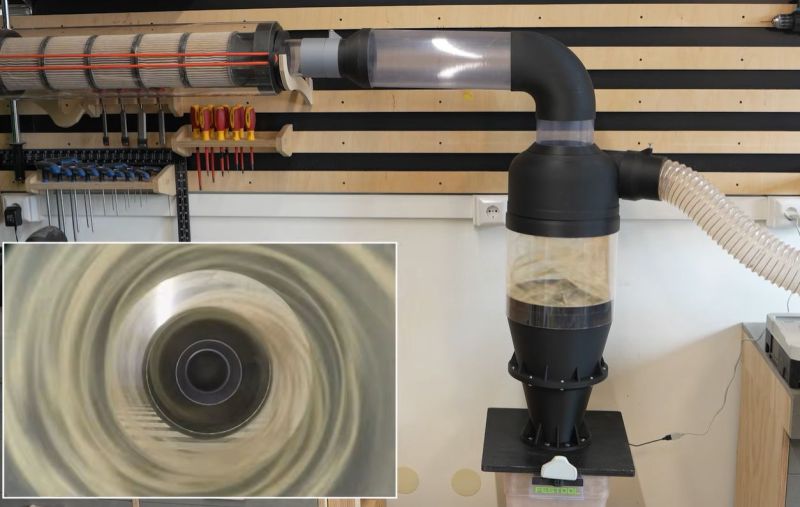
Filtering sawdust out of an airflow is easy until you try to do it with cyclone separation, but the obvious appeal here is of course not spending a fortune on filters. Over the years we have thus seen a lot of DIY takes on this concept alongside commercial offerings. Recently [Ruud] of the [Capturing Dust] YouTube channel gave it a fresh shake with a claimed 99.95% filtering efficiency that outperforms a commercial solution.
As a starting point the commercial and very succinctly named Oneida Air Super Dust Deputy Cyclone Separator was used, which retails for about $179 and claims a 99.9% filtrating rate of fine dust and debris. Based on its design a 3D model was created and printed with an FDM printer.
Initially only about a 98% rate was measured, but after some investigation this appeared to be due to the incoming and exciting airflows interfering. One tweak later to add some separation between the flows and a lot of testing of different configurations a final design was settled on that would seem to be rather quite efficient compared to the commercial option.












Amazing! The only thing he could improve are the collecting containers. They need a valve on the bottom to cycle a container into an blue HDPE 80L trash bag. That way he can keep the downtime short and needs no mask to empty them. Remembering his previous videos I hope there will be a follow up.
The concession made in the interest of having a quantitative test rig is certainly that no vibration is used for automatic filter cleaning.
Commercial vacuum cleaners are available with automatic or latch triggered filter cleaning options to knock fine dust buildup off the (vertically-oriented) pleated filter.
Here it seems attractive to run two smaller separators in parallel, each with a vertical fine filter on top. With both outlet pipes merging in a valve block, one can create air pulses and, in an alternating fashion, flush back one of the filters. Since the separator inputs are connected, the flushed fines are subjected to another pass through the separator.
(and if that’s not cool enough for your shop – I’m waiting for someone to combine dust extraction with a subwoofer)
It’s probably easier I just a blow down. I say this primarily because most industrial down draft tables or other filters that get clogged quickly use them
Exciting airflows indeed!
Another application of cyclone separation is those of us with old vacuums that filters are no longer made for. Reducing the load on, and cleaning of, the filter lets us stretch the remaining life thereof.
Cyclones also maintain vacuum strength as they fill, which filters don’t.
It is a bit of a hassle to move the cyclone around with the vac, if you need a portable solution. I have seen various carts and brackets to combine the two units onto one set of wheels.
I’m definitely checking this out, been on the hunt for a while. Although I thought cyclones were rated efficiency per particle size. The provided efficient one this one sounds pretty amazing.
I’m willing to bet that the texture in the printed cyclone aids in the separation through making mini turbulence and mixing the smaller particles with the larger ones. Much like a hypersonic scram jet has little teeth on the inlet so that the nearly laminar flow of fresh air mixes with the fuel that’s sprayed in.
I also wish that it was scaled down to fit a 256mm^3 print bed. It changes out the requirement from spending money with one company to another.
since the separation is largely a matter of centrifugal force and gravity I doubt the minute drag induced by the texture of the print has any appreciable benefit nor deficit on the efficacy
Here’s something to think about though: The separation relies on particles eventually losing momentum and dropping out of the air stream, so if a particle interacts with the wall, won’t it do so more effectively against a textured wall?
Commercial separators are kept smooth to reduce erosion and increase airflow efficiency and the speed of the cyclone (and this more effective generation of centrifugal force in the particle). If you don’t care about erosion, and are just tinkering I would guess there’s a “sweet spot” of surface roughness where a bit of friction actually increases separation while the boundary layer of airflow remains pretty much in place.
the dropout happens because the airstream becomes to weak to support the particle not a loss of momentum. The purpose of the cyclone is to cause the particles to drop out at the periphery so they are not pulled up into the exhaust path.
I think he needs to better deal with static electricity. It looks like there are no measures to discharge it, like grounded metal meshes or foils.
This is dangerous, because a strong spark could set the collected dust on fire or even cause a dust explosion.
He even mentions static electricity several times as an issue and got zapped in the footage of the video.
Your no fun.
Dyson is pulling a face. The Chinese, on the other hand, are smiling – they’re big fans of open source.
Now they’re going to incorporate your work into their product.
How exciting is the airflow?
“quite efficient” or “rather efficient” would parse OK, “rather quite” feels like a vocab car crash.
They, obviously, pay HAD writers by the word.
She’s not even close to the worst.
Like high schoolers trying to fill a page.
Super wide margins, useless words, purple prose.