
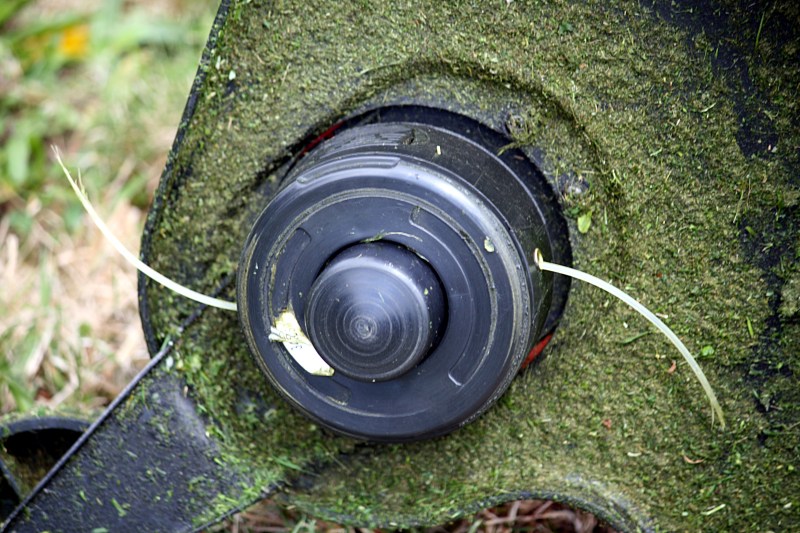
My old friend Jeff was always vocally upset that he didn’t come up with the idea of a string trimmer, commonly known as a Weed Eater or Weed Whacker. On the one hand, the idea is totally simple: spin some nylon line and cut grass and other relatively soft things. But, it turns out, that making the device actually usable requires a little bit of mechanical engineering.
Of course, the noisy part is a motor. The motor — driven by an engine, a battery, or a power cord — spins a flexible nylon line fast enough that the line becomes rigid from centrifugal force. That’s not the important part.
The humble spool at the bottom of the trimmer is where decades of mechanical engineering, questionable patents, consumer frustration, and genuine cleverness all meet. The earliest string trimmers were primitive. [George Ballas], who patented the Weed Eater in the early 1970s, reportedly got the idea from the rotating brushes in a car wash. Attach flexible cords to a spinning head, and they become cutting tools. In fact, the prototype used a tin can for the head. Elegant. But once the line wears down — which it does constantly — you need a way to expose fresh line. That turns out to be harder than it sounds.
The Simplest System
The easiest approach is fixed-length line. Some trimmers still work this way. You cut short pieces of heavy line (or buy it precut) and insert them into holes in the head. No spool. No springs. No moving parts.
These systems are rugged and are popular on commercial units designed to survive abuse. They also work well with thicker lines or even plastic blades. But they are annoying because every time the line wears out, you stop working and manually replace it. Spool-based systems became dominant very quickly.
The basic spool idea is straightforward enough. Wind a long nylon filament onto a reel. Some reels have two sections to feed line out on two sides of the rotating head. As the line wears away, feed out more line from the spool. But how do you do that while the thing is spinning at several thousand RPM?
Bump Feed
If you’ve ever lightly smacked the bottom of a running trimmer against the ground, you’ve used a bump feed mechanism.
Inside the head is a spool loaded with line and pressed upward by a spring. The line exits through eyelets on the side of the head. Under normal operation, friction and centrifugal force keep the spool from turning freely.
When you bump the bottom of the head against the ground, inertia momentarily compresses the spring and disengages locking tabs or detents. The spool can rotate briefly, paying out a short amount of line. When you release pressure, the spring re-engages the lock.
At least, that’s the theory. In practice, bump heads have to balance several competing requirements. The spool must not unwind accidentally. The line can’t bind. Dirt and grass clippings can’t jam the mechanism. The head must survive repeated impacts with concrete, rocks, and fence posts because users inevitably abuse them.
And then there’s the line itself. Nylon trimmer line is more complicated than it looks. Different diameters, shapes, and stiffnesses affect how well the feed works. Star-shaped line cuts aggressively but tangles more easily. Round line feeds smoothly but cuts less efficiently. Humidity even matters because nylon absorbs water. Anyone who has left old trimmer line in a garage for years has probably discovered brittle line snapping constantly. We’ve heard people suggest you soak the line — especially old line — in water overnight before loading it.
The bump feed mechanism has another subtle trick. Many heads rely on centrifugal force not only to stiffen the line but also to help lock the spool during operation. At speed, the line pulls outward hard enough to increase friction on the spool. When rotation slows, the spool loosens slightly. A simple mechanical solution.
Of course, they don’t always work and when that happens, you might find some troubleshooting advice in the video from [Will Shackleton] below.
Automatic Feed
Of course, someone decided bump feed was too much work and, thus, the automatic feed was born. These heads attempt to sense when the line has become too short and feed more automatically. These systems are common on electric consumer trimmers.
There are several ways to do this, but many use a ratchet-like mechanism tied to motor speed. When the load on the motor changes because the line becomes shorter, the system advances the spool slightly. Some units feed line every time the motor starts. Others use centrifugal clutches or vibration-sensitive mechanisms. Great when it works.
Part of the problem is that the operating environment is terrible. Grass juice, dirt, vibration, heat, and impacts are all happening simultaneously. It is hard enough to make reliable machinery in a clean factory. Designing a precise mechanism that lives inches from flying mud is another matter entirely. That’s why many professionals prefer simple bump heads despite the inconvenience. Simpler systems usually fail less dramatically.
You can see several head styles in the video below.
The Eyelets Matter More Than You Think
One overlooked component is the eyelet where the line exits the head. That little metal or ceramic ring takes an enormous amount of abuse. The line is moving at perhaps 200 miles per hour at the tip, vibrating continuously, and carrying abrasive dirt particles. A plain plastic hole would wear out quickly.
Some trimmers use hardened steel inserts. Others use aluminum oxide ceramics. The better heads often have replaceable eyelets because manufacturers know they are consumable parts.
The angle matters, too. The line should exit smoothly with minimal friction but still maintain enough control to prevent tangling. You probably don’t notice how important the eyelet is, but you’d notice if it were poorly designed.
Why Tangling Happens
Anyone who has reloaded a spool badly knows the pain of internal tangles. The spool effectively stores torsional energy. If the line is wound unevenly or crosses over itself, it can dig into lower layers under centrifugal load. Once that happens, the line jams. Pulling harder only makes it worse.
This is why most spools have directional arrows molded into them. The line must wind in the correct direction, so rotational forces tighten the winding instead of loosening it.
Modern “easy load” heads try to solve this by allowing users to thread the line straight through the head and then twist a knob to wind it automatically. These systems are genuinely better than older designs, although many still become incomprehensible the first time you disassemble one accidentally.
One trick we’ve heard is that if you spray a lubricant like WD-40 into the eyelet before you use the trimmer, it will help the mechanism feed more smoothly. Let us know if you’ve ever tried that and how it works.
Batteries Changed the Game
Cordless electric trimmers have altered feed mechanism design in subtle ways. Gas trimmers typically run at nearly constant speed, which makes centrifugal systems predictable. Battery trimmers vary speed more often due to electronic controls and power-saving logic. That means newer designs increasingly depend on passive mechanical systems rather than RPM-sensitive tricks. Electronic control also allows some high-end trimmers to detect load changes more intelligently.
Ironically, while motors and batteries have become dramatically more sophisticated, the line feed mechanism is still mostly springs, friction surfaces, tabs, and molded plastic. No microcontroller. No electronic sensors. Go figure.
The string trimmer looks like a brute-force tool. But hidden inside that disposable-looking plastic head is a surprisingly nuanced mechanical system balancing centrifugal force, friction, vibration, inertia, wear, and user abuse. Poor [George Ballas]. He took his prototype to toolmakers, who were all uninterested in the invention. He started the Weed Eater company and launched a lucrative product category.
We love finding all the strange tech around us, from shopping carts to gas pumps.
Featured image: “String trimmer” by Hedwig Storch












“moving at perhaps 200 miles per hour at the tip” – that’s what she said.
How many RPM please.
I guess it’s the inertia that causes the cut to happen? High mass for the nylon filament must be a requirement. I wonder how metal wire would do.
More expensive to replace and would tear up your house, porch, siding, etc.
My cheap but innovative grandfather ran out of trimmer string so he put a bicycle spoke in that little eyelet. That worked great until the spoke fatigued and failed in tension and shot out like a spear.
Where I live, they use what look like rotary saw blades attached at the spinning end instead of all this plastic string being cut and thrown out into the yard. It’s terrifying to see spin, but they seem like they work rather well and they’re never used against something they might damage. Best of all, they’re not constantly shooting microplastics nor large pieces of nylon out into nature. As amazing as weed eaters are, they’re horrible for the environment.
I’m using a disk with actual teeth on it and it can cut 1″ thick wood stick with no issue. I know some people are using these machine to cut grass, I wonder why they don’t use a lawnmower.
Where I live, grass doesn’t exist, it’s only trees and rocks. Even a simple weed will grow to 3 feet tall in a week, that’s not even thinkable to expect a plastic thing to cut it.
When I first used the machine with the fishline cutting tool, and it wasn’t even able to cut what my lawnmower does in a single pass, I thought about returning it. But I installed the disk and I’ll never come back. There’s also some disks with multiple small sawchains on them (never tried them, I wonder how hard it’ll be to file them acute) if I ever want something that’s not rigid.
Oh, you’re right. I’ve seen those sawchains before, and it reminds me of some bush-hogs (big tractor mowers) I’ve seen that just used big chains instead of the spinning blade. People get up to some pretty horrifying stuff just to cut plants.
For weird shaped lawns or getting into edges/corners is why a lot of people own a strimmer as well as a lawnmower.
Reports from a friend the uses a battery-powered trimmer is that the disks are much better for battery-life. I guess they’ll have a similar effect on fuel consumption on ICE trimmers.
200mph would be 8 inch radius, 4200rpm
There are heads with metal wire. Typically it’s non-repleaceable wire and is just a small bit of plastic to hold it all and 3 threads with 6 ends sticking out. Lasts long enough to be just a little more expensive than a spool of nylon, but you don’t have to deal with rewinding spools.
Metal wire would be more dangerous than I’m willing to deal with. String trimmers shed bits of plastic multiple times per minute. If wire only shed once every minute or two, the chance of one bit puncturing an eye is still to high unless a full face mask is worn.
I just saw an ad for a string trimmer cartridge that “lasted forever” and used lengths of cable. Might also be good for wood carving, opthamologists, and surgeons familiar with skin grafts and muscle/tendon loss.
Just install a cheap circular saw blade.
GD word nerfers.
My Demon mechanical scythe has that sawblade-like cutting shield. It’s a bit slow compared to line but when it cuts it cuts powerful.
My 1950 sickle bar mower is rated at 5th grade…max age of child it could ‘mow’ the ankle of.
I’m surprised that in the write-up there is no mention of curved shaft vs straight shaft. The rotation on a straight shaft is counterclockwise and curved shaft is clockwise due to the flexible driver inside the curved shaft. Straight shaft uses bevel gears in the head. Very cool stuff and great write-up!
Considering the article focused almost entirely on trimmer line and the head why are you surprised?
Wait, is that plastic string biodegradable?
Nylon. So.. no. But honestly its such a small amount of plastic, who cares? Im on year 2 of trimming my 1 acre yard with a single fill of string. I probably use less than 10cm of line to trim the whole yard.
You have an acre and trim it with one of these?! Why?! That must take all year! Why not a proper mower?
Lol no, that would be crazy. I trim the periphery and around the house.
I care. I don’t want any more plastic in nature. It’s enough already. There is a floating plastic soup island in the middle of the Pacific bigger than Texas. Enough is enough!
+1
You honestly believe that?
Find your teachers and kick them square in the crotch.
https://theoceancleanup.com/great-pacific-garbage-patch/
Read it or don’t, believe it or don’t. The only one needing their crotch kicked is you.
There is not a “floating plastic soup island in the middle of the Pacific bigger than Texas”. The amount of plastic in the Pacific is said to be equivalent to one. Whether or not that is true is debatable but there definitely is NOT a floating island made of plastic.
Nope!
Unlikely. String trimmers are machines that by design leave little bits of plastic all over the landscape.
Myself, I’d tend to call it more of a side effect than by design. Theoretically, I don’t think the cutting effect is dependent upon the wearing away/shredding of the line. But, back here in the real world the unavoidable erosion surely doesn’t make the string manufacturers unhappy.
I don’t know what the basis would be for a ‘theoretical’ judgement of it. It’s engineered to solve a few different problems. One of the problems is that no matter what they make the blade out of, it will wear. So they used an inexpensive material where the fact that it abrades relatively quickly is offset by the relatively low cost and effort to replace it with a new piece of string. I’m kind of torn, myself, on whether that’s a good compromise (i do use a nylon string in mine), but it definitely reflects a decision to accept a relatively high rate of wear / dispersion.
Polyester and nylon clothes are machines that by design leave little bits of plastic all over the landscape.
I’ve used biodegradable line before. It performed fine, but now I can’t find it in stores anymore. This site may help, but I haven’t tried any of these myself: https://backyard-farmer.com/biodegradable-strimmer-cord-the-eco-friendly-upgrade-every-gardener-needs/
Of course, this is Hackaday, so we could just grab a length of PLA filament from a 3D printer… If anyone has already tried this, please let me know. It’s autumn here so I’m unlikely to give it a try myself for a couple of months.
I wished those feed mechanisms would actually work. I’ve also seen where the head can be exchanged for a hub that has replaceable fins that attach.
I’ve found the feed mechanisms to work pretty reliably. Then again, I was there when we had to turn the thing over and spool off more string by hand when it wore down. Even with that, it was a marvel compared to trimming by hand or with metal blades of some sort. That bump head definitely spoiled me though.
Now I’m spoiled by needing none of the above. I’ve gone from my younger years where string trimmers didn’t exist, to my older years where I’ve set myself up to not need them to exist. Ah…the circle of life. :-)
yeah i had one where it was hard to load and the feed never worked. i converted it to a fixed piece of string by putting a 3d printed wedge in it just to pinch the string against the axle. had to put two wedges for balance of course. next one i got, i shopped around to get one with “auto-load”, and so far it works flawlessly and easily. knock on wood!
I just turn it over and press down on the button with one hand and pull on the string letting just one notch no more out and have a sense of when to do that again before the line breaks off short. I get the most use of each inch of line. Bumping on the ground at speed works but wastes line and overshoots and that gets clipped off for waste. It’s hard on that plastic tooth and cog at speed as well. Done without poison ivy.
There are alternatives to plastic string, blades like saw blades and one like twisted cable wires in a wheel which seems the safest of these for cleaning cracks in paved areas. This is something which is harder on string trimmers than small weeds.
i heard this stuff is what was used for filament in the oldest 3D printers, back when they were called RepRaps
It’s Nylon, so you can print with it. You have to thoroughly dry it first and the diameter tolerance probably won’t be as good as normal filament.
Disappointing to see so many AI tells in this article
can you over-water your trimmer line? why, yes you can! (apparently) – i heard about this trick from Bre on her Chickanic YT channel (she’s great) and so i figured why not just keep the line stored in a wet environment ALL the time … next spring that Stihl orange line was extremely brittle which i guess kinda makes sense since water isn’t compressible, but nylon is – the line kept breaking right at the spool
WD40 on the spool.
i got a giant spool of nylon trimmer line and i store it in the same dry box as my backstock of 3d printer filament :)
Nylon is stronger once it sucks up some water.
Your not 3d printing with it.
I always struggled with these kind of systems. Reloading the wire always failed…
I switched to the system with 2 fast rotating bits of red plastic. Much stronger!!!!! Very very reliable and refilling is super easy. I loose one red bit of plastic every hour; I just pick it up out of the grass and put it back.
I have a couple of small electric Ryobi string trimmers. I don’t miss my old gas powered one as it was yet another engine to maintain just to use it once a week for half the year. Without frequent tuneups… frequent stalling.
But… these little electric ones… the spools are supposed to automatically let a little more line out each time they start/stop. I find they do the opposite. The line self-winds back in! So I find myself purposely holding the trigger down for longer runs then each time I let it stop.. I have to flip it over and manually pull a little string out. If I forget to do this… a couple cycles of the trigger will suck it back in far enough I have to pry the lid off to get to the end again.
I bought them both used though… did these things ever work when they were new?
I tried buying those little blade attachments that replace the string. But those turned out to be for the larger model and didn’t really fit my trimmers.
Did you put the soil in upside down when you inserted it back into the weed wacker? Because the Ryobi does let it out a little each time, there’s an arrow on the refill spool showing which way it should turn, the fact it’s going the wrong way in not out means you put it in wrong. Hope that helps…
For the electrics, try to find a brand with the spool on the motor’s shaft — if the center of the motor doesn’t line up with the center of the spool, it uses gears or a belt drive and the gears or pulley will be plastic. Plastic moving parts wear and deform. Bearings embedded in plastic will eventually get hot, the plastic deforms or melts, and internal moving parts will contact the plastic case and shred it.
I have a 3 year old B&D unit with less than 50 hours on it that goes to the dump tomorrow. An internal plastic part shifted position and ate a hole in the side. Garbage.
The channel “smarter every day” did a wonderful deep dive video on the physics of the trimmer line. Very surprised it wasn’t mentioned in this article.
wow, you all seem to be having all kinds of trouble with your trimmers. I had one that lasted 25 years with no problem, when it wore out i replaced it with another one. for far it’s still going strong after 8 years. I releases line when the rpm drops below a certain level. Have spool that you can either buy a new one or put line on yourself, it winds in opposite direction. it hold maybe 10 ft of line. it very dependable. as long as you are careful when you place the line on the spool. couldn’t have asked for better tools.