
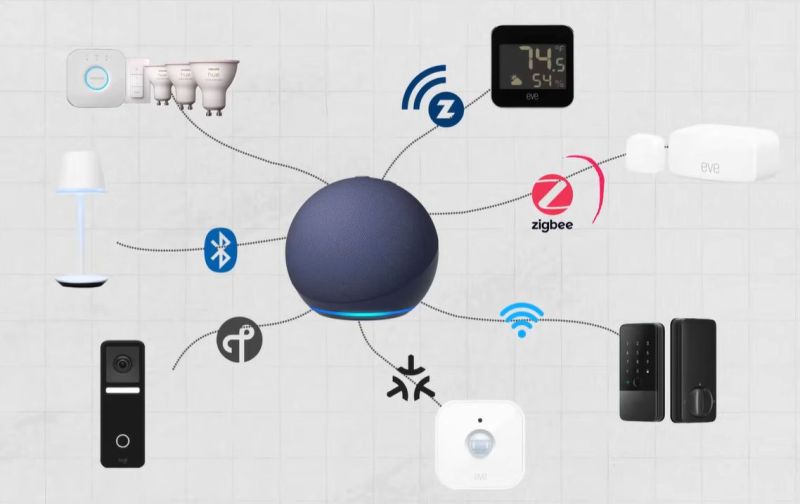
Circa 2015 or so, it seemed like you couldn’t move a finger without being bombarded with ads and articles about ‘smart homes’ and the ‘internet of things’ — all of which would make our lives so much easier and more automated. Fast-forward a decade and this dream has mostly evaporated along with many of the players in the space. Why this happened is the topic of a recent video by [Caya].
An interesting bit of context that the video starts off with is that home automation really kicked off back in 1975, when the X10 protocol and related devices using power lines for signaling began being sold. These fully integrated solutions generally worked reasonably well, but what all changed when the IoT and ‘smart home’ craze kicked off and brought with it an explosion of new standards.
Over the past decade we have seen the concept of a ‘smart home’ collapse into a nightmare of abandoned IoT devices, subscription services, forced ads, privacy violations, and an increasingly more congested 2.4 GHz spectrum that everything from WiFi and Zigbee to Bluetooth and others ended up competing for, with a corresponding collapse in reliability of data transmissions.
As raised in the video, a big issue is that of the financial viability of running the remote services for a smart home solution, even if this is the part that should make it as plug-and-play as a 1990s-era smart home solution. To the average user setting up their own locally hosted smart home solution isn’t really a straightforward option.
Although at the end [Caya] demonstrates using Home Assistant (HA) as a locally hosted alternative, this is still not something that a non-techie will be able to set up or maintain. Even if you shell out a cool two-hundred clams for the Home Assistant Green plug-and-play hardware solution, the average person will be lost the second any of the prescribed steps in provided documentation do not work. Woe to whoever is the person who is ‘good with computers’ in those cases.
Ultimately another problem with ‘smart homes’ is that they’re really not that smart, as you can definitely set up all kinds of rules in HA and similar solutions, but this is more painstaking manual automation with all the excitement of programming PID controllers. Having an actual intelligence behind the system that could react to what’s happening would make it a far easier sell, yet which is where all the ‘smart assistants’ like Alexa keep falling flat.
Currently [Caya] has set up his HA-based lighting configuration to be used by OpenClaw ‘agentic AI’, as a way to add some actual ‘smarts’, but it’s telling that he hasn’t integrated the smart lock of his apartment into the system yet. Nobody wants to have the OpenClaw agent tell you that it ‘cannot open the front door’ for you, after all.












I still like my alexa for lights, timers and other simple things but no way am I shopping with it. That’s where their dreams of profit fell through.
There should be a rule that for any given HAD entry, there is a corresponding XKCD. In this instance, 1807 applies:
https://xkcd.com/1807/
“Alexa, set a recurring 3 AM alarm of horror movie sounds”
Even still using it for the lights puts you into a tiny percentage of people who still use that thing. It’s been years since I heard anybody anywhere talking to an Alexa, but the last time I heard it I distinctly remember it feeling about as anachronistic as hearing somebody hock a loogey into a spitoon indoors.
It seems anachronistic because it is. No one wants to take 30 seconds to say something that a 0.5s button press can do.
As someone who also uses plenty of smart home stuff. Set it up to be seamless and quick to use. Using it shouldn’t be its own activity.
Oh there are plenty of times I’d want to, and that is just because the hands are dirty or the switch is annoyingly far away and the floor is likely booby trapped if I’m busy. So if you had real mobility issues etc…
Never actually used one though, as I’d never want to use an external product for such features – I dislike having as much to do with Amazon, Google etc as I have, but its so so inconvenient to try and avoid these behemoths entirely.
it was a solution looking for a problem..
Bizarre ableist comment. Lots of people still use voice control, its benefits for the less mobile are obvious
That would be the tiny percentage they talked about. I have mobility problems, yet I don’t expect everyone to consider me in their comments. If you don’t have mobility problems you probably won’t consider them. Expecting everyone to do that is what’s bizarre.
At some point you’ll be in that ‘tiny’ percentage.
This and also we have standinglamps in inaccessible corners of our living room. With dogs and two entrances trying to automate them is complex. Alexa is a perfect solution
The downfall of alexa and other such services was always the set of skills. Things like reminders, calendars, being able to tell the time, etc.
Once upon a time there was Vi, for which the killer app was that it could assemble a collection of simpler tasks together. This isn’t particularly hard to do. Wolframalpha has been responding to queries like “us towns with a population of approximately 100 million” for 15+ years. But they struggled with getting buy-in from external services to integrate.
Then apple bought them out just to kill it. Now we have language models which clumsily fumble the reasoning part, and we still have the API tie-in problem.
Feature creep happened, and somehow people don’t enjoy being surrounded by physical devices that are as reliable as the beta software they get pushed on their phone.
Just have a look at Home Assitant, it is so hilariously bloated that it’s kinda fascinating that it even sometimes work.
What are you even talking about?
Well…. that depends….
Lets say it’s a simple light. It’s either on or off. So…. theoretically you only need to have a single bit somewhere to persist that state.
From that view… having an OS that runs Linux, Docker containers, SQL databases, MQTT on top of TCP on top of IP on top of IEEE 802.11 (I’m missing a lot here)…. might seem a little bit bloated to some.
I always chuckle when I see “MQTT is a lightweight protocol”. It runs on top of TCP. TCP Book, Volume 1, is 550 pages. It’s brilliant, but I will never think TCP is light weight.
It IS a very lightweight protocol compared to alternatives like HTTPS and the additional hurdles the different platforms layer on top of that…
At its simplest, you could be doing a simple POST request to push a text string to a server, but that’s not good enough for the IoT platforms. You have to send reams of metadata and meta-metadata, requesting and sending security tokens up the wazoo, to the point that updating a single value – like a new sensor reading – may see you transferring hundreds of kilobytes back and forth.
That’s like saying inverting a register bit is “not lightweight” because you need a general purpose CPU with an instruction set that allows for flipping bits. And don’t get me started on the CMOS technology used to build that CPU. Or the quantum effects that allow CMOS to function.
Abstractions hide complexity. That’s what they’re good for. It’s not helpful to say something is complex simply because the abstraction it runs on is complex.
If your software isn’t saving state, then that’s on you.
I mean… I feel HA is bloated so it can support the infinite pile of abandoned iot crap that’s still physically viable. Blender isn’t for everyone either, but boy does it kick ass for the price.
“What did the toaster say to the washing machine?” Is a question that needs a punch line, not a serial protocol. A lot of the smart home and IoT ideas just didn’t have a raison d’etre. Just a lot of work to set up with minimal payoff.
We’re on a 16A main fuse so take a 5 minute break while I toast the toast.
Can you still flood on demand?
Live, laugh, toaster/washer bath.
Talk to the phone and call an electrician you shouldn’t be toasting anything on that circuit
Washing machine in the kitchen is a hack to get around the layout of ancient apartments with no space in the bathroom for a washing machine.
how about ” i feel like i have contributed to the small one’s getting jam all over itself again, over to you…
At the end of the day, the entire “smart home” idea goes against what a smart home actually is: an intelligently designed house doesn’t need constant monitoring or adjustment because it simply works.
All the problems that home automation was set to solve are better handled by non-connected and passive solutions that don’t require constant upkeep and fiddling with, or they’re trivial non-problems invented to sell novelty gadgets. I have yet to see a single genuinely useful idea come out of the home automation field that actually improves the house it’s installed in.
An example comes to mind with leak detection sensors around your kitchen appliances to detect if the dishwasher just flooded the floor.
There’s the smart home solution with sensors and transmitters and servers and whatnot. Then there’s those little pucks that have a buzzer and a coin cell battery, and when the water shorts the battery contact the buzzer starts making a sound. Otherwise it’s completely inert.
Which one is the smarter solution, all things considered?
Whilst “keep it stupid simple” has it’s upsides, a buzzer isn’t much use if you’re not at home.
I would strongly disagree that home automation doesn’t improve a house. Even just for basic things like sending a notification when I’ve got post in the postbox has made a meaningful improvement to my life so I don’t forget to check the postbox for 2 weeks and have an overdue bill. I would argue a home automation system can be part of a “intelligently designed house” as you put it. I never have to faff around with the home assistant app day to day, things are just automated to work. When the house is empty the roomba runs automatically, when I get home after sunset the lights come on, when the humidity gets high the blower fan kicks on. I’m not denying there’s upkeep and maintenance involved in it, and it’s definitely on the hobby spectrum, but it also cannot be denied it makes life easier
Neither is an email alert, because you’re not at home to do anything about it.
That doesn’t require a “smart home”, that’s just regular timers and thermostats, light meters etc. that operate independently and regardless of each other. They don’t need to be networked and centrally controlled to function.
A lot of the stuff that’s sold as smart home automation was already there as “dumb” solutions, such as shutting down your water heater when the dryer wants power – there’s a special junction box with a relay that opens when it detects load on the other circuit.
So your definition of smart home is something with a central controller? That’s an awfully specific definition, in my opinion any way in which the home automates responses to stimuli is “smart” irrelevant of whether it uses a whole load of relays or a raspberry pi in a cupboard. Are the wires between your special junction box and the loads not functionally a network?
Yes it is. That’s the point of it, to think about what we’re really talking about instead of just using vague marketing terms that could mean anything.
A simple heating radiator is “smart”. It senses the environment by its thermostat and decides whether to turn on or off. Many aspects of ordinary homes are already “smart” in the sense that they are adaptive to the conditions. What is added by the concept of a “smart home” is to control and monitor these individual parts as an abstract whole – to optimize it as a system.
What makes it genuinely smart is the way in which these individual systems interact naturally, when the house is designed in such an intelligent way that the individual sub-systems fit together and interact well even though they don’t directly talk to each other.
What makes it “marketing smart” or a “smart home” is the way in which these individual systems are forced to interact through technology, by data networking and the internet, with the premise that this would enable you to optimize the system better. This is often unnecessary and cannot improve on the fundamental point of building a house that works well by itself.
It’s basically going back to the wisdom of “You can’t improve bad hardware design by software”.
The “smart home” as a concept is to add a software layer on top of a house and whatever is in it. It can’t improve on what the house already is.
Think of it like touchscreen controls in cars replacing mechanical levers and buttons. Good or bad? How do they improve what was there before?
Depends on what you’re doing/needing.
The truth in the “smart home” promise was “not one size fits all”.
The lie was that most people don’t need that enough to justify the headache.
But. If you have the need (and the budget), it’s much better to set something up that does not need your presence to mitigate foreseeable problems. Nicer to eliminate the possibility, but when that is not practical for some reason, minimizing the resulting harm is also a kind of win…
Of course, if you’re going to put in water circuits and valve actuators, you might just want to use those to disable large segments of your water system when you’re not home… especially the segments that won’t be needed without a human in residence.
So, there’s no one good answer that applies to everyone. But solving unique problems is kind of the point; the universal problems are more likely to be solved by the mass market (when it’s not being distracted by fantasies of implausible RoI, at least)
At my family house, we just turn the main water valve off by hand whenever we leave the house empty for more than a day or two.
The question for the smart home would be, how do you know the house is going to be empty for the weekend? Well, you have to tell it so, which is just as cumbersome as going to the utilities closet and turning a lever.
I think it’s more that SmartHome companies try to market every solution to everyone. And the reality is that every solution is somewhat of a niche. To me that’s why Home Assistant is so compelling. It brings all those niches together and one place and makes them capable Of working with one another. And that’s where power comes.
“Did you know there are 10 types of washing machines, one that knows…” Click. “Stupid toaster, it was always one sided.”
washing machine to toaster: laundry is done, activate the smoke detector to call the human
“Over the past decade we have seen the concept of a ‘smart home’ collapse into a nightmare of abandoned IoT devices, subscription services, forced ads, privacy violations, and an increasingly more congested 2.4 GHz spectrum that everything from WiFi and Zigbee to Bluetooth and others ended up competing for, with a corresponding collapse in reliability of data transmissions.”
XKCD about one more standard that doesn’t get along with the previous standards.
I do not follow the stated consensus. Zigbee + h.a. has been great for me. (Difficult to get started though) I also run various self hosted services that make things easy or financially (smart ev charging etc) a huge difference . Wifi/Zigbee is once in a blue moon blocked by some over powered radio source. ‘smart’ is maybe not it, but certainly stuff gets automated.
Ditto.
Unfortunately you need to be aware of what you’re doing or you’re going to fall into a ton of traps. You have to really look and work to avoid most of that stuff too.
The problem with “smart” homes? Any device that REQUIRES the internet to work – SUCKS.
If you think your TV remote or any device needs to have voice input commands then you suck too.
People suck. How can someone even imagine talking to the machines. And someone imagines, creates and sells barely reliable gadgets.I command the smartphone to reply on your comment. Now;)
You forgot to say “sudo”.
But we’re all already suckers from birth.
Which smart home needs the internet? An irrigation network is smart. A demand-driven load-shed mechanism for your limited power-storage is smart. An adaptive ventilation system is smart. None of those requires any form of internet, and all of those solve real problems that real people have.
It’s like debating what LLMs are versus what they’re hyped to be. One of these is a useful discussion that can result in potential real solutions to (often narrow) problems. The other just leads to tears and frustration…
It’s like defining “human” in terms of Mother Theresa, Genghis Khan, or some specific chosen-by-dice-roll HaD contributor. All of these are “human”, yet none is useful as a definition of humanity…
I have a smart home and it’s reasonably reliable. Problems occur about once every 6 months, mainly in the form of failed switches (I recently replaced one that hailed from 2008).
The secret to its stability is two-fold: (1) don’t use a cloud based infrastructure, and (2) add plenty of surge protective devices.
For the former I mainly use a Universal Devices Eisy box with Zwave. In 18 years I’ve had to replace it once (when the isy99 box died, and replaced with the eisy).
For the latter every power panel has a level 1 and 2 SPD attached to it. I did this after noticing a very high attrition rate for devices (something at least once a month). SPDs effectively eliminated it.
Additional goodness that’s not mission critical runs on a NAS, e.g. logging and whatever.
For security reasons everything lives in its own isolated LAN segment.
Oh, and I always stock up on replacement parts for everything.
Wow, you make the smart home sound so easy! You just need extra switches, surge protectors on everything, everything vlaned off and lots of replacement parts, got it
Hey now, nobody said it solves any of your problems ;)
The whole point is that people don’t all have the same needs, but the common solutions are all set up to solve the common problems.
What about uncommon problems, then?
“I have a smart home and it’s reasonably reliable”
Well, that is just about it. Reasonable reliable is simple not enough, it needs to be reliable all the time! Most people just want a house that functions and not another project just to keep the light on.
My freezer is reliable all the time. Until it isn’t, and I potentially lose $1000 in food. So I use a reasonably reliable temperature sensor linked to Home Assistant to alert me if the temperature is out of range. That “reasonably reliable” sensor saves me money and worry about the freezer breaking and causing the food to spoil. Neither freezer or sensor have broken yet but when one of them does someday, the other will likely still be functioning just fine.
Question is, what do you do with a freezer full of food when it does break?
Regardless of whether you receive an alert, do you have any backup solution to deal with the case?
You (I) go to the supermarket down the street and buy a kilo of dry ice and put that in the freezer while the new one is on order. Or if it’s december-march you put all the food outside. When my freezer broke it took two WEEKS for the replacement I wanted to arrive and I went through quite a bit of dry ice, but the temperature never went above freezing. (Which was also a nice reason to have a thermometer that could signal me if the temperature rose too high.)
Nice. I don’t have a convenient source of dry ice. I could buy regular ice and dump a load of salt on it, but I’m not sure if I can maintain doing that for weeks.
Looking for the prices, it seems dry ice goes for 19€ per 2 kg here.
1 kg of dry ice has a cooling capacity of 571 kJ which is equivalent to around 6 hours of cooling for a typical chest freezer (~30 W average) so a reasonable estimate is 4 kilos per day at a cost of 76€ and for two weeks it would be 1064€
Maybe you go through less dry ice if you allow the temperature to rise closer to melting, but I would rather dump the food than pay for the dry ice.
Oops, that price was for 2 kg, so the cost for two weeks would be 532€. Still, I doubt the value of the frozen peas, ice-cream and chicken in my freezer would be worth enough to invest in dry ice.
The point being, dealing with the inevitable is still costly, whether it comes as a surprise or not.
Plain ice here costs 2.50€ per kg and it has a cooling capacity of 333 kJ. It takes 30 cents worth of salt for a saturated solution to melt a kilo of ice, so 2.80€ all told. That gives you 3 hours worth of cooling at approximately -21 C, or roughly 22€ per day to keep your foods frozen with ice cubes from the nearest supermarket.
It would be just about doable. You fill a 10 liter bucket with ice cubes and salt, mix it around every couple hours, and dump it out for a fresh bucket of ice every 24 hours.
Would be an interesting experiment.
X10 was a mess. All it took was an AM radio to listen to even one triac light dimmer buzzing to know it may not work.
The reason all this died a death was due to privacy. Recently car cameras, dumb rayban glasses etc. have all been mentioned by people tasked with watching the videos, the videos the owners didnt even know were being recorded by them, using the toilet, getting jiggy with it etc. Who on earth would trust google, tesla, meta, MS, apple etc with control over their house ? Allowing cameras to film their children etc., most of these companies already provide platforms where children are exploited, and abuse is shared across them, so I doubt most of us want this scum viewing us an our familes 24/7.
Who said that smart homes have to be internetworked? None of my solutions have ever needed (nor bothered) with internetworking. Well, other than during the couple of years when I spent several days at a time away from home working (in transportation range though) and needed to ensure that both of my cats stayed reasonably healthy.
Ensuring reasonable temperatures in the converted bedroom that housed my server stack when I wasn’t present was a very “smart” requirement, especially during the summer when outdoor temperatures could reach >40 deg C for > 96 hours, complicated by the fact that the compute load was often higher during the summer.
This was professional requirement, not personal hobby, (although it was fun too), and I couldn’t justify installing a full multi-zone HVAC. Multiple thermal sensors, a few electically-controlled dampers, and a fallback thermal cutoff on the circuit meant that I never once had to replace a server stack that cost significantly more than my car did. And none of it required cool branded “smart tech”, just off-the-shelf components common in most commercial buildings. Why pay extra, when there’s already an entire industry making fungible high-quality components to solve exactly that problem?
The premise of “smart homes” is not just pretty displays and cool remote oversight apps. It’s “I have a problem that is not well-addressed by common consumer solutions”.
There has been a lot of snake oil produced, but it’s an attempt to profit from perception, and is not definitive of the idea.
It’s more of a point of semantics, but the kind of systems we had before someone decided to call it a “smart home” were already full of automation and interconnected feedback systems. What was added was the ability to outsource the control to some app in the cloud by putting it on the internet. That’s what “smart home” became to mean.
I use home assistant, everything is local including cameras. the system is set up to work without internet including my locally run AI assistant. Takes some work, but a privacy first smart home is totally possible in 2026.
I use HA as well. For simple stuff it generally works. It’s the software updates that break things and FU the system forcing me to rebuild everything. I stopped doing the updates because I don’t need a bunch of new added bloatware to support devices or features I will never own. The HA AI is a POS and utterly useless, I don’t understand why it’s getting rammed down our throats as yet-another-thing-to-go-wrong bloatware. Kinda like downloading a 4GB firmware update on an apple product just to get a different poop emoji or background image. WTF
I’ve never seen HA even mention using AI. Is it there-yes. Not sure where you come up with rammed.
As for bloatware, many many integrations but if you don’t intentionally enable something. It isn’t in use. And that list of integrations is what’s providing privacy, saving devices from the landfill or recycling bin.
…because the companies they bought it from stopped supporting the “have to be connected to the server” systems eventually so you would have to buy their new one and people suddenly found out the tech was so fragile and vaporific that they couldn’t open their garage doors or control their lighting anymore.
Not everything has to be “connected”.
The entire purpose of the constellation of technologies was to rope people into product ecosystems and thus extract rents. Without the connected aspect (and the inevitable bricking of goods) the business model doesn’t make sense.
Maybe there’s an alternative philosophy that leads to a better smart home. Like the 390 MHz garage door opener that has been around since the 1950s. Can’t really turn that into a whole greasy “Your-Own-Home-As-A-Service” scheme.
No significant value was added by the massively over-expensive and complex system of voice assistants over just flipping down the sun shade in the car and pushing a button to open the garage like we’ve been doing for seventy years. Oh and RGB LEDs all over your house are hideous and trashy, but that’s a different story
There is, it’s just not called “a smart home” because the solution is to address the individual automation tasks as individual automation tasks that do not require central coordination and mutual connectivity. It’s just every device or thing doing its own thing.
Your HVAC system doesn’t need to be talking to your toaster, because it can already sense the extra heat through the room thermostat. When room gets too hot, stop heating, if it gets even hotter, start cooling. It’s that simple. You could be saving energy by reducing the heating by as much as the toaster is consuming at the moment, but the potential saving is too small to be meaningful, and it will be negated by the cost of maintaining and operating the smart system.
Purpose is subjective and defined by both parties.
A lot of the purpose of many providers of smart home tech may indeed be as you say. And a lot of the consumers may have wanted gee-whiz.
But neither of these facts define the technology, nor do they apply to all providers and all consumers.
There are plenty of foods and fluids whose purpose (according to the providers) is to make a very high profit margin. Yet, to their consumers, the purpose is often to stay alive. By your understanding, which of these purposes is “the” purpose?
We can observe that smart home technology is not defined by being automated or by having feedback alone, because that was already available and widely used before coining the term. They were also to some extent interconnected, such as the heating system telling the air conditioner not to run when the heat was on, or the washing machine telling the water heater to stop heating while the laundry was on, through load shedding relays.
Therefore what a “smart home” doesn’t mean is the fundamental home automation. It must mean the centralized control and monitoring of said automation by computer systems. That’s what’s been added on top of what already existed.
As a product to be sold, the smart home means A) selling the control and monitoring hardware systems, and B) turning the centralized control and monitoring into a service running in the cloud for a subscription. Here, point A has some purpose for the user, while B generally lacks any real point other than extracting money from rent.
I got codex to control my Phillips hue lights. Once the API got reverse engineered and realized it’s just an ESP32 with a LAN URL to send the API too…it was quick to control. I just wish computer hardware was as simple…there’s no point doing lighting if your computer insists on doing the Rainbow Wave for life.
fix hardware problems in hardware. and yes, tacky rgb lighting is a hardware problem, in the sense that it exists. easily remedied with a soldering iron tho
Tacky rgb lighting is a hardware problem, in the sense that it exists. It is easily remedied by not buying such hideous shit in the first place.
Taste is subjective. It would be equally justified to make the same argument for electricity. Or pavement.
Someone who feels a need to insist on their subjective view may be quite unhappy to have others be equally insistent with their own conflicting subjective views. The general solution is to avoid stepping on other people’s toes lest they be motivated to find big boots then return the favor.
Of course, that solution fails as a universal; some people have the goal of getting their toes stepped on, due to masochism or as an instrumental step in achieving less-obvious goals.
And sometimes, it’s just venting. But really, if it’s venting, just whose lawn are you on right now, anyway? :D
Taste is subjective, but for general lighting there’s not much leeway from “white” unless you’re a total weirdo.
Most people prefer more or less natural color perception, so the ability to change your room lighting away from 2500-5700K white is a pointless gimmick.
Keeping pink lights in your room is going to end up in reduce visual acuity and a mild headache regardless of what your youtube “healing colors channel” claimed it would do.
I loved my X10 system and even had it control my Christmas lights. It got too difficult to find inexpensive modules for so, when it died, I got rid of everything.
I’ve spent years commissioning industrial automation and given an decent budget, yeah, your bath would be filling to a perfect level and temperature when your front door automatically opened for you and after you finished your ready-made coffee.
Problem now is too many closed systems that won’t talk to each other and get abandoned by the manufacturers.
How does the system know that I want a hot bath today, when I haven’t even decided when I walk in through the door?
I like to think about the automatic drip coffee maker that gets your brew ready in the morning so you always wake up to fresh coffee. Only, you have to load it up with water and grounds in the evening and then the coffee tastes bad because it’s been sitting in the machine all night. If I decide to press the snooze button, the hot coffee is sitting in the mug getting cold…
The real solution is the capsule coffee maker that brews a cup in 30 seconds from pressing the button, but that’s not a smart home solution. It’s just a better coffee maker.
It is “better in a specific vector”. And of course that is very much a subjective choice (and properly so). But at least in my locale and with my water and grounds, the capsule coffee makers make coffee that tastes worse than even brewed coffee left to cool overnight then reheated, let alone brewed-in-the-morning grounds. And even with the recent spike in coffee prices, the price difference in supplies is enough to pay for quite a bit of fun technical equipment every month.
But the real point is “to reduce pain”, and pain is subjective (and the opportunities/tools are situational, not universal).
In my case, my schedule is highly variable per day; whenever I get an emergency alert and wake up, I sit down at the computer to triage the alert; about the time I know if this is going to be a short or long response, I have a fresh and hot cup of coffee. And if I decide that the heuristics for how much sleep arms the coffee maker aren’t working, I can just disarm all of those and start it from the cli as part of my existing workflow.
It’s not about fitting an existing tech offering. It’s about finding low-effort solutions to high-misery problems that most people don’t find annoying. In my case, a few cents gave me a lan-reachable microcontroller with relay; an hour was sufficient to design a firmware. no need for tcp even; just throw an ethernet frame at the macaddr and set an intended state for each relay, or read-back the current relay states. I extended it to also report several i2c sensors just because this was low-effort, so I know if there is coffee in the pot, if it is hot, and due to a count-up timer, how long these have been true. Not needed, but it was easy and killed the time when waiting for physical intervention on a server in a different timezone…
If anyone were to suggest that “smart home” tech is for everyone, I would guffaw. But if someone suggests that there is no point in it, i laugh equally hard…
I find that hard to believe, as leaving coffee grounds to the air for 8-10 hours is much worse than the instant-coffee that’s in those capsules. They’re surprisingly good for what they are, and I also have the option to use freshly ground coffee with the machine so it’s not like I have to compromise. It still does the brew in 30 seconds.
Though I there are some bad capsules around. They try to make different flavors but they just end up missing the point. I buy the cheapest espresso flavor and draw a long one, and it’s the perfect “americano”.
I don’t like coffee
Or just use Loxone. That is a smart home solution, not 50 different devices cobbled together with duct tape
Because it was entirely manufactured. There was absolutely zero organic consumer enthusiasm or interest. Same with VR. It was just a case of some startups preying on VCs with buzzwords and salivating over all the data they could mine out of people and subscriptions they could extract, asking:
“What if people actually wanted to talk to a stupid farting hockey puck to open and close their garage door instead of pushing the button? What if that was real?”
It wasn’t real. Nobody normal ever cared about any of that.
While very this is an extremely nihilistic viewpoint, It is without a doubt far more accurate than most want to admit.
If anything this manufactured and insincere enthusiasm has spread to nearly every niche intrest.
A less nihilistic take: Some entrepreneurs failed to realize that what makes a great Hackaday project is about the opposite of what would make a great consumer product. Here, something that looks cool but is insanely hard to get working and has no practical use is celebrated.
My smarthome works f#cking great. Home Assistant takes some learning, but works just fine.
For now.
@Hackaday: your babysitting-filter sucks.
I’ve put together systems with tasmota, mqtt, and homemade software. Those systems are rock solid and have been since 2020.
This is oddly timely, as I’ve been doing this forever, with among other technologies UPB (gasp! yes, line transmission!) and, after some hand-wringing initially, has worked for, well, decades. This item actually prompted me to submit myself to the tip line as I’ve done up a WiFi extension to UPB, makes ESP32’s emulate and play nice with line UPB devices and software … but as I joked in the submission, the Venn diagram of people who use UPB and are Arduino-hip and Make Stuff …. might only only me =))
i wrote a wifi-to-UPB bridge at some point because i was still using x10 devices as late as 2018. they were handy as a general solution for turning devices on an off with a remote back then and i found them reasonably reliable. they also seemed to hold state through a power outage, which a lot of iot equipment fails to do (even my $400 Reencle composter can’t seem to hold state through a power outage)
As a software developer with very specific needs and an off-grid Adirondack cabin, I find smart home tech useful, but only if entirely on my own terms. I use a smart home solution that I built from scratch, and it does exactly the things I want it to do. I control all the data and will never have to worry about the company providing my services going bankrupt or being sold to whoever owns Pets.com.
This is the best way to do it. A lot of people are saying this is all manufactured hype for a system no one needs or wants, but that’s only true if you’re just another dumb consumer. Smart home tech started with hackers building stuff out of esp’s and other small wireless microcontrollers and then big tech got the scent of people making simple things to do amazing stuff, and they tried to ride the wave to the bank as they always do. But as they always do, they enshittified it as quickly as they could, and they did this before it ever hit mainstream. It failed before it got good chance because of greed. Greed is usually the reason cool stuff never gets very far.
AI is basically going through the same thing right now. Researchers and hobbyists built a great open source system that needed a lot more streamlining and R&D work on it before it was capable of being used affordably, but big greed comes along and takes all that open source WIP stuff and starts building highly inefficient data servers to profit off the system before its even ready for deployment. They throw so much money at some code that never got even close to a version 1 release candidate, and now global markets are dying. I love AI, I hate how humans screw everything up because they think everything has to turn a friggin profit. Oops.. got a little off topic, but the effect and the cause are the same.
A lot of what the hackers do is non-solutions to non-problems. They do it for the pleasure of hacking, where the exercise is the point and the “smart home” aspect is merely a flimsy excuse to build some Rube-Goldberg gadget.
That’s what makes selling it as a manufactured system amount to manufactured hype for something that no-one needs or wants. From the hacker’s point of view it’s like selling pre-assembled LEGO models, and from the regular consumer’s point of view it’s just false promises of technological convenience.
Yes, this. By definition, the class of problems that this technology solves are niche problems, with custom solutions. The lie was in selling it as a universal need or consumer “solution”. The truth is that there are problems for which it is well-suited, and situations where the pain is worth the gain.
Reading the discussion on this post makes it clear that these words are not being used with any kind of consistent consensus on definitions… Without shared definition, no signal remains; it’s all just noise…
This is intended, just like in the AI bubble and the Blockchain bubble before. The people with the money / deciding power to invest, love their little buzzwords.
Your explanation of the protocols missed an important concept, that of layering. Zigbee, for example, just provides station to station transfer of data. Other layers will add meaning to that data and that’s where everything flies apart because everyone wants to have their own proprietary protocols, protocols that they like to keep private so they don’t just fail to interoperate, pulling them apart so you can provide open source equivalents is unnecessarily tedious (and potentially illegal these days). I’m used to industrial protocols which are not only straightforward but standardized. Your “Smart Home” just needs a bunch of sensors and actuators plus something acting as a “Programmable Logic Controller”. Its all standard stuff. Its been standard stuff for decades. Adding complex, proprietary and usually cloud based protocols into this mix adds no value and introduces all sorts of interoperability problems and points of failure. Hence no traction — it adds no value.
industrial protocols are just as bad.
EtherNet/IP is the most common ‘industrial ethernet’ protocol, it’s just a thin layer on top of CIP. No data gets out unless you pay a $50k/year Kepserver license.
eh, there are many MANY fully-open industrial protocols and fieldbuses. Pick one. You can find cheap hardware for it.
Failing everything else, any stupid ethernet transceiver will work just fine for data-in-ethernet-frame, without any concern about a protocol stack. And it’s not like it’s hard to implement an arbitrary protocol gateway. arduino/esp/rpi2040, even 8051 all can get the job done with plenty of excess capacity.
… oh wait. I may have misunderstood. No, if you are expecting to play lego, there’s a significant premium, but you’re not paying for the tech, you’re paying for someone else’s effort at integration (and in many cases, paying for safety certifications that might be irrelevant to your use case)
For generic house control you don’t need anything more complex than MODBUS which is commonly implemented over serial or TCP/UDP. Another straightforward, if not strictly industrial, protocol is SNMP. (Then there’s always CAN/Open.) The point is that these are open standards and they have established mechanisms for publishing device dictionaries that can be directly utilized by software running a control panel, a PLC or any one of a number of command and control programs.
The primary disadvantage is that these protocols can’t be monetized — you can’t lock users into a walled garden that only allows them to use your products and (preferably) dings them for a regular subscription fee.
There are some expensive semi-proprietary Industrial protocols but they are used to provide isosynchronous data transfer. The two big (European) ones still use CAN/Open as their primary untimed data transfer mechanism. Ethernet/IP is both American and a bit oddball, its the sort of thing that you might find useful if you were making a F-35 but not for controlling lights and A/C units at home.
Incidentally, none of these protocols preclude the use of the interface for audio or video streams assuming the underlying technology has the bandwidth to handle it.
i had an abandoned ha instance.. never the time to get it all working perfectly, one tricky issue after a power outage and it sat off for a year or so.
then they invented claude. now not only does it work properly, it does much more of the stuff i wanted it to but never figured out. and if i wanna add new stuff its like a prompt away. tbh it solves the single biggest problem with the whole thing. i want home automations, i dont want to be a home automator. i didnt even need to dig into the ha config or settings pages. its kinda the dream really…
I remember the old joke : “The S in IOT means Security”…
All my RGB light bulbs (over 30), all my physical light switches, my curtains, my pet door, my garage doors, leak detection, green house sprinklers, pet food dispensers, couple of motion sensor, plus the 30+ odd items (I have a bunch of animated props) all run from the Tuya platform (and like 3 switch bot devices). Most them (all but about 5) can run local Tuya and do, so I have home assistant for some of the more complex things. Other than having to expand my subnet it’s all worked pretty well. I use either tasker or the app to do 90% of things, with a fallback to home assistant if there is an internet outage. All the IoT is on a separate network from the rest of the house for a little safety. Sure I’ve had a few issues over the last 10 years or so, but largely there have been no issues.
I won’t connect my dishwasher to your stupid cloud
Level 2 Jeff
2,505,341 views – Mar 24, 2025
“I don’t recommend the Bosch 500 series. It’s dumb.”
https://www.youtube.com/watch?v=5M_hmwBBPnc
i had an abandoned ha instance.. never the time to get it all working perfectly, one tricky issue after a power outage and it sat off for a year or so.
then they invented claude. now not only does it work properly, it does much more of the stuff i wanted it to but never figured out. and if i wanna add new stuff its like a prompt away. tbh it solves the single biggest problem with the whole thing. i want home automations, i dont want to be a home automator. i didnt even need to dig into the ha config or settings pages. its kinda the dream really…
“abandoned IoT devices, subscription services, forced ads, privacy violations”
Or you run Domoticz locally on a Raspberry Pi.
“To the average user setting up their own locally hosted smart home solution isn’t really a straightforward option.”
That is a good point. And Domoticz can be a pain in the backside to maintain. Between updates of the system, OS upgrades (mandatory for system update), Python updates plugins and scripts break and need to be fixed.
HomeAssistant to me is visually unappealing and the YAML based configuration is also not something I’d look forward to be getting into.
Meh. That’s when a technology really comes into it’s own… after it’s bubble bursts.
I remember my friends all getting excited about buying smart lightbulbs, proprietary cloud based controllers and inviting Amazon to live in their living-rooms under the guise of Alexa.
That wasn’t for me.
But after repainting the bathroom walls too many times, getting on the family about always turning on the fan when showering, and then noticing that the new problem was the fans were never off…
I bought some Zigbee switches and humidity and presence sensors. The fans come on automatically when the humidity rises over a certain point. They turn off automatically after so many minutes of no one being in the bathroom and the humidity being below a setpoint.
Since then the Zigbee network has been growing with more lights being put on it and Home Assistant installed on all our phones. Now the whole family is sold on it.
I still haven’t tackled automation via HA YAML yet though. When I started I didn’t really know much about HA and was skeptical of anything I couldn’t easily install directly, without Docker. So I wrote my own scripts in Python which talked through Mosquitto to Zigbee2MQTT. HA is my remote control but the automation is still in Python. Why change it when it is working?
i used to have fans controlled automatically based on temperature sensors, and lights that i could control from the computer. and then i got rid of it and didn’t miss it at all. turned out to be kind of a solution in search of a problem. of course if your house is gigantic maybe you found the problem!
but i do enjoy sensors — temperature and video for now. and speakers i can control remotely too.
the barometric sensors are fun if you have lots of cheap ESP8266s because if you plot their outputs on the same graph, you can easily see which are higher in elevation and also, if they are spread around geographically, the direction airmasses are moving. i’m at the point now where i pretty much only use the BME680, which has temperature, humidity, air pressure, and even a little on-board kit for doing atmospheric chemistry experiments (though i’ve never yet gotten that to give me anything useful)
I’ve considered some kind of Home Automation trice, early 1990s (when Radio Shack thought it was awesome), mid-2000s, and mid-2010s. Every time my research would come back with “too proprietary, I don’t want the provider go bust later and leave me with the system I cannot control”.
Now that I can probably do simple X10 system using open source libraries I may reconsider, design and built what i need, for the price I can truly afford, and have it under complete control.
My rule of thumb is SIMPLE. It has to be simple to set up, change/upgrade/revise, take down. I also don’t need my house automation to be so complicated, I might as well be a diesel mechanic living inside a yellow submarine ( : – ] ). I need what I need and nothing more.
A bunch of cranky folks in here. I use the smarthings hub at home and its been great. Replaced my light switches with compatible ones. Its nice being able to adjust dimmer or turn of lights from couch. The switch for outdoor garage lights gets updated sunrise/sunset times for turning on/off. No more having to adjust times manually throughout the year.
My door automatically unlocks when I get home and locks when I leave. If someone needs access to let pets out I can remotely unlock for them. I dont have to worry about the wife locking herself out anymore. I can ask alexa to turn off the tv and all lights in house when going to bed.
If properly setup it can be very convenient. Its also not that hard to figure out. Start with one or two switches and add over time.
One big problem is that there’s no good universal standard for allowing gadgets to talk to computers and phones without some either some kind of central server, or a proprietary, special-purpose app.
A hub like HA, or a cloud service is an overkill in most cases (especially for beginners), but the alternatives are terrible.
What we needed was a universal standard where a device could connect over bluetooth or something like it and say “I need to show the user two buttons and a toggle switch.”
With the right standards, Installing a smart-home device could have been as easy as pairing a new headphone, but nobody realized we needed that back in the day, and now it’s too late.
(Sure, you could have a gadget that hosts it’s own wifi hotspot and then serves a webpage from it. That’s technically universal and open, but it’s a hassle, and many devices will complain about non-internet hotspots.)
I personally think that the big reason for many IoT problems is that many companies treat their “solutions” as tech demos more than anything else. Security? It’s just a working mock-up. Intercompatiblity? An iPhone app is good enough for the CES showcase. Unexpected switch to a subscription with intrusive ads? Just showing the investors possible features. Suddenly canceling the service customers paid for, bricking everything, and forcing people to completely rewire their homes? Those “customers” were really just there to demonstrate the product.
Are there any good projects to re-purpose all the dead IoT hardware? The likes of Amazon put a lot of effort and money into the hardware and it’s shame that a load of pretty decent speakers are going to go to e-waste when they could be re-purposed as non-evil streaming speakers or similar.