
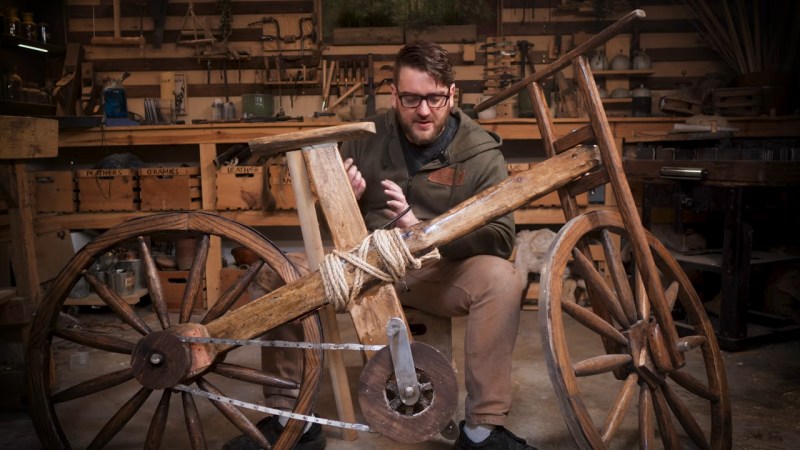
There is a drawing of a bicycle in one of Leonarda DaVinci‘s sketchbooks– except it wasn’t drawn by DaVinci, and dates long after his death, so we can’t say the old master invented the bicycle. We can, however, wonder what it would have looked like if he did– and so did the [How To Make Everything] YouTube channel. As you might expect, they investigated the question of a Renaissance Bicycle in the best possible way: they built one.
In some ways the device looks like the first, primitive hobby-horse proto-bicycle of the early 19th century, which is not without reason. From the renaissance to the dawn of the industrial era, there wasn’t a huge change in how europeans worked with wood, and in both eras wood is the obvious choice. Where this bike differs from [Karl Drais]’s invention is that it has both pedals and brakes– both of them using drawings from DaVinci’s sketchbook.
You might be surprised to learn that ball-bearings are period-appropriate, and weren’t even invented by DaVinci. The drum brake, on the other hand, is right out of the Old Master’s notes: a steel band wraps around a drum on the rear break, and is tighened by a lever. With iron rims, no brake would stop on a dime, and this probably works as well as anything while being quite simple to make.
The chain is also based on one in DaVinci’s notes, and honesty it’s a weak point of the design; they’d likely have been better off with a leather belt, or perhaps a stack of gears as we’ve seen before. The hand-made chain just isn’t able to get the bike up to riding speed. Still, this is recognizably a bicycle and entertaining content for anyone who plans on violating the temporal prime directive or wants to get around after the apocalypse.












Janeway!
Did it so many times that the Federation had to invent the Time Police
A lot of the issues stem from simple manufacturing tolerances. The parts are rough and uneven in size, so the chain catches and wobbles. That may be authentic to some degree, but even in Leonardo’s time they could have easily made it better. For example, by turning the pins on a lathe so the links rotate smoothly. Even without special tricks, working consistently and carefully with simple hand tools and jigs can do a whole lot better.
One trick is to put paper between the links before you peen the end rivets, then dunking the chain in water or oil. The paper turns to mush and falls out, leaving enough clearance for the links to turn.
Small things make a huge difference.
In Renaissance they were skilled woodworkers unlike this Youtuber. They were actually earning their life with wood working and not with Youtube videos. This is very very rough and ugly work.
And they were also using modern bearing balls.
I mean, if you’re gonna cheat then why not go all the way and just have someone laser cut you a bunch of chain links, so you can pretend to make your own medieval chain like you pretend to make your own medieval ball bearings?
Stay awayth from the mead hall when you see a row of these foul things up fronth, lest thy carriage strike them by accident–for you are assured of being accosted by ruffians.
True, but I bet ye olde tyme woodworkers would also have used some rough-hewn pieces for the first prototype. No need to get into ornate carving at such a stage. I’ve seen their wheelbarrows, they didn’t go all-out all the time
In medieval times paper was a luxury item that was available only to kings and high priests, not some bum in garage building bicycles.
I do believe the journals themselves were on paper, yeah? By the Renaissance linen paper was both good and fairly cheap
You could use a leaf. Take some straw and flatten it.
Lots of options besides paper.
In Islam it is taboo if you don’t use water to clean yourself. So there’s that.
And wiping doesn’t actually wipe anything but just spreads fecal matter all over the body.
what a mess! i discovered the assblaster hose while i was in India wondering why the toilet paper rolls (supplied only in western-style hotels) were so small. now i have an Assblaster 2000 installed at home — it was just in time for the covid TP crisis of ’20. but even as an atheist, that taboo makes sense
Not true and not credible.
Islam has instructions on how to properly wipe your ass with a stone.
Anybody sane would prefer water.
Islam has rules that cover all the options.
IIRC water is only ‘strongly recommended’ if bleeding from butt.
Obsessions say more about the authors than anything else.
Also rock hounds get a sad…coprolite!?
‘Move out of the desert!’
/ Kinison
Friend has an Autistic son, toilet problems.
Working on toilet seat bidet mod with video game shooting noises and flashing lights for him.
Too many projects.
Perhaps a sonar poop detector to add falling bomb sounds…or Mr. Hankey.
Confession: Will install one myself.
A penny-farthing type bicycle would avoid a whole lot of problems with chains, sprokets and probably brakes.
Insert appropriate “The Prisoner” reference – “Be seeing you”
Oh, but what’s the fun in that? Everyone knows a penny-farthing is doable. A safety bicycle… well, it’s still not clear, really. That’s what makes it fun.
After nearly 40+ years of low-level s/w development in constrained environments, my brain automatically says simplify, simplify, simplify!
A bicycle chain is simplicity itself – it’s just repeating the same point many times. Kinda like fractals – people think they’re very complicated because there’s more parts than you can count, but it’s just repeated simplicity. In code, which is more complex: a for-loop or rolling the same thing out line by line? The rolled out loop has more lines, but it’s less complex because it lacks the logic for keeping a loop count and conditional jump to the beginning.
Before chains, people attempted with four-bar linkages with the crank at the rear and a swinging arm at the front. You couldn’t really steer because the pedals swung to the sides of the front wheel.
https://www.cyclist.co.uk/in-depth/worlds-first-pedal-bike
Come back and talk to me when you make a bicycle chain out of 1010 steel and it lasts more than 10-15 km.
While I do that, you go out and make a bag of hammers out of cheese, and tell me it ain’t dumb.
While it’s a bit hard to find correct information among the AI slop, it seems like bicycle chains are commonly made out of 1050 or C50 steel.
The 1010 steel is about 70-75% as hard and about 60-65% as strong, so it wouldn’t last very long, but it would probably hold on for more than 10-15 km. There are chains made of worse materials than that.
Obviously:
The simplest way to implement a loop is a recursive function.
90 degree gearing predates power via chains, by 1000 years or so.
Shaft drive for a wooden bike.
Also Frame, triangles are your friend.
Then there are of course ways to work around the weakness of the chain, for example by making the sprockets bigger. That way the chain doesn’t turn so sharply and it carries less force for the same torque, which both help to reduce wear on the pins.
Simply making things bigger would also help with the manufacturing tolerances. If you’re constructing a medieval bicycle, winning Tour de France isn’t the goal anyhow.
Or a driveshaft instead of a chain? Could also implement gear-switching.
With an H pattern shifter!
A dandy horse would have been easier, but not as entertaining.
Ok, but now a modern bike made of wood? There’s lot’s of potential for woody elasticity.
That’s where bamboo comes in
This is the best submission for what I call the “Roman Challenge.” Romans had aqueducts and many modern things, but they didn’t have bikes. The challenge is to build a practical bicycle with Roman era materials. If it works, you have successfully one-upped the Romans in your spare time. Thinking: laminated bamboo, laminated wood. Tendon lashing. Solid gutta-percha “tires.” Or leather tires. Leather belt on V pulleys… even a pulley CVT would be OK.
In the video it looks on one picture like they made the ‘tires’ from ropes.
I wonder if that is accurate and how long they tried that.
I know they tried wooden tires, but you’d be shaking yourself into oblivion with those on cobbled streets, and of course some materials are just too expensive or wear way too quickly.
I’m always amazed how long hard ironclad wheels were used on horse-drawn carriages, even with the springs/straps they came up with to reduce the shaking. But then again, I also see and use things every day that I know could be done better, so humanity did not universally speed up the process of improving stuff.
As for the Romans, they did not have mass media and the internet and printed books to gain a wide knowledge base as a starting point when trying to think up stuff. So I don’t think we can feel superior if we make things with technology of the time.