
If you work with radio, the chances are that before too long you’ll be winding an inductor. At radio frequencies these won’t be big chunky transformer style chokes, but often air-cored affairs supported by their own rigidity. As grizzled old radio amateurs will tell you though, relying on such a coil for stability is a fool’s errand. It will shift inductance from the slightest movement, thermal expansion, or even sound. Luckily [SolderSmoke] is here to remind us of the trusty fix, in the form of Q-dope, or a polystyrene solution that dries to form a rigid low-dielectric coating.
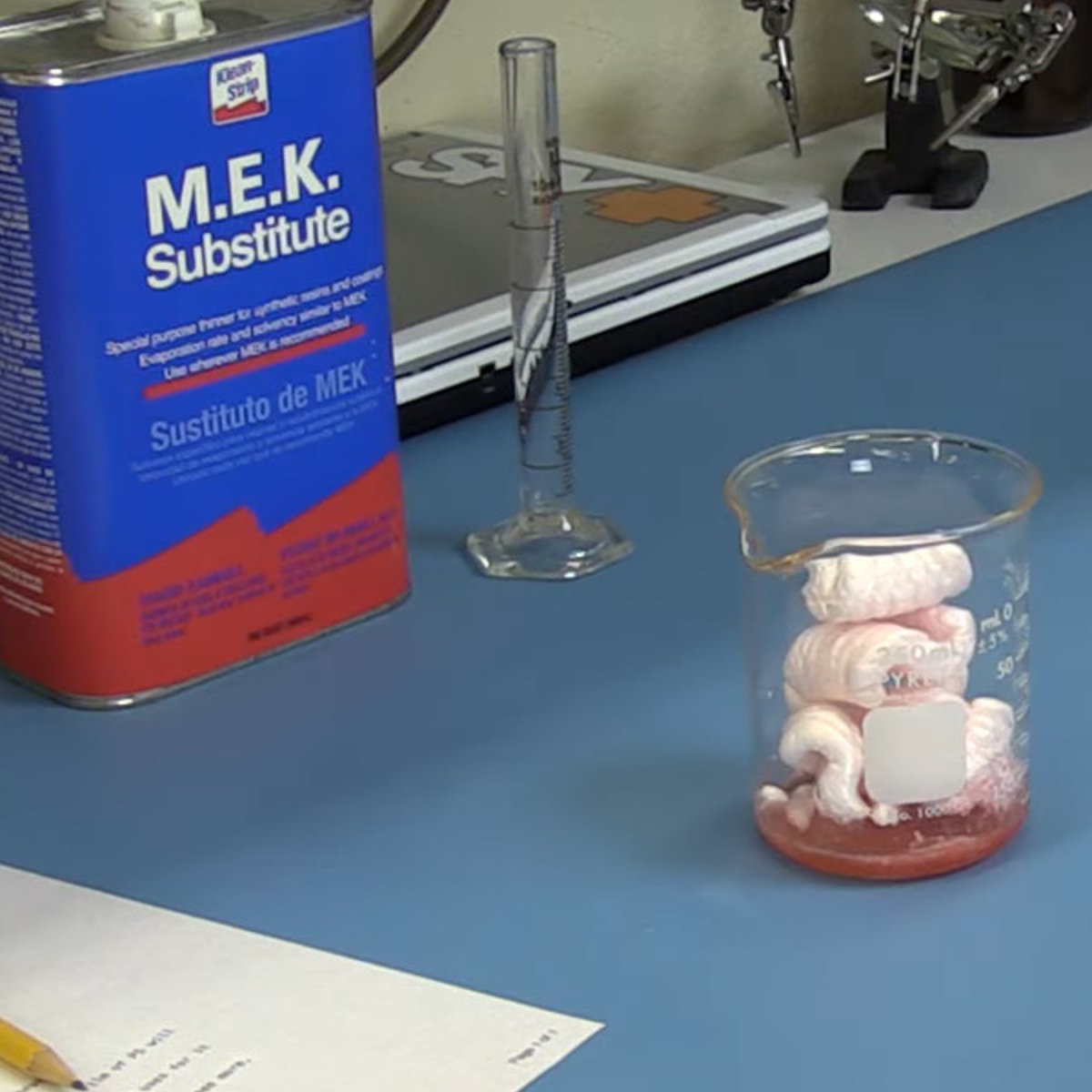 Where this is being written it wasn’t on the market so it was more usual to use nail lacquer, but reading the piece it seems American hams swore by the stuff. That’s in the past tense because it seems it’s no longer on the market. Even there though help is at hand, because dissolving packaging polystyrene in solvent yields an acceptable substitute. There’s even an 11-year-old how-to video linked from the SolderSmoke post, should you fancy making some of your own. We suggest you proceed with caution though, polymers dissolved in solvents sounds a lot like home-made napalm, and probably puts out fumes you don’t want to breathe.
Meanwhile should you fancy experiments of your own with inductors, we’ve got you covered.












The MSDS for GC Electronics Q-Dope is still online. It lists the (main) solvent as methyl ethyl ketone (MEK). Although because of VOC regulations it’s no longer readily available in the paint department, it’s not hard to acquire (at least in the USA). MEK and polystyrene is also called “model cement”, albeit in a different proportion than for dope.
Incidentally, the “M.E.K. Substitute” is ethyl acetate, a good solvent for PLA, should you want some color-matched solvent glue for your FDM prints.
I still remember the day I learned you can’t glue styrofoam together with model glue.
I remember learning that you can’t use Styrofoam for a buck when making fiberglass parts. A few weeks ago, I watched a YouTuber who should have known better learn the same lesson while on video.
So what you’re actually looking for is ‘sprue goo’? For those who don’t know, this is the high-impact-polystyrene used for most (not Catalyst, those are PVC) plastic models and miniatures, dissolved in the above plastic glue. Usually the bulk styrene is sourced from the sprues of a completed model kit. Hence the name.
I thought the solvent for melting packing peanuts to make your own glue/whatever like that, was acetone? At least that’s the version I have used the few times I needed it.
I am a ham and wind a lot of inductors. I have had great luck using 3d printed PLA forms with a helical groove to set and maintain the coil geometry. I have a parametric model built in FreeCAD so I can plug in a few dimensions and get what I need. I have coated a few of the wound inductors with polyurethane or lacquer but mostly don’t bother.
73
KR4AHM
Q Dope is an insulator and protector like lacquer or a thinner version of Corona Dope, used as a high voltage insulator.
For mechanical stability use a staking material https://spectrum.ieee.org/staking-electronic-components
Or, if you just need a fixed value and don’t need to reform a coil to tweak the tune, use the [Shaw] method and print a form. Though ASA, PC or resin is a better choice, or ceramic if you’re obsessive. PLA has that unfortunately-low softening point.
From the ancient days of inexpensive Japanese AM/FM radios and VCRs, the old paraffin+beeswax on a piece of foam stuffed in the air-core is still darn cheap and allows easy tweaking by distortion of a turn or two.
In a recent build of a crystal radio with my grandson, we wound the aircore inductor and used a drop of UV glue every 15-20 turns to prevent an unwinding disaster in the event the plastic tube got loose.