
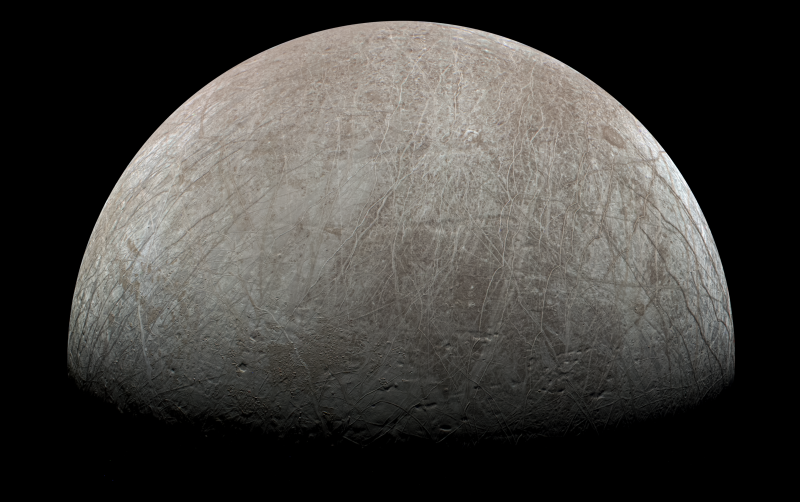
Unlike on Mars where for decades we have had dozens of orbital and ground-based platforms zipping and scurrying about to prod at every bit of emitted radiation, rock type and twitch of dust devils in its thin atmosphere, for other planets and their moons we have to do a lot more speculative interpretation of data. Such was the case with the presumed existence of water plumes on Jupiter’s moon Europa. These now appear to have been a statistical fluke, per research by [L. Roth] et al. in Astronomy & Astrophysics.
As succinctly summarized in the article on this by [Javier Barbuzano] of Sky and Telescope, the original 2013 finding of said water plumes by the same team was based on faint UV emissions from Europa’s southern hemisphere as captured by the Hubble Space Telescope. However, in more recent captures these emissions were not detected again, leading them to reexamine their original analysis of the 2013 data.
One of the main flaws was in the assumption of where Europe was located on Hubble’s 1,000 x 1,000 resolution detector, with the re-analysis showing that they were off by a couple of pixels. A second flaw was quite understandable as since 2013 we have learned that Europa has a thin hydrogen exosphere which interacts with the Sun’s UV radiation. The resulting scattering induces a UV glow which could be mistaken for UV radiation emanating from the moon’s surface.
Even with this one intriguing feature turning out to be a mirage, it doesn’t make Europa any less interesting as it’s still assumed to have vast liquid water oceans. Along with Uranus’ moon Miranda this makes it very worth it to experience more of the sights and sounds of these alien worlds, whether in person or via our robotic friends.












For those who wonder “Who cares?”
Europa is a leading candidate for finding alien life, due to its large ocean (which is still presumed to exist; we have evidence even without this revision).
For all we know, there could be bacteria, whales, or a pre-industrial civilization under that ice. When we thought there were surface geysers, we were hoping to just send a probe flying through the plume and test the water for organic compounds. We have the technology and budget to do something like that.
If there are no geysers, we’d need to drill through 20 km of ice to find out. We don’t have a budget for that.
So the odds of us finding evidence of actual aliens within your lifetime just went down a lot.
Whales?
“Another thing that got forgotten was the fact that against all probability a sperm whale had suddenly been called into existence several miles above the surface of an alien planet.”
I now know the alien planet that was referenced.
“For all we know, there could be bacteria, whales, or a pre-industrial civilization under that ice.”
First point: I mean, I get people have to be dramatic to drum up interest and funding, but the issue with complex life on Europa is and always has been its energy budget. People have been talking about Europa as a source of complex life for decades, but you have to do a bunch of weasel-wording and heavy assumptions to get there. Europa’s energy flux, being as generous as possible, is easily a factor of 100 smaller than Earth’s.
Personally I think it’s way more interesting to talk about Europa being a way to view an analog to Earth at a very early stage in development just because the chemical processes are practically frozen (see what I did there) in time.
Second: The geysers aren’t just a way to get access to the ocean. If they existed, they also imply cycles on Europa, because material coming up also implies material going down, which allows you to make arguments about components that get transformed by the surface being reintroduced to the ocean at a rate.
Yeah, I mean some sponges living around thermal vents are plausible-ish and would be extremely exciting. Whales are far-fetched. But it’s just kind of nuts that there are places in our own solar system where we haven’t ruled out megafauna. It reminds me of how we hadn’t ruled out our sun having a red-dwarf companion until ~2010.
I’m not familiar with the energy flux argument. As in: there is 100x less energy coming with from solar / geothermal / tidal sources?
I would guess that puts a limit on population sizes rather than complexity. I.E. I could imagine a biosphere with ~100 million tons of algae-equivalent (instead of Earth’s 10 billion) which would cascade up the food chain to ~50,000 whale-equivalents (instead of Earth’s 5 million peak).
But maybe 50k is too small a population to evolve and persist in a world-sized ocean?
We could have the budget if the military budget was cut just a few billion… The powers that be just haven’t made it a priority.
But someone doesn’t want to lose the war with Iran so he’d rather waste few billions dollar a day for that glorious “international war victory” on his presidential resume.
I don’t know about that, to get a drilling setup to Europe that can drill so deep, that might take hundreds of billion. With a rather large chance of failure.
The real issue is that there isn’t a financial ROI for such a mission. A lot of people want to feel special as the only life in the universe; learning otherwise would be a blow to them. And, I heard on the news, that the wars being waged could result in “huge profit,” which is all we need to know about why money isn’t being dedicated to knowledge endeavors.
With a surface temperature of the icy crust (or outer shell) of about -160 °C (-260 °F or 110 K), I honestly can not see humans ever being sent. And estimated thickness of roughly 29 to 35 kilometers (18 to 35 miles). It is not a place for humans. And I’m totally ignoring the radiation on the surface of about 5.4 sieverts (Sv) per day. I’ll leave this here in case you do not know how bad that actually is https://xkcd.com/radiation/
That is quite a lot. Still, it would be reduced dramatically once you’re even a little way in to the ice. Still not practical.
Yeah, squishy human bodies that evolved for the cozy Earth biosphere will probably not even do too well on Mars, never mind Europa, without some serious shielding and other life support systems. Which is not to say that it wouldn’t be very cool if it was possible somehow, even as an immersive VR experience :)
Sounds it’s about as suited for humans as Mars.
Unless there was an advanced technological civilization under that ice or future human technology reaches the ‘indistinguishable from magic’ stage then I can’t imagine going in person would make much sense. And I am someone who is for human exploration and advancing out into the solar system. I just don’t see the point of going to a plain ice surface with basically no atmosphere nor descending into an ice-enclosed ocean that probably makes the Mariana Trench look like the top of K2.
But sending robots down under the ice to discover if life is there… that’s another story. We would need the drilling rig to survive the radiation just long enough to dig a bit down into the ice. We would also need something that sits at the top to serve as a communication relay. That part would need to be very radiation hardened.
I wish this really would happen during my lifetime.
— Ok had to look it up before posting… Mariana trench is about 1,086 bar at the bottom, Europa’s ocean is estimated to be 1,300 to 2,600. Let’s get Elon in touch with the remaining OceanGate people. I’ll make the popcorn.
I would imagine that Europe was nowhere in the Hubble’s detector field. Unless it had somehow flipped 180 degrees.
It was reflected on one of the massive starlink mirrors in front of it.
Why is Hubble pointing at Europe?! I thought it was outward facing.
No Europe is now going all self centered lately.
(just adding to the confusion :)