
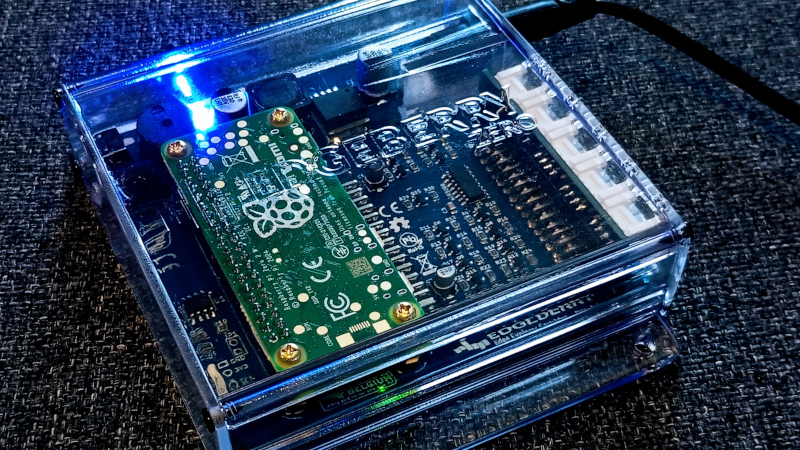
By now we’re all used to single board computers such as the Raspberry Pi Zero, but it’s likely we’ve all been frustrated at times by the number of support components required to use one. This becomes ever more annoying out in the field away from a handy HDMI, USB desktop, and power supply.
The Edgeberry Zero is an attempt to tackle this by mating a Raspberry Pi Zero with a PCB holding a robust power supply and interface connector, all together in a case. better still it comes with Edgeberry Hub, a software management interface.
It appears to be a commercially available product, but it’s Open Source Hardware Association (OSHWA) certified and everything is available in a GitHub repository. Looking at it from a Hackaday perspective it’s hardly the first power supply support board we’ve seen for a Pi, but its approach of making its own expansion module format is an interesting choice. To us they are reminiscent of Game Boy cartridges in the way they slide into a slot in the case.
We like the general idea behind the Edgeberry Zero, but whether it offers enough differentiation from packaging up a Zero with cables and duct tape is up to you.












Remember the NEC Monitors with built in Raspberry Pi Compartment?
No….? Which models?
No UPS with 18650? hm……
When putting the 18650 inside of the device, you’re landing in a different product category. I’m sure there are beautiful projects that could be used by this project as an external UPS.
hackaday io bloking my comment , I cand send any message to this projectw
I’ve built a simple circuit on a perfboard which takes in USB power, has a TP4056 charger and a battery, and auto switchovers to USB when power is available, and battery+boost converter when is not. It works remarkably well, I’ve been using it to power my Pi Zero 2W for about 2 years now. The only time I’ve lost power was when there was a 6 hour blackout after a storm.
I’ve been thinking of designing and building a custom board for pi zero 2W which can have a dozen or so USB ports by cascading them. I have no idea if the bandwidth for USB, along with using WiFi will choke its quad core CPU but I have no reason not to try. The only “problem” is that I will need to use a microusb cable on the custom board to connect USB to the pi zero 2W, since the USB pins are not exposed as a part of the pin headers.
I plan on using such a device as a home server with many, many external 2.5″ HDDs connected to it, accessible through SMB.
It’s your lucky day – the USB pins are exposed as test points on the underside of the Pi and can be connected via pogo pins! Although I highly suspect you will be significantly bandwidth limited with that many USB devices.
The consistency of test point positioning across versions is not reliable enough for building a product around, though. But great hack!
They are not as header, but they are as test pads. And USB2.0 is totally able to survive good quality pogo pins.
https://xkcd.com/927/
If… ever there was a situation that’s NOT an example of that, it’s this one. This exists because there are no competing standards, really, for this particular niche application/market.
Mmm. Folks try to create standards by either creating a product, or suggesting an idea to the IETF via RFC.
How about a middle ground wherein XKCD 927 applies equally to RFC’s 1149/2549 ?
the thing i find myself wanting with the Raspberry Pi (and microcontrollers like the ESP8266) is an I2C Hub. With one of those, it would greatly simplify my provisional birds-nest wiring jobs. it would also be convenient if I2C devices (including SBCs and microcontrollers) came up with a pin arrangement standard for the four pins such a hub would consist of. and, no, Quiik or whatever it is called isn’t ideal because the pin pitch is too tight
Why are you wiring up birds’ nests, and do the birds know? 😈
Not a peep out of me!
and the lack of sufficient gauge wire to drive anything. Especially if you’re daisy chaining the devices. And yes, the multiple standards for pinout is very irritating.
IoT, responsible for smart toasters that can run doom.