
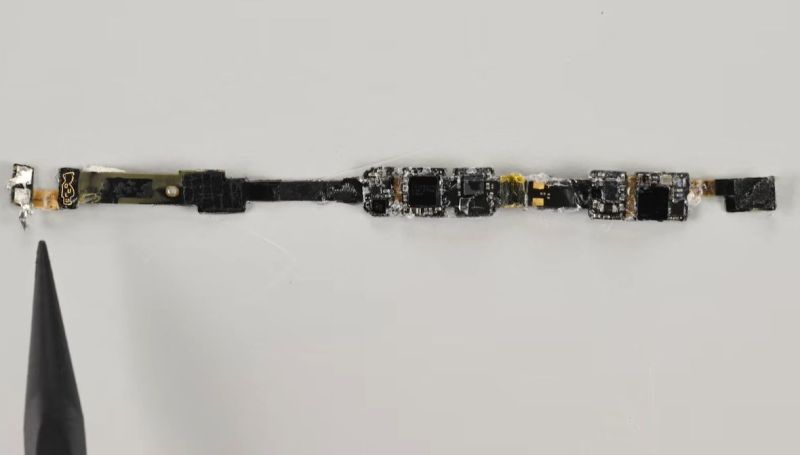
In the quest to make every wearable device ‘smart’, a lot of electronics along have to be crammed in very small spaces, along with ways to make them resistant to environments that our bodies do not mind, like getting hit by a rainstorm or simply washing our hands. These two factors combined make especially devices like smart rings an interesting case study for repairability, with [iFixit] recently taking apart a modern Oura smart ring to assess its e-waste factor after the built-in battery dies.
The subject of the teardown video is the Oura Ring 5, a $400 smart ring that’s designed to track your vitals much like a wrist-worn fitness tracker — just in a much smaller package. This metal-and-epoxy sandwich can definitely survive a good rain shower and washing of hands, but to get to the internals rather forceful methods were needed, unlike previous Oura and Samsung smart rings where some applied heat was enough.
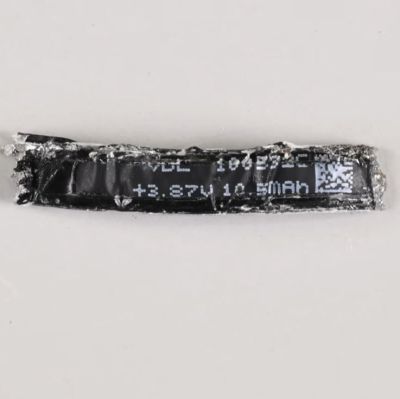
In the Ring 5’s case even more heat was needed to make the inner ring start to slide out, but by that point the Li-ion battery inside had already popped from the heat. The inner ring then got stuck and more violence was required to continue the disassembly and get to the super-tiny, 10.5 mAh battery. Of course, at this point the smart ring really won’t be getting back together, never mind still work or be waterproof, which is a central issue with these smart rings.
With the EU’s February 2027 deadline for user-replaceable batteries looming on the horizon, it’ll be interesting to see whether devices like this can squeeze into an exception category, or whether manufacturers will have to massively redesign or stop selling these devices to this rather large market. So far this particular regulation has already forced Nintendo to make a special Switch 2 console for the EU.












Wearables are generally already exempt from the legislation
Nice to see that EU is leading the charge by regulating tech. Without EU we would still have zillions of different types of chargers for phones. User-replaceable batteries will definitely force innovation.
Next up, standard-sized and materials for packaging of common goods. Either recyclable easily or reusable.
“or whether manufacturers will have to massively redesign or stop selling these devices to this rather large market. ”
This is why we can’t have nice things.
Technology has reached a point to put a 1980s mainframe computer on your finger, and if sausage hand bob can’t fix it by beating it with a hammer and oversized screwdriver, then no one is allowed to have it.
God forbid we ask a person who doesn’t want a thing to just refrain from buying that thing. No it has to be ruined for everyone else with a new law all because a few people have no self control
Or the manufacturers will redisign it to fit the legislation, making it easier to repair and probably hack too.
And if the manufacturers refuse, you can still make your own.
The EU is a small market for most big tech companies, and compliance with EU laws is rapidly becoming not worth it, especially as the EU has decided that you can meet the letter of the law but be fined anyway – which is kinda anathema to how law generally works.
The European Union may only have about 5.5% of the global population of humans, but European Union (EU) member countries hold about 16.6% of total global personal wealth.
For comparison the US has about 4.3% of the total global population, and holds about 35% of total global personal wealth.
Looking at the above is it really worthwhile ignoring about one sixth of all the money on earth and focus on just over one third of all money on earth ?
When the cost for them is substantially more than elsewhere? Not worth it.
Probably not for niche item like a $400 smart ring.
For mobile phones, tablet computers, etc. The lost of the E.U. market would cost them billions in lost revenue. Factor in the U.S. economy is currently shrinking faster than that of the majority of their trading partners and the tech companies cannot afford to lose access the E.U. market.
Huh? How is the US economy “shrinking”? I would love to see your data citation for this.
About 60% ofUS pooulation has trouble paying rent. Wealth disparity is one of the largest there. You can’t just go by averaged wealth to define potential markets.
It’s also distorted by companies with paper value far exceeding their assets. e.g. Meta/Facebook, Xitter, OpenAI, etc. Whose primary assets are a few buildings and several hundred millions dollars worth of ‘pre-owned’ computer equipment.
Well generally governments that try to regulate too much usually find themselves in a position where no one wants to do anything with them
Just like kids at the playground who make up their own rules that you need to follow if you want to play. At one point all the other kids go, “yeah no thanks, we’re good”
That’s a very U.S. centric point of view which simply doesn’t apply to much of the world and the E.U. in particular.
Lol he’s very clearly talking about the E.U.
“Kids” … you nailed it.
Grown-ups play here: https://policy.trade.ec.europa.eu/eu-trade-relationships-country-and-region/negotiations-and-agreements_en
Yeah… At some point you have to accept the trade off of durability vs repairability. Both cannot be achieved as you shrink in scale.
This is one class of product where repairability truly does not make sense. It’s going to get damaged, it basically must be potted in epoxy or some equivalent hardening goo, it’s too tiny. Economy of scale just has to make it cheaper and disposable.
Perhaps not – if the potting epoxy like material is designed to easily dissolve in x relatively safe chemical that doesn’t harm the electronics or occur in day to day life then the insides could be very easily repairable, and potting it again is no great hardship either. A little beyond most regular folks to do at home perhaps, but easy to drop off at the repair shop.
The real question with things like this is are repairs ever actually worth it?
To me actually repairing it seems unlikely to make sense, as even if it was easy it probably wouldn’t be done given the manhours and price of a better replacement. But a recycling program and mandated requirement for something like it would be pretty easy.
Absolutely spot on. The number of products that are deliberately potted/encapsulated in materials that deliberately resist solvents that don’t exist in nature is out of control.
Agreed! The wind industry has some reverseable epoxies for recycling turbines, so it definitely is something that can be done. A middle ground of letting professionals handle the chemical bath in a repair shop seems reasonable.
My Oura 4 has handled a great deal of abuse, but the battery life has probably halved over the year or so I’ve had it. It would be nice if there were an easy way to replace the battery, but barring that, adding an option in software to limit charging to 80% could definitely improve the longevity of the cells. Slower charging could also help, although you’d probably need to do that as a settings checkbox as well. Sometimes I need to top it off in a hurry before I walk out the door, and other times it isn’t urgent.
The disproportionate value proposition blows my mind. $400 Laptop, $400 Ring…
Accessories teams perhaps piggybacking on the mobile phone experience. Phones are expected to last 4+ years now. Look how they can shine with a fraction of the effort and devices that only last a year…
I loathe these guys. lowering the overall experience for a buck, always.