
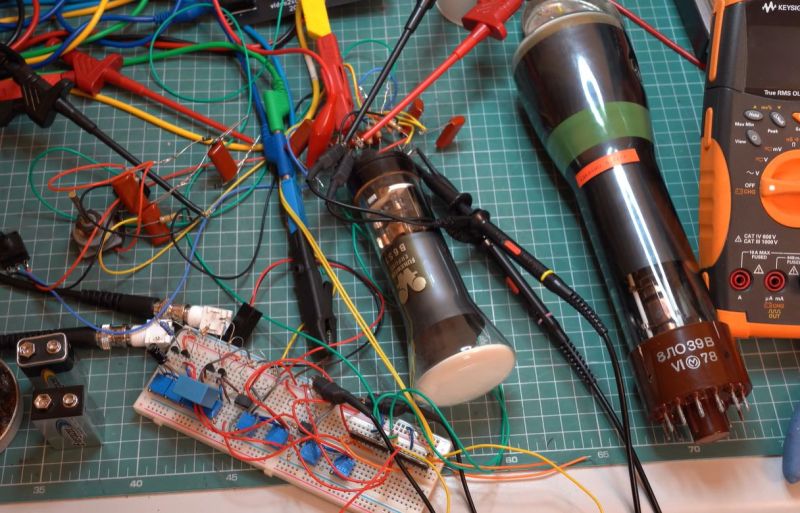
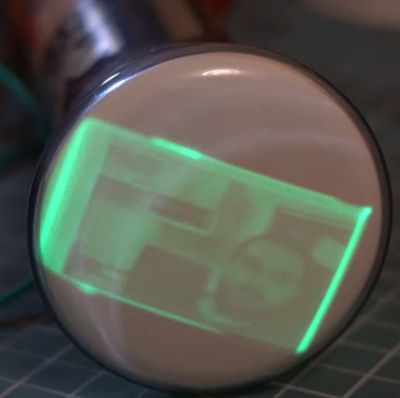
 For most of us the abbreviation “CRT” brings to mind a monitor or TV. But at its core it’s about the special vacuum tube that makes the images appear.
Regardless of whether it’s just a simple monochrome CRT in an oscilloscope or a full RGB CRT, the basic steps to make it work in a device remain the same. In a recent video by [Void Electronics] these steps are worked through, including the biasing at the end that is necessary to get a stable image.
A big part of installing a CRT and driving it is knowing how to read its datasheet. Much like other vacuum tube types, there are heaters, control grids and a range of voltages to get right and keep happy. Even then you can still have a situation where you must troubleshoot problems, which is also touched upon in the video. All of this is demonstrated using an RFT B6S1 CRT as the subject, including how to build your own bias circuit.
Despite calling it an “obsolete skill”, there is still a lot of demand for CRTs in vintage lab equipment, arcade restorations and far more obscure fields that still have new CRTs produced for them. Not to mention that even today CRTs have characteristics that make them competitive with flat-screen technologies.












I have about, 20, 30, maybe 40, CRTs in my collection ranging from the ones in my scopes, to some bare tubes, vga cga monitors, custom projects, and a few of those little viewfinder CRTs. Do I have a problem? I just can’t bring myself to throwing them away. They’re too pretty!
Would have to agree completely! There’s nothing that gives off the same esthetic as a monochrome crt glow!
This is why I was sad to see VFD table top games get replaced with LCDs. Even when they try to simulate the look of VFD with an LCD, it does not at all look the same. All of the subtle characteristics of the VFD just isn’t there. The faint red glow of the filament wires, the slight halo to a glowing VFD segment among other things just isn’t there. And the VFD games often looked and played amazing, like looking at an arcade monitor and the gameplay was good enough that you stop noticing the “jerky” movements (limitation of segmented displays) of the action.
No, you don’t have a problem.
But the people you leave them behind for — they’re the ones with the problem. Be kind. Take care of that before you go.
i was happy to get rid of my last CRT a couple years ago but yesterday i was trying to boot up a 2006 PC and my VGA LCD is obviously on death’s door and i almost couldn’t get it to work. i found myself staring at the wall trying to process the fact that there’s nothing in the house that can display VGA. how could this happen?
after several power cycles, the LCD started working again, right as i realized that the 4″ LCD monitor i bought from temu (designed to be mounted to a truck dashboard) has a VGA port right beside its HDMI port. pfew! i imaged that old HDD and i’ll probably never touch the computer again. but it makes me anxious to know that my pile of obsolete HDDs is also becoming inaccessible because IDE is as long-gone as VGA is.
There may be external enclosures that take IDE.
VGA displays are not hard to find. The thrift stores around here always have bunches of monitors with VGA inputs. The ones without HDMI usually sell for around $10.
At my local Goodwill, pretty much every monitor, VGA, HDMI, small, large, HD, and even old 4:3 monitors all go for $9.99. They sell at a pretty good rate, especially the HDMI ones, so you have to check often.
It’s a common misconception that someone somewhere is still making CRTs. They aren’t. If you look very carefully, the one or two companies that seem to be making new ones are actually only reconditioning them. The last manufacturer to make CRTs was I believe Toshiba, who shut down production in around 2008.
Sadly, this is true for anything resembling a normal CRT, but I’m pretty sure the article is correct in the sense that there are still highly specialized CRTs being manufactured for military applications (such as specialty avionics HUDs) and scientific research applications (such as RHEED Guns).
.. and there are still extremely simple ones being manufactured for science class demonstrations and/or just for fun. Even a motivated hobbyist can make a crooke’s tube.
A possible problem with military CRTs is that they cost an arm and a leg when new because, well, why not with a captive market that has deep pockets. Used military CRTs are generally smashed to protect restricted security screen burns.
I must be the only retrogaming enthusiast who hates CRTs. Frankly its terrible fidelity, distortions, pixel smearing, makes it difficult to see anything clearly. Text is harder to read.
CRTs are truer to form for retro home computer and console gamers, where sprites were designed around how horizontally adjacent pixels smear when they’re converted to composite color then sprayed on a phosphor CRT meant for broadcast TV. Some games look wrong when rendered pixel-exact in emulation or digitized to an LCD.
The dev of Galaga certainly intended pixelized art. SMB1 I dont believe that Nintendo intended to make a diagonal pixelized graphic look smooth via crt blurriness. It sounds like an oversimplified assumption, each game dev would have their own custom processes and “blurry crt” seems to go out of the way to claim intention when it is merely an artifact of the technology.
Many emulators can use shaders. There are plenty of shaders for simulating a CRT. They aren’t perfect, but they can look pretty good when used with a high resolution OLED monitor.
I particularly like the Smoothing shaders, but they do introduce input lag and reduce emulator performance so I am hesitant to use shaders
CRT electronics are niche but not dead, mass spectrometers use similar circuitry to generate, steer and focus ion beams, in some cases electron beams. High voltage in vacuum brings specific challenges that every TV designer once knew, an HT flashover in vacuum can destroy all but the best protected electronics.
I work with electron beam lithography machines they are very much like crt….electron microscope, TEM and similar technical tools are all based on principle similar to CRT.
At one point in the ’80s, RCA TVs had frequent HV flashover in their CRTs. Often just an alarming snapping sound, but I replaced a lot of horizontal output transistors. In some cases, the new output transistor would go too unless you replaced the CRT, despite RCA saying this was normal and harmless. Even before that, RCA TVs often had bad flybacks that would wipe out the horizontal output. You learned to change them together, or you’d see the set back in a few weeks.