
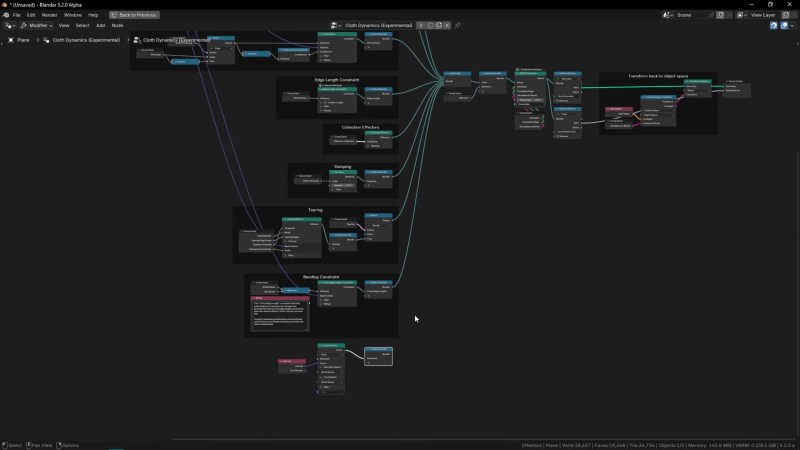
Traditionally, one of the weak points in Blender has been simulations, with even professional users of the free and open source computer graphics suite off-loading such tasks to programs like Houdini. But according to [3Dan], once version 5.2 is out of beta in July, that may become a thing of the past.
Simulations aren’t a necessary part of a 3D animation software, but they are very, very nice to have. If you want realistic-looking fluids, hair, or cloth, it’s incredibly difficult to animate it by hand. One, because there are so many degrees of freedom in, say, flapping cloth, keyframing is a major pain, but also figuring out how to make the model move and deform realistically is by no means trivial. It’s easier to offload all that on a physics simulation; then, as long as the physics is realistic, the animations will be as well.
That’s not easy, computationally speaking, and one thing that’s clear is there’s been work behind the scenes to optimize the simulation algorithms, not just improve the workflow, as the basic “drop cloth on a monkey head” demo now runs twice as fast. The new workflow itself bring simulations more into line with how Blender has been going– it’s part of geometry nodes now. So there’s simulation nodes you bring in, but that means things like tearing cloth become quite straightforward compared to the occasionally byzantine workarounds required before. This node-based workflow also brings Blender more into line with how paid software works these days.
[Dan] demonstrates the power of it by adding air pressure to a cloth simulation with some custom nodes, inflating and popping a fabric sphere. He also demonstrates how cloth simulation can be applied to animate realistic foliage. This update probably doesn’t have Houdini developer SideFX shaking in their boots, but it might allow some animators to stop paying that license and go fully-open source, which is great to hear.
Even if you’re not into digital sculpting or animating, you may find yourself downloading a copy of Blender at some point to add texture to 3D prints, or make fancy resin-print miniature models FEM-friendly. The right addon can even let Blender do parametric CAD, though FreeCAD is getting better all the time, too.












Cloth and Hair only, experimental.
Meh. Just get AI to animate it. You only have to starve one village of water and electricity for each five-second block.
I’m just waiting for simulation to come to kicad. Antenna radiation sim, current density, thermal analysis, transmission line analysis etc etc. Maybe integration with FreeCad will make it easier?
Wish I was smart enough to help.
It’ll only be another 35 years.
Still got my C-Card when Blender crowdsourced buying the source code from (Neogeo?) and the beautiful paperback manual that came with it. At that point Blender was fitting a 1.44MB floppy disc.
Came with a byzantine interface to boot.
Huh I somehow never heard of this. Blender’s first lines of code date back to 1994. Wow.
Yes, Neogeo, and it started in 1994. The “Free Blender” campaign was in 2002 and collected (over) EUR 100k in donations. More about Blender’s history in:
https://en.wikipedia.org/wiki/Blender_(software)
I once tried to use Blender. Spent a bunch of free hours on it over the course of a few weeks. It’s setup is very much “different” from most other software and it takes some getting used to. I was beginning to see the beauty of Blender and it’s interface, but my main goal was technical drawings, and Blender really had to be forced into doing technical things. Because of that I did not go further with Blender, and later settled on FreeCAD, which has quite powerful sides, but is also still struggling to become a “good” program.
If back then there were already projects like https://www.cadsketcher.com/ I might have kept with Blender.