
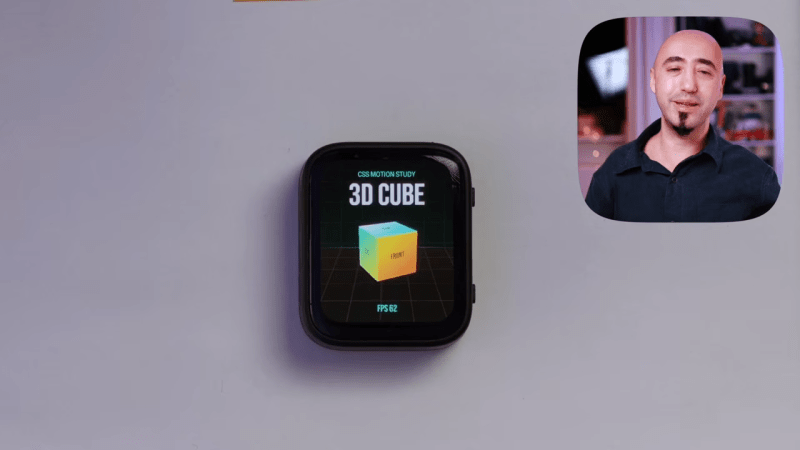
There are lots of graphics libraries available for the ESP32, and lots of ways to program one to boot. Even still, most of us wouldn’t immediately think to CSS when it comes to embedded products — yet that’s now a thing on the Espressif platform, apparently.
The Gea stack allows one to compose CSS and TypeScript code that is then turned into generated C++ code that compiles to native firmware. The team behind Gea have demoed this ability by running a 3D cube animation on an ESP32 at up to 60 FPS. This isn’t some ugly, low-res wireframe demo, either. It’s a full-color animation running on a 410×502 AMOLED screen. It’s very fluid, and can even handle transparency on the cube faces (albeit with a performance penalty).
It’s worth noting that this isn’t a full browser engine. As you might expect, some concessions had to be made to get it running on the ESP32. Namely, it doesn’t handle “:hover” states because it’s designed for touchscreen use, fonts are rasterized, and the UI tree is limited to just 512 nodes. Regardless, it shows that using CSS and TypeScript to develop for the ESP32 is entirely possible without some crazy loss of performance. If you want to build easy interfaces on an ESP32 while leaning on web dev experience, this could be very useful indeed.
There are lots of fun ways to write code for the ESP32; you can even try MicroPython if you like.












Is this an open source project or is it commercial? There is very little info in neither the video nor the website. It seems to be in an “early startup” state.
One project that has been in the back of my mind is a microcontroller that can render (a subset of) standard HTML. Goal is that a small SBC is configured as a server, and a power efficient handheld device pulls pages from the server and displays them on a touch screen to create a customizable remote control, sort of like the old Philips Pronto.
The device does does not have to be capable to be a full web browser, but it must understand standard HTML well enough to render at least one picture type, and send button presses back to the “server”.
This server is then part of an home automation system, and it may have extra modules to create RF or IR commands to control external equipment.
Wifi is a bit power hungry, maybe it’s possible to use bluetooth as the underlying protocol. Linux can also work with http over USB.
Well, you don’t need to force yourself to html, just make a custom simple DSL, encode it with e.g. json and draw it yourself.
There’s nothing available that allows to actually try it and most of the pages on that page are empty – a little disappointing to see this being posted here then. Whole page seems to be vibe coded (fair I guess) by a guy working in a co-working space in Berlin, who has “3 times winner of hack’n’tell” in his linkedin bio.
Not sure if it’s the final (last commit is 2 months old) but I’ve found this repo from the same guy.
https://github.com/dashersw/gea-embedded
I’ve not tried it though.
Why are you stalking him?
was curious if I find a github under his name
oh wild, actually found something – lost track a bit, it’s super warm here. https://github.com/dashersw/gea-embedded
Still, the hackaday post was a bit lacking for my taste
Hi, I’m the guy on the video. https://github.com/dashersw/gea-embedded is the PoC for Gea, and the new version that I have been demonstrating over the past week will be open sourced next month. It will be dual licensed, where the open source components will be GPL licensed and a commercial license will also be available. In the meantime, to get a glimpse, you can try out the gea-embedded repo, and I would love if you shared your thoughts. Since that version, I replaced C with C++ and added a proper TS->C++ compiler, instead of only compiling simple primitives.
thank you Armagan for giving some more insights to it!
TIL researching publicly available projects and their authors online is now known as “stalking.” SMH. Let me guess, Wikipedia is now also known as the “dark web.”
Only if you switch it to dark mode ;)
I think he lurrrves him xXx
I have no doubt an ESP32 chip can do this. The frame rate may have been sped up. That’s all.
So it’s not “CSS On The ESP32”. Maybe change the title?
Sure it is. But it’s not CSS interpreted on ESP32. Who care if the interpreter is your computer as long as you can render the result on a ESP32? The main issue right now if that you can’t have dynamic content on ESP32 since each content “builds” a complete firmware. I guess, combining this with esp-elf project, you’ll be able to load the embedded “website” from a elf file at runtime (the elf file will be built on the server). Still a lot better (and probably less resource hungry) than running micropython + LVGL on top like it is now. The main issue for me is still the dual commercial / GPL license that you’ll find in almost all embedded rendering engines (Slint, Qt, Gea). We need a true “free” scene based geometry engine for embedded system, not something that’ll ask you 1$ per device of your 3$ gizmo.