
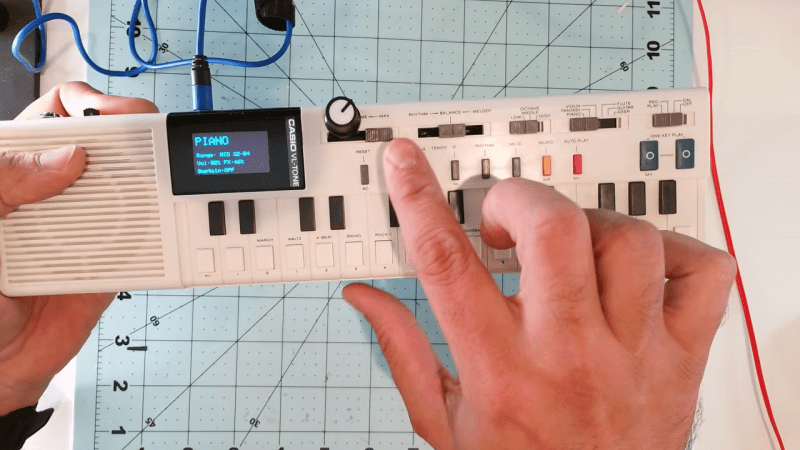
The 1981 Casio VL-1 was a fine cheap keyboard. It had a robust build, though an admittedly limited sound palette. [Max Vega] had one of these charming instruments, and decided to use modern tech to rebrain it for the modern world.
The original electronics of the VL-1 were largely surplus to requirements for this build. The original interface and speaker were kept in service, while the rest of the monophonic sound synthesis hardware was removed. [Max Vega] enlisted an ESP32-C3 to run the show, turning the VL-1 into a ROMpler instead. If you’re unfamiliar with the term, it refers to a keyboard or other instrument that relies on hardcoded sample playback instead of raw synthesis. The ESP32 loads its samples from a microSD card, which provides an enormous amount of storage for different sound packs. Selecting different instruments is handled with a simple interface built around the original buttons and a OLED screen. Playing the instrument is still the same using the simple keyboard, though [Max] also implemented some extra fun modes that play chords at a single touch.
If you want a fun, versatile keyboard instrument that fits perfectly in a backpack, it’s hard to go wrong with a build like this. We’ve seen similar Casio keyboard hacks before, too. Video after the break.












Wow I had that as my first keyboard! I would love a new one tricked out!
A #1 hit made with this “fine cheap keyboard”: https://www.youtube.com/watch?v=lNYcviXK4rg
I suspect there’ll be some purists saying not to destroy such a … err, fine? … piece of technology. However, I look at it and think “This screams 3D printing.” Mind you, at that point, I think, I should print a keytar, but with an ESP32 =))
Oddly, I don’t believe that audiofool nonsense about vacuum tubes and gold-plated super-shielded wiring, BUT I miss me the Jean-Michel Jarre analog synths. Squeeze that into a keytar with an ESP32 and some NeoPixels, which I realize makes no sense, but we’d be talking.
Audiology, I like it. The valves is about the type of distortion, basically lots, and it tends to appear as musical thirds. Whereas transistors clip, they flat line, the distortion is very harsh. At lower levels valves have a warm sound, visible on an oscilloscope. The gold plated blah blah is rubbish. The manufacturers of such expensive speaker leads cheat, they fit passive filter parts in the connectors. They even file patents detailing what they are doing.
Aha aha aha!
I always hear it when I see a VL-1.
The sound of a VL-1 , or the Veal Tone as we called it played through a bass amp and an Ampeg folded horn cab was pretty awesome. The 3 inch speaker just wasn’t the same a 800 watts and a cab the size of a refrigerator.
Could have 3d printed a replica and enhanced that. Unless the donor unit was actually broken.
If I run across one for 3.99 at the thrift store I’m sure as heck going to mod it rather than spend eons working out every little detail and nuance in cad just for it to be ever so slightly off in printing
Not every specimen is precious
First of all, your English is excellent. Secondly, your skills are elite. Thanks for sharing!
I can’t remember the brand/model of the beginner keyboard I had as a kid in the 80s, it’s been driving me mad. No keyboard, now or since, has been able to get that Bossa Nova rockin’ right.
We live in the future now, quantum computers and self-driving cars! Good Bossa Nova should not be an unachievable technology for us!
Hey, can you remember at least the brand?
There are some resources online focused on these sort of entry level keyboards.
http://weltenschule.de/TableHooters/instruments.html
There’s also the excellent Keen on Keys channel (https://www.youtube.com/c/KeenOnKeys) and the old 8bit keys channel, both on Youtube.
I used to know more that unfortunately I can not find. Internet is awful to find info now, what a twist ha?
I still have a VL-tone somewhere. I’m pretty sure it could sample a sound and play it back (shifted in key accordingly) but I may be misremembering.
There were the SK series of keyboard, from the first the SK-1, to the biggest one with 49 standard size kets and stereo sound, the SK-2100. Casio also made the FZ-1 and XW-G1 professional sampling synthesizers.
I still have mine, but the pots are so bad it’s more static than music now. It really was a classic.
Casio Cz remake would be quite a use good if compared to modern mass effort remakes of 90s computer games. I hope
brother had one. was it not the instrument use on the European hit DA DA DA!
does anyone know how to make one of these ancient keyboards velocity-sensitive? when i play a keyboard without that feature, it feels like petting a cat with Rock’em-Sock-em robot
Oh, a KEYBOARD, not a KEYBOARD…. where’s Christina?
No source code, as far as I can see.
Have two of these somewhere, although one is held together by it’s pouch because I tried to repair it decades ago and the screws immediately vanished. Two because I was extremely jealous of the one my sister had so asked for one of my own for the next Christmas/birthday.
I had a VL-1 back in the day as my first keyboard. A step up from a Radio Shack, 50 in one kit, thermin-like knob and single switch circuit that drove my parents crazy. I remember the CZ 101 having so much better sound quality at the time when it came out. And the CZ 230 S with the wicked programmable drum machine sounds. If I only had your mod back in the day. That would have been awesome.
Not quite as heinous an act as taking to a 1954 Fender Stratocaster with a chainsaw, but heinous all the same.