
You may have a 4K television. Perhaps you have even bought an 8K screen, despite the shortage of things worth watching in 8K. A 16K display is, today, a rarity. But even when those eventually become commonplace, yours probably will not cover 14,900 square meters, rise 73 meters into the air, or wrap over your head and behind your peripheral vision.
That is approximately what happens inside Sphere in Las Vegas. The venue’s interior display is quoted as having a resolution of 16K by 16K and an area of 160,000 square feet, or about 3.7 acres. Unlike most enormous movie screens, it is not illuminated by a projector. The entire surface is a direct-view LED display: an immense, curved video wall assembled from tens of thousands of smaller pieces.
After seeing The Wizard of Oz at Sphere, however, the most interesting part was not simply the screen’s size. It was how thoroughly the screen could disguise itself.
Where Did The Theater Go?
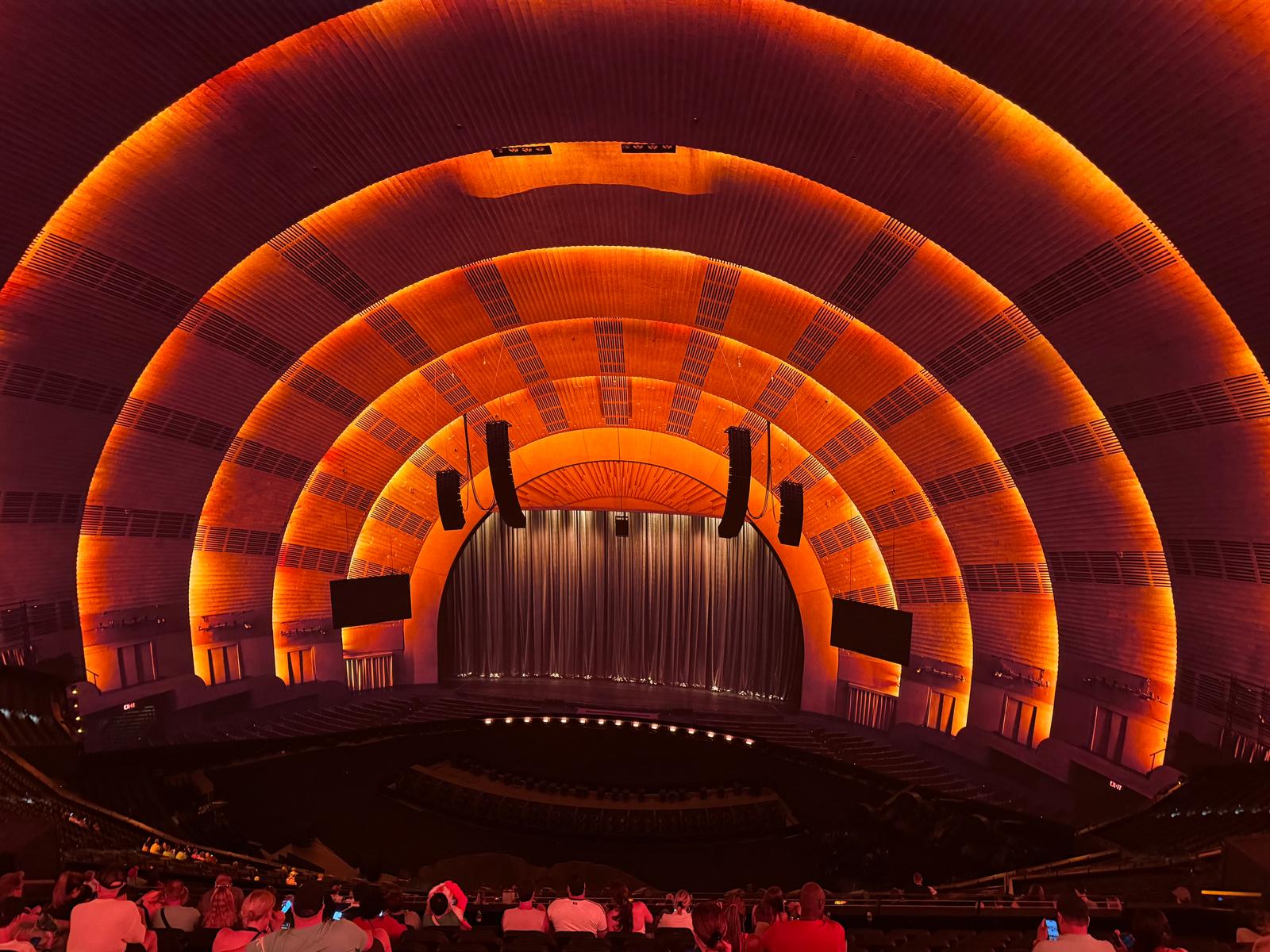
The obvious first conclusion was that the LED surface must be optically transparent, allowing the audience to see the real roof behind it until the pixels illuminated. That explanation was attractive because Sphere’s audio system really is installed behind the display, and the surface must allow sound through it.
It was also, apparently, wrong. The only explanation that makes sense is that the ceiling, ribs, grilles, speakers, and monitors were already being displayed by the screen. It was like a holodeck impersonating a physical theater interior. When the Oz material began, the system simply replaced one complete visual environment with another.
That’s what happens when a display fills nearly all of your useful visual field. A normal screen announces itself with a bezel, a wall, or at least a clearly visible edge. Sphere’s display extends upward and around the audience, removing many of those references. Give the image credible perspective, texture, shadows, and familiar architectural details, and the brain accepts the pixels as a room.
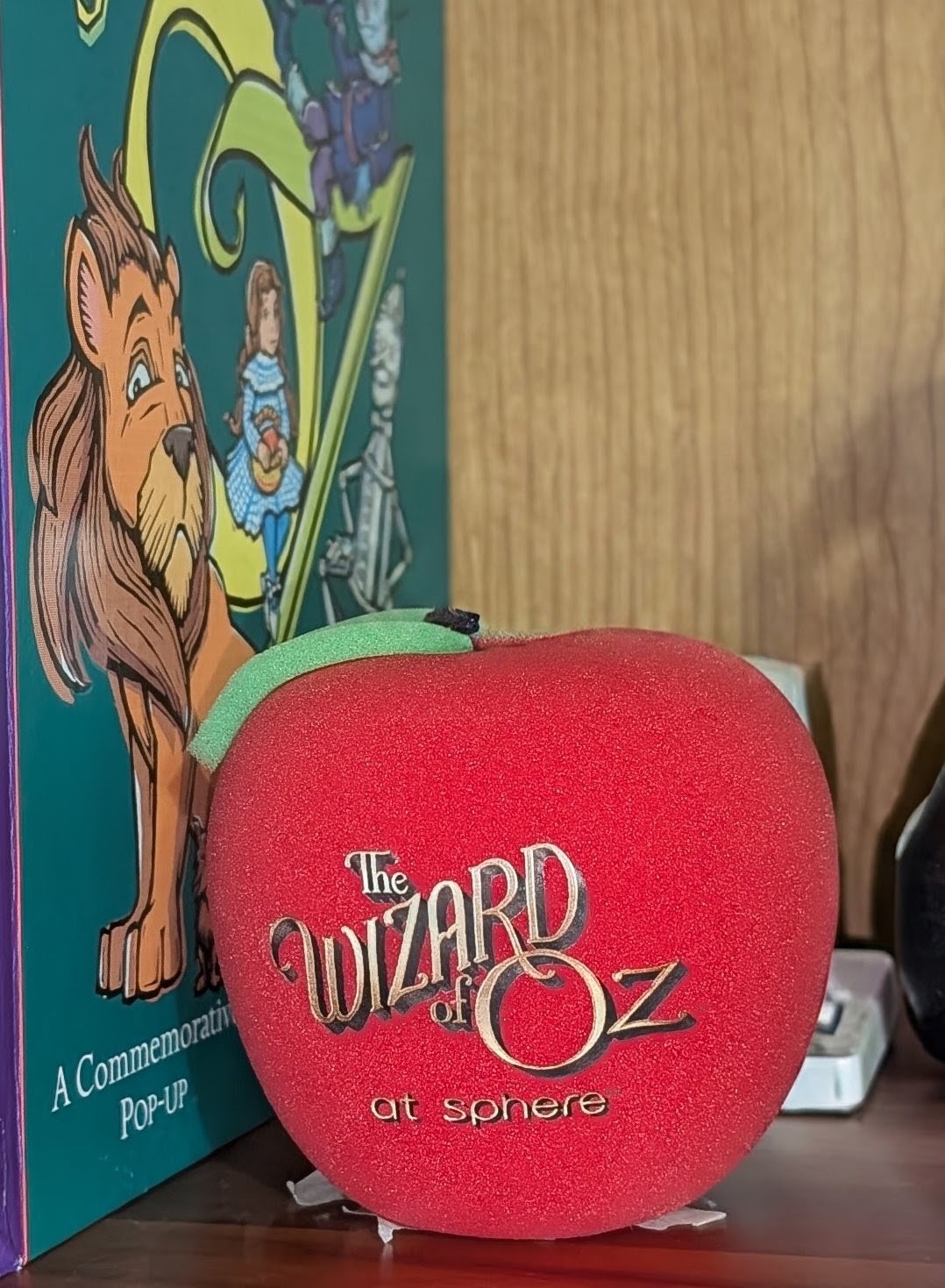
The same effect makes the Oz landscapes seem less like scenes displayed in front of the audience and more like places into which the auditorium has been inserted. Of course, there are more special effects. For The Wizard of Oz, there is wind and smoke, along with paper leaves, flower petals, and foam-rubber apples that fall from the sky. All of this makes it even more immersive.
Not Your Standard 16K Monitor
Calling it “16K” is not exactly untruthful, but potentially misleading. Consumer display resolutions normally describe a rectangular raster. A 4K UHD television has 3840 by 2160 pixels, or about 8.3 million pixels. An 8K set has four times as many, at roughly 33 million.
A literal 16,384-by-16,384 image contains about 268 million picture locations, but that’s not how Sphere is built. Sphere describes its interior display plane as 16K by 16K, but that does not mean it is equivalent to a square desktop monitor with a neat, uniformly spaced Cartesian grid. It is a custom media surface with complex curvature and geometry, driven as one enormous canvas.
Sphere says the screen reaches 240 feet high and wraps up, over, and around the audience. SACO, the company responsible for the LED technology, describes the interior as the world’s highest-resolution LED screen and says it has more than 120 times the resolution of an HDTV.
Published numbers vary slightly depending on the source. One source describes approximately 64,000 SACO LED tiles, while structural contractor Seele refers to approximately 65,000 LED screens or frames. The difference may be terminology, rounding, or the boundary between the LED tile and its mechanical carrier. Either way, this is clearly not a single panel that arrived in the world’s largest shipping crate, but rather was built on-site.
The surface is assembled onto a precisely engineered secondary structure. Seele says it created 839 facet units containing approximately 45,500 custom structural components. Those facets establish the overall geometry and give the LED hardware suitable mounting points while maintaining alignment across the enormous screen wall.
In other words, the apparent smooth curve is made from many accurately positioned pieces. At the intended viewing distance, the facets and individual emitters merge into a continuous image.
Feeding The Beast
Building the display is only half the problem. The other half is getting a quarter-billion-pixel-class image onto it up to sixty times per second without tearing, losing synchronization, or pausing while somebody clears a buffering dialog.
The public description of the playback chain resembles a broadcast plant crossed with a high-end video wall. Pre-rendered content is kept on network-attached storage and streamed to dozens of 7thSense media servers. Each server produces 4K video at 60 frames per second, with the streams distributed using the SMPTE ST 2110 professional-media-over-IP standards. Pixel processors drive the appropriate regions of the display.
Hitachi Vantara says the storage system can deliver data at up to 400 GB/s with less than five milliseconds of latency. (At least it did for Postcard from Earth; it could be capable of more, for all we know.) The material is handled using 12-bit color and uncompressed 4:4:4 chroma sampling. That does not necessarily mean every show continuously consumes the maximum quoted bandwidth, but it provides some sense of the infrastructure needed to treat the whole venue as a dependable display rather than an interesting laboratory experiment.
Content also has to be geometrically transformed for the screen. An image that looks correct on a flat monitor would be badly distorted if copied directly onto the curved surface. The production pipeline therefore needs a detailed model of the display and the audience’s relationship to it.
Stretching Oz Beyond The Frame
The Wizard of Oz presents an additional problem: the 1939 film was photographed for a nearly square 1.37:1 frame. Sphere’s interior is absolutely not 1.37:1 or even close.
Simply magnifying the original would waste most of the display. Cropping it to fill the screen would remove the actors and much of the composition. Instead, Sphere Studios expanded the film’s world beyond the photographed frame, using Google AI tools along with conventional restoration, compositing, animation, and visual-effects work.
The original photography remains central to the presentation, but scenery, skies, crowds, buildings, and environmental details extend far outside the old frame. Sphere says the project used AI to enhance characters and expand scenes while attempting to preserve the performances and familiar imagery.
This is more complicated than expanding a still photograph. The additions must remain temporally consistent as the camera and characters move. A tree cannot change shape from frame to frame, and a newly invented Munchkin cannot grow an extra arm whenever the model becomes distracted. The generated material also has to survive at extraordinary scale, where a small artifact can become several meters wide.
Whatever one thinks about altering a classic film, it is difficult to imagine adapting this particular source material to this particular display without reconstructing substantial portions of the unseen world.
Of course, not everyone is thrilled. If you hated colorizing black-and-white movies, this will probably set you off. Even the original Star Trek got new digital effects.
What Happens When A Pixel Dies?
With roughly 64,000 or 65,000 LED assemblies, failures are inevitable. We couldn’t find much public information about Sphere’s exact maintenance procedure, but we can infer some probable scenarios from other large LED systems. Big systems generally report power, temperature, communications, and controller faults automatically. We would imagine that Sphere can do this, too. Then, technicians can also probably display red, green, blue, white, black, and low-gray test patterns while cameras or human observers look for dead, stuck, or miscalibrated pixels.
A single failed subpixel may be invisible from most seats during moving content. A stuck-bright pixel in a dark sky would be much more conspicuous, as would an entire failed tile or data branch.
Seele says the screen structure includes 229 accessible panels, suggesting that maintenance access was designed into the system rather than left to exceptionally adventurous climbers. A failed field-replaceable assembly could be swapped, repaired on a bench, and returned to the spare inventory.
The replacement would then need calibration. LEDs from different production batches — and LEDs of different ages — do not produce precisely identical brightness or color. A technically functional replacement could appear as a visible rectangle unless the controller corrected its red, green, and blue response, gamma, and low-level output to match its neighbors.
Curiously, this may be one of the hardest features to appreciate during a show: tens of thousands of modules are working together, yet the audience perceives no modules at all.
The Screen That Pretends Not To Exist
Sphere’s specifications are impressive, but resolution alone does not explain the experience. Spread 16K pixels across a screen tens of meters high and the pixel density is far below that of a phone. The system works because the pixel pitch, viewing distance, brightness, content, architecture, and human visual system were engineered together using a lot of science.
While the Wizard of Oz was an impressive feat, we hope they’ll bring us something like 2001: A Space Odyssey. Or maybe a triple feature with shorts from Star Trek, Star Wars, and Avatar. Sure, the rights to pull that off would take a team of lawyers, but we can dream, can’t we? What movie would you like to see on a giant screen like Sphere? Or would you only see an original production? Any of you out there work behind the LED curtain?












“The system works because the pixel pitch, viewing distance, brightness, content, architecture, and human visual system were engineered together using a lot of science.”
Future archeologists could figure us out from artifacts like this, even if our remains disappeared.
The ONLY thing you can say about that sphere is….
A GARGANTUAN waste of AC power.
It’s bonkers how much power that thing uses. It should have never been cleared to hook up to the grid.
True, Las Vegas is generally known for conserving power and resources in general.
If only we had used Edison’s superior DC power, we wouldn’t have this problem.
What are you talking about? If the sphere was connected to DC power, then to convert the HUMONGOUS amounts of filtered low-voltage power needed for the panels down from 110 DC you would probably – at this scale – need a rotary converter. That would be even less efficient.
Uhm, zero AC power would be wasted. Unless I’m making up my own jokes here…
gottem
So I had to look it up.
28 megawatts.
About the same as a large town.
Or one modern datacenter.
That’s four percent of the output of a standard-size nuclear reactor.
About a thirtieth of what an aluminum smelter uses.
1000 acres of solar panels.
Or one third of the Ivanpah solar plant’s average output.
125000 tons of CO2 per year if supplied by coal power.
Now ask…. Per hour operation costs.
Lunacy regardless of angle of observation.
The regulatory body that approved this crap is going to have to answer some questions i think.
Dude, it’s Las Vegas. The raison d’etre for the whole place is overconsumption, waste and excess.
Regulatory body? Las Vegas? Yeah, I’ll call them up for you. You just wait here. Mind the passing prostitution ads.
I’m wondering about that figure, I see it but have issues with it. Heat dissipation for one thing, you’re talking 100,000,000 BTU there. And one SACO tile is rated to consume about 110 watts, 64k times that doesn’t give that figure. Maybe if that’s some absolute “burn out everyone’s eyes” brightness figure for everything at max all at once? Anyhow, doesn’t make sense. Could be a “headline” figure to rile people up and then announce a much lower figure is the actual use a bit down the road, that’s been done before.
As opposed to the rest of Vegas, or a theme park, or any of the millions of other things humans do for fun?
“the pixel pitch, viewing distance, brightness, content, architecture, and human visual system were engineered together using a lot of science.”
The human visual system was engineered first, then all that other stuff was done to match it.
Well the whole RGB system exists because we have 3 types of receptors, sensitive to wavelenghts we call “Red”, “Green” and “Blue” – there is nothing universal about it, it just mirrors our light sensing systems.
regarding: “The human visual system was engineered first”, I would rather refer to that as evolution not engineering. And I wouldn’t call it human either, the start of the visual system in general biological sense I mean.
GOD was the first biohacker
Where’s my tetra-chromatic vision? Maybe IR and ultraviolet? God made those too, just not for us?
The original version of the sphere has been reported by many mystics and trippers.
Feels a bit like an advert
I think if they wrote an advert, they would have bothered to call up someone from the team and gotten answers to all the unanswered questions in the article.
Although the tech is rather cool I don’t see how it fits this site. I’m here looking at cool stuff made by ordinary people, not what a huge company can make when they throw money at it.
This site is interesting hacks and technical write-ups. There is an article about the PDP-11 or the transistors used by big blue in the 60’s. It’s not just things hacked together by individuals, hasn’t been for a long time.
Was this article from the archives? Because 8k was tried and refused on the market and there’s maybe 1 vendor still. 4k is already in the hurting area, hardware sloowly catching up and content still somewhat rare, while there’s not much more to see with 8k for the 4x resources.
The Holoplot audio that’s used in the Sphere is really interesting too. I’ve experience an impressive demo where different audio (e.g. diifferent languages) are concentrated in different areas of the room with hardly any bleed between them. We’ve also used it at work to concentrate audio in a conference room without bleeding into adjacent spaces.
This is one of the best well-written HaD articles lately. Kudos to Al for the efforts and for not-copy-pasting for us!
I wonder if Al gets annoyed when people confuse him with AI? Maybe a font change is in order.
I have to agree. It’s been a while since I’ve read through an entire HaD article start-to-finish – this one had me very intrigued, and I’ve saved all the YT links for later watching.
Thank you, Al, for the clarity, level of detail, and storytelling chops you bring to articles like this. I’m substantially more curious about the technical achievements of the Sphere than I was fifteen minutes ago.
“The replacement would then need calibration.” Yeah, no kidding. If this is built at a scale large enough to hide the seams between panels (never mind the geometry involved), how do you recalibrate one replacement panel? How do you calibrate /any/ of the panels?
Generally, the panels are all manufactured from one “bin” of LEDs, usually when purchasing a sizable amount of panels you would also purchase LEDs from that same bin. This gives you a good start. Each panel has an individual ID, and an associated calibration file from the factory which must be loaded on to the drive module to which said panel is attached. In general, the replacement of a couple of pixels on a panel won’t cause you a calibration issue, but screens definately look worse as more repairs are carried out.
Ask me how I know how bad it looks when you load the calibration data incorrectly…
“An image that looks correct on a flat monitor would be badly distorted if copied directly onto the curved surface.”
In San Jose California, the Tech Museum has an IMAX screen that’s in the shape of a dome. (But much smaller than the one in Vegas.) When they show specially-shot IMAX films, the footage looks beautiful. But when they show Hollywood movies, it can be a compromise. When I saw the the 2009 Star Trek movie on it years ago, it was letterboxed with parts of the dome dark with no footage, and the great curve meant other parts were distorted like the title “Vulcan” when the scene showed the planet. You just have to accept you’re seeing it that way.
While this was interesting it also completely failed to give any actual details about the hardware or construction – what does a panel look like, what do the bones of the building look like, stuff like that.
I really don’t get why people like this things. Yeah its a giant TV display, big deal. I may have been impressed in the 90s, but now it just seems like a huge waste. It doesn’t make me feel impressed, it makes me wonder why we can throw so much money at a vanity project while people around us die of easily preventable diseases.
What about 3D TVs? They came and they went. People wasted so much effort making something that was forgotten by the Holywood because people wanted stories that are like video games.
Theoretically you won’t be able to see the difference between 8k and 16k TV screen
As your eyes at the dpi for a TV in the living room
Max out around 10k resolution or so.
So selling color depths, contrast, and color resolution and dynamic range is what they gon do, just like they basically put laptops in the TV and call em a “smart TV”
Gonna need a computer to handle the 4k and 8k data streams
Actually between 3k and 4k. More, and you’ll either only see part of it (close enough) or it could have been less resolution, because you don’t see the difference at your distance.
Saw the Wizard of Oz there last year. It was so well done. They also had physical elements that flew around the theater. At one point a few little panels opened in the ceiling (very obvious as the sky is being projected at that point) and they threw foam apples out to land in the audience.
I was disappointed that the image of the Sphere with the Hackaday icon, didn’t have the icon massaged from flat to fit the Sphere!
I hear ya. I had a sandwich near the Sphere last year and it had too much mustard on it!