
 Ceefax was the BBC’s broadcast teletext service that ran until 2012, providing text and rudimentary graphics that were broadcast invisibly with the TV signal. In order to get this teletext data merged into the analog TV signal, special equipment was needed, of which [Nathan Dane] has a 1997-era unit on his bench to take a gander at.
Interestingly, until this time the Ceefax signal had been generated centrally in London, meaning that regional TV broadcasts might have Ceefax issues on occasion due to retransmission glitches. This makes this Ceefax Inserter system so much more interesting, as it was one of the early examples of what these regional stations would end up installing in their racks.
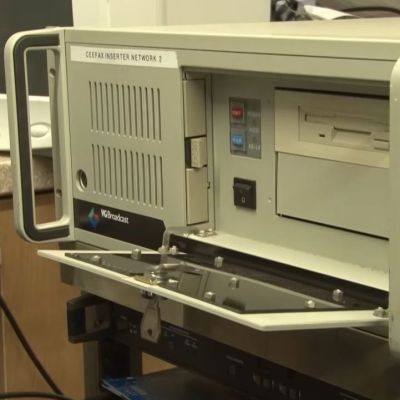
At their core these units are regular PCs, running MS-DOS 6.22 on a 486-class CPU and all the typical bits and bobs that go with a PC. The speculation here is that these are essentially rebranded industrial PCs, which would make a lot of sense. As for how [Nathan] got his hands on these units, it required a deal with the company scrapping them, preventing him from showing details of the software configuration.
Following a booting demonstration, we get the teardown of a typical 1990s rackmount PC, revealing a rather interesting backplane with the mainboard being one of the cards on it. Of these, two ISA cards provide the special Ceefax sauce as well as a timing signal in the form of a PDC card featuring a Lattice CPLD or FPGA that VCRs could use to automatically start recording.
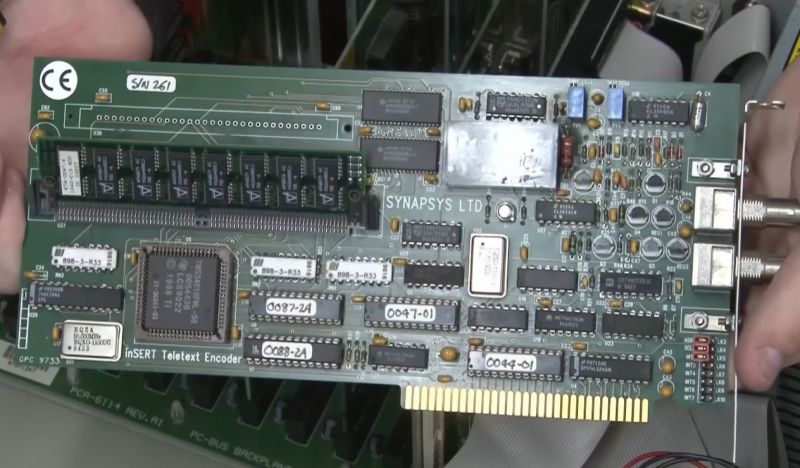
The Ceefax main event comes in the form of the inSERT Teletext Encoder card. This is pretty much its own computer system, featuring a TI TMS34010 CPU and its own RAM as well as IO. Compared to modern takes on teletext generators, this card appears to directly mix the analog signals, without any kind of conversion.
Although teletext systems have been largely shutdown now at this point due to the transition to digital TV broadcasting, there’s still a lot to be said for having such a service available for basic news and information.












Count Binface has called for CEEFAX to be brought back.
This!!
And nationalise Adele!
And the 99 flake icecream to be price-capped at 99p!
Gets my vote.
His policies are definitely better defined and more helpful to the people of Clacton than the other guy’s.
Nobody’s really sure what the other guy’s policies are, apart from privatising everything, and blaming all failures on some other demographic.
I miss Bamboozle.
Now they use anagrams and sudoku style grids.
No doubt the text based service is only still available for convenience in spy craft, who knows, it could take a while to manually go through all the undocumented pages.
At least the page refresh is a little quicker these days.
I am a little surprised there’s not much if any real homebrew scene for CEEFAX or Teletext. It would seem like an interesting way to reuse a TV, web feeds or stock prices perhaps, maybe even the retro version of HaD.
CEEFAX was a top-down operation, not peer-to-peer. that’s why there’s no homebrew scene. It was the first teletext, and pretty much all these services elsewhere suffered the same fate. And as mentioned the hardware is mostly cards that were hidden inside ordinary PC stuff. Minitel(there was an odd little compsec course from 2020-? featuring emulated minitels) and Nabu have different and interesting, although barebones, hardware. The Nabu network may have also been abandoned, idk. I’m curious but also ignorant of FujiNet, it’s staying fairly niche, afaik. I invite all who disagree to respond here. My point is nostalgia needs a visible physical presence to appeal to retro-fans. Teletext doesn’t really do that.
Funny thing, I’m half working on a peer to peer wireless solution using that mesh thing everyone’s playing with but not finding a good user for beyond random text messages to strangers
I’m using RAK wisblocks for my home hvac control source / room temp sensors. TXs its payload every 60 seconds. Has been up for a month now and is at 82% battery with a 2000mah lipo.
That ship has sailed. Good luck Nigel.
Better get this one dusted off and installed at the Clacton local TV station :)
“preventing him from showing details of the software configuration.”
uhh what? we are talking 1997 here, are we?
Some companies can be quite protective of things that no longer have any value at all..
It’s down to the lawyers and liability.
If you used these PCs to illegally insert Teletext into the PAL broadcasts in some third world country, the original manufacturer could be sued.
No matter how unlikely, it’s a risk and without the diligent efforts (for which they’re paid a tidy sum) of lawyers, you’d be open to a lawsuit (when they’d be paid, again, to defend you)
Whenever I’ve had the opportunity, I have released schematics of products I have worked on. The companies no longer exist, so it’s unlikely I’d be sued, but then, again, there’s the spectre of tSCOg, so who knows?
Some third-world countries never bothered with any copyrights whatsoever and couldn’t care less. Maybe in some big cities yes, but as far as rural places go, licensing what licensing, reverse-engineer and be over with, do profit first ask questions later (ideally never).
I personally seen such places. No, I didn’t work for them, but 1980s were one interesting decade to witness.
Local signal injection (as in “regional/small cable TV” – municipality level) who they gonna call, ghostbusters? Yes, I recall hearing about DOS machines, also local Commodore copycats to boot. Both were used, unsure which one doing which part, since I was not anywhere near, but small city is like that, everyone knows everything.
I still miss Ceefax news – having only 40 characters per headline meant there was no room for fluff, self promotion, click bait or surreptitious ads for TV programs, just news facts which I struggle to find these days.
Something like, https://www.textise.net
Neat!
Worked on my website a treat 😁
https://www.textise.net/showText.aspx?strURL=alloydog.neocities.org
BBC website gets by with much less than 40 characters – which leads to weird headlines you need to read several times to understand exactly what they mean (grammar seems to not be needed on the beeb dot com)
Seems a reminder is due: https://nmsceefax.co.uk/
I remember it well it was called a TDG6 (Teletext Data Generator) the telemext management system which ran on windows sent the Teletext pages to it via either NetBIOS or TCP/IP. I wrote a tool which the BBC used to manage them all. There were 2 per Chanel for each region, standby and backup. A 1u unit was used to automatically switch over to the backup TDG6 when the Teletext signal failed, also written by me. There was a newer version of the insert card which used a Motorola 68000 and had a PCI bus. It was controlled by a TDG7 which was hosted on Linux.
An idle thought, build idea: “Meshfax”
Build it in two layers:
Meshtastic radio network
↓
Raspberry Pi gateway
↓
Ceefax-style page generator
↓
Web browser, monitor or television
The Meshtastic network carries short updates.
The Raspberry Pi then stores them, assigns numbered pages and renders them in a Ceefax-style interface.
Maybe not send complete screen images through Meshtastic. But send only the useful text and metadata..
Maybe
In the Netherlands, Teletekst is still alive and kicking, with https://nos.nl/teletekst being a high-visit site which I see several mid-20-coworkers regularly check.
Because I come from a “it still works so it’s good enough” family, deapite being in my 40’s I’ve never owned a teletekst-capable TV so it has never caught on with me.
When I was a kid I was lucky enough to have a BBC micro and Teletext Adapter. This allow me to view Ceefax and ITV ORACLE pages on my Beeb, but it also enabled me to download software and other things like weather satellite images. This was part of some BBC education program, using the pages above 700 to store chunks of code or image data, with each teletext page providing slightly under 1KB of data. There was an index page which provide the filenames and the page range containing the data.
The software files were update weekly, sometime things were serialized over a few weeks. IIRC the satellite weather image was updated daily. If you were able to download the satellite pics a bunch of days in a row, you could create your weather animation (of northern Europe).
Living in the north west of Scotland we didn’t get the best TV reception. If one of the pages/chucks was corrupted due to a bad signal, we had to wait for it to come around again before to try again. Sometime it would take hours to download something, sometimes you never managed to download all the chunks before the file was replaced at the end of the week.
I did downloaded lots of stuff. There was something great about, even if it was download only, it felt like you were on a network and had access to things.